
Handicap Parking Signs: The Rules to Check First
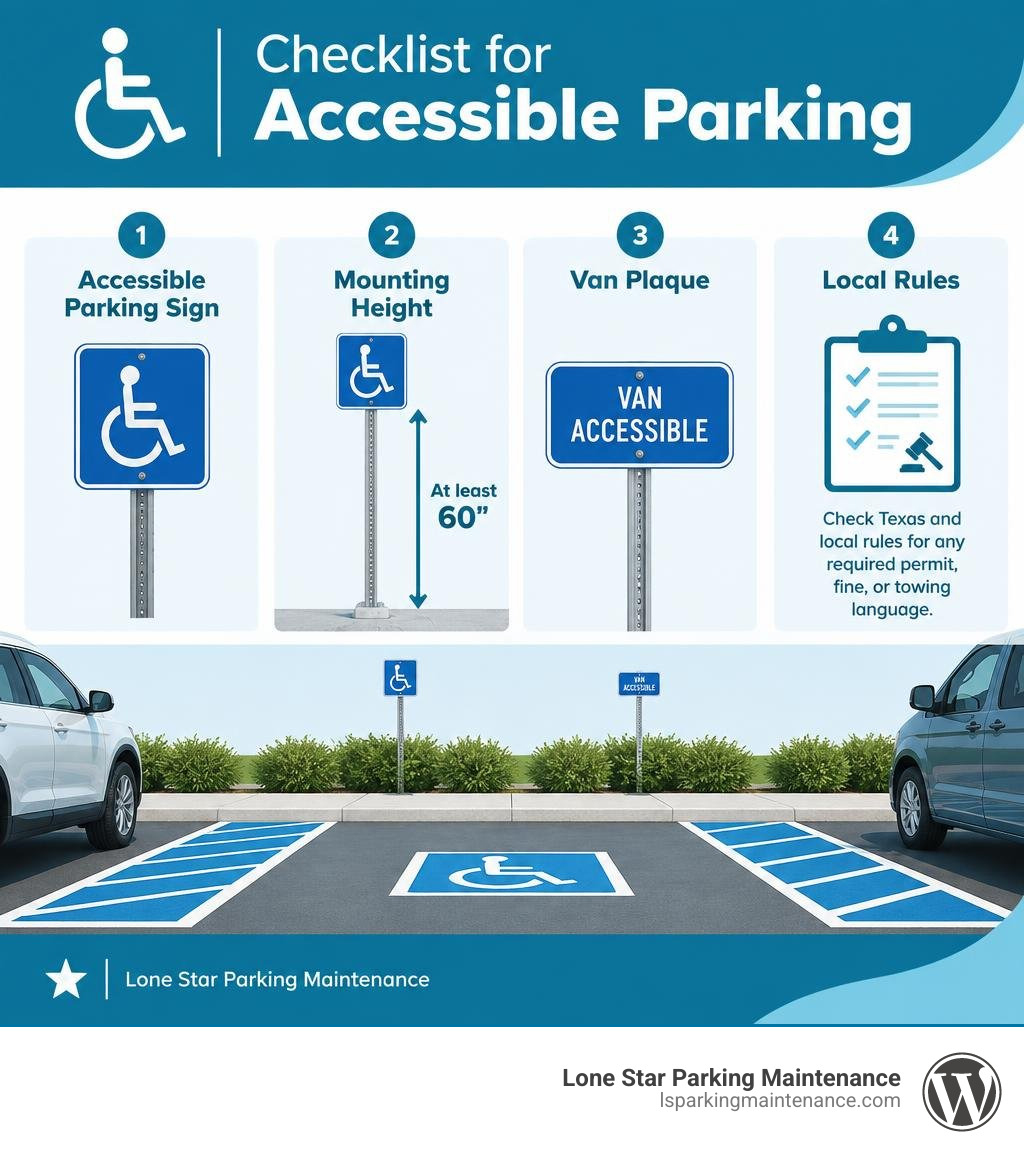
For an accessible parking space, start with a sign showing the International Symbol of Accessibility. Mount it so the bottom of the sign is at least 60 inches above the ground, where a parked vehicle will not block it. Add a “Van Accessible” sign at each van-accessible space. Then check Texas and local rules for any required permit, fine, or towing language.
The sign is only part of the job. The space and access aisle also need the right layout and clear markings. I’m Cason, and I’ll walk you through the rules and practical choices for your lot, including how to maintain proper handicap sign parking standards across your commercial property.
Handicap sign parking further reading:
Federal ADA Standards and Handicap Sign Parking Requirements
Navigating federal mandates for accessible parking and handicap sign parking requirements does not have to be an overwhelming process. The Americans with Disabilities Act (ADA) and the Manual on Uniform Traffic Control Devices (MUTCD) establish national guidelines designed to ensure that accessible parking is easy to identify, properly reserved, and safe for all motorists. Reviewing our field guide to markings and signage provides a practical foundation for how these federal rules translate directly to pavement and post installations.
Federal regulations require that every designated accessible parking space features a permanent, clearly visible sign showing the International Symbol of Accessibility (ISA). While temporary plastic yard signs on metal wire stakes are sometimes used for short-term events or lawn overflow, permanent commercial facilities require rigid, weather-resistant reflective metal signs mounted securely to posts or building structures.
| Feature | Temporary Plastic Signs | Permanent Reflective Aluminum Signs |
|---|---|---|
| Material Base | Corrugated plastic or lightweight polymer | 0.063″ to 0.080″ rust-proof aluminum |
| Reflectivity | Typically non-reflective or basic vinyl | Type I Engineer, Type IV High-Intensity, or Diamond Grade |
| Mounting Style | Wire H-stakes inserted into dirt or grass | U-channel posts, square posts, or masonry wall anchors |
| Outdoor Lifespan | Few weeks to several months | 7 to 12+ years with UV-protective laminate |
| ADA Compliance | Non-compliant for permanent commercial lots | Fully compliant with ADA and MUTCD standards |
Core Information and Symbol Requirements
To meet federal standards, every sign must prominently display the ISA—the universally recognized graphic of a figure in a wheelchair in high-contrast white against a vibrant blue background. Understanding specific ADA parking sign requirements ensures that your facility avoids visual ambiguity that could invalidate parking enforcement.
Beyond the universal icon, standard federal MUTCD R7-8 signage incorporates explicit regulatory language, such as “RESERVED PARKING.” Signs must provide clear visual contrast (light characters on a dark background or dark characters on a light background) so drivers can easily identify stalls in bright daylight or poor weather. In many jurisdictions, supplemental text indicating “State Disabled Parking Permit Required” or specific penalty notifications must be integrated to facilitate legal towing and ticketing.
Proper Height, Placement, and Visibility Rules
Correct vertical and horizontal placement ensures that an accessible parking sign remains visible even when high-profile SUVs, vans, or trucks park in the stall. Utilizing proper ADA sign mounting techniques prevents common code violations where signs are hidden behind vehicle bumpers or hoods.
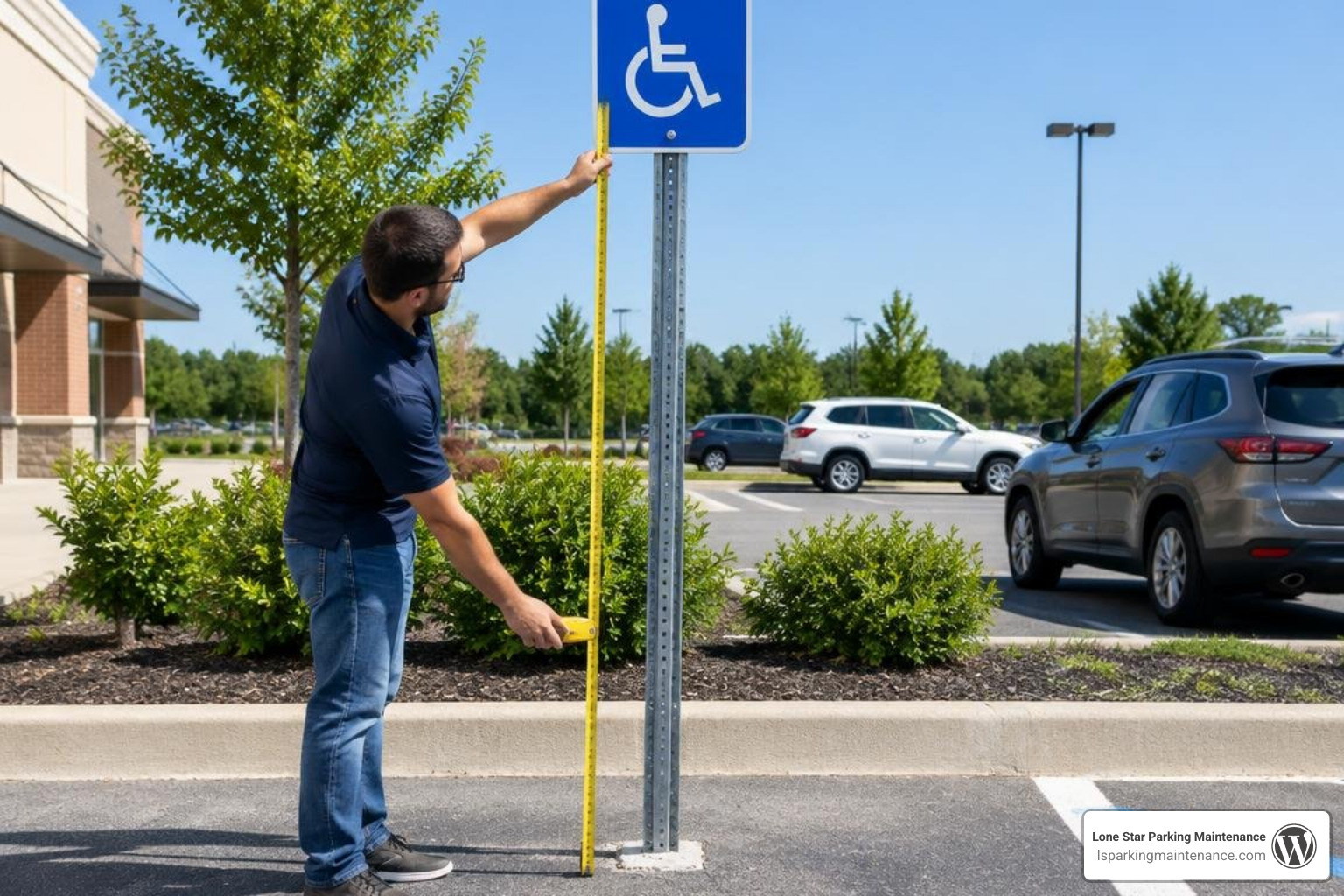
Federal rules require the bottom edge of the sign (or the lowest supplemental plaque) to measure a minimum of 60 inches (5 feet) above the finished grade of the parking surface or sidewalk. This vertical clearance ensures an unobstructed line of sight for approaching traffic. Horizontally, signs should be centered at the head of the stall and set back slightly from curbs or wheel stops to prevent vehicle strikes while remaining clearly associated with the designated bay.
Van-Accessible Stalls and Stall Dimension Requirements
Van-accessible stalls are an essential component of universal parking lot design. Wheelchair-accessible vans rely on motorized side-entry ramps or rear lifts that demand significantly more physical room than standard passenger cars.
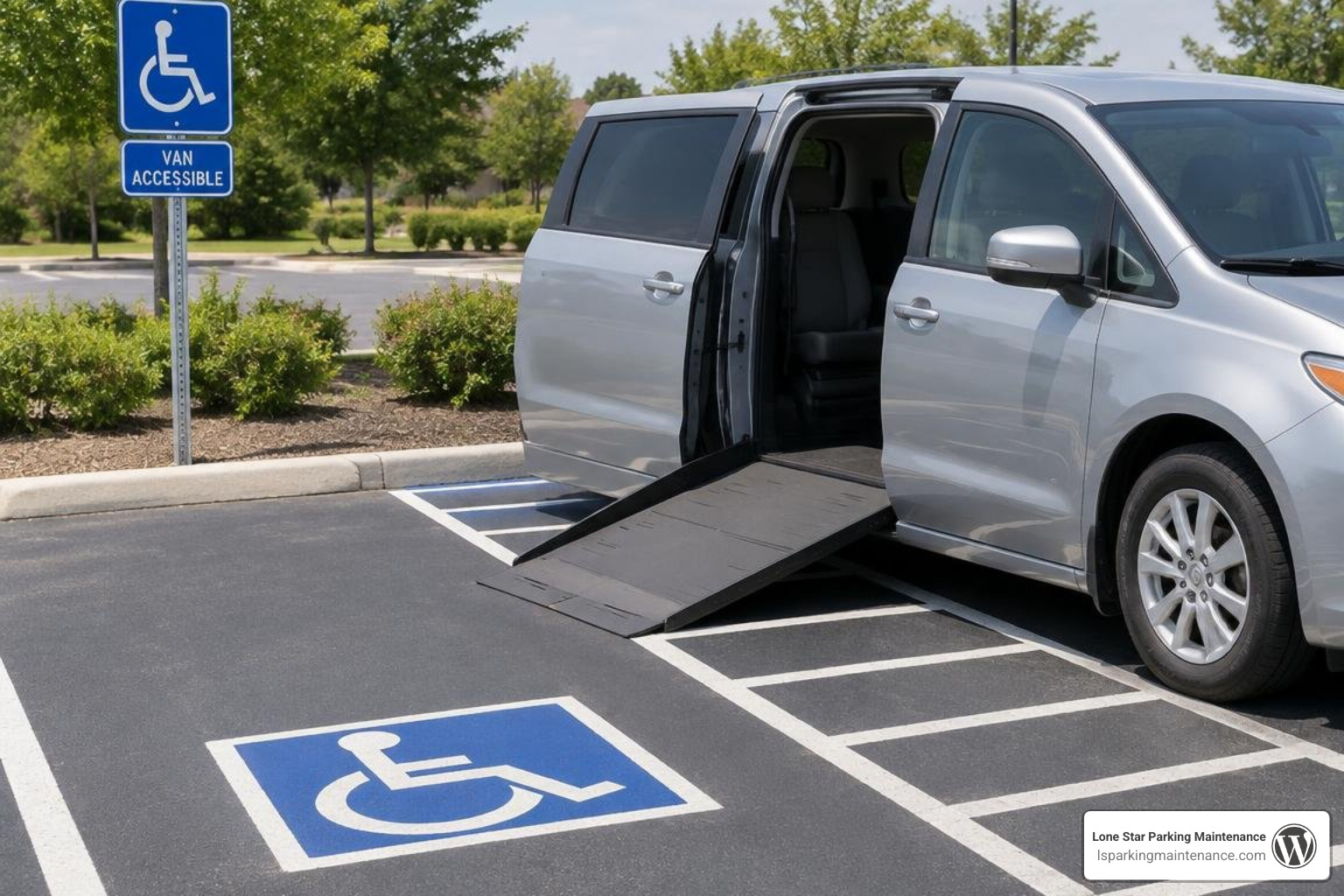
Van-Accessible Space Dimensions and Sign Plaques
Van-accessible parking spaces require explicit signage designations alongside wider space geometries. To comply with federal and Texas accessibility standards, these stalls must feature a standard R7-8 sign mounted with a supplemental “VAN ACCESSIBLE” plaque directly underneath. Reviewing specific ADA van parking requirements helps ensure the layout accommodates specialized mobility equipment.
Under federal ADA guidelines, van spaces can be configured in one of two ways:
- An 11-foot-wide parking space paired with a dedicated 5-foot-wide adjacent access aisle.
- An 8-foot-wide parking space paired with an expanded 8-foot-wide adjacent access aisle.
Additionally, van-accessible stalls, their access aisles, and the vehicular routes serving them require a minimum vertical clearance of 98 inches to accommodate high-roof conversion vans and rooftop wheelchair carriers.
Calculating Space Ratios and Aisle Markings
Understanding your facility’s total parking capacity allows you to calculate accessible stall ratios accurately. By calculating ADA parking space ratios, property owners ensure they provide enough stalls to remain compliant. For every six accessible parking spaces (or fraction of six), at least one must be designated as van-accessible. For facilities with only one accessible space, that stall must automatically be van-accessible.

Access aisles must be clearly marked to prevent other motorists from blocking ramp deployment. Professional ADA compliant parking lot striping creates sharp, painted diagonal hash marks (typically spaced 36 inches apart) across the aisle in durable, slip-resistant traffic paint, clearly signaling that parking within the aisle is strictly prohibited.
State Variations, Tow-Away Rules, and Legal Penalties
While the federal ADA sets the baseline for accessible infrastructure, individual states and municipalities enforce specific signage and penalty parameters. Implementing practical handicap parking compliance strategies protects your commercial property against code citations and ensures local law enforcement can cite unauthorized drivers.
State-Specific Variations and Statutory Fines
Across the country, statutory fine postings on handicap signage range from $50 up to $500 depending on state traffic codes. For example, California utilizes sign code R99B displaying minimum $250 fines alongside mandatory tow-away warnings. In Texas, state standard TxDOT R7-8T reserved parking signs are standard for accessible stalls, often paired with supplemental penalty plaques reflecting local municipal enforcement codes.
Local municipal enforcement codes grant police officers and parking enforcement personnel the authority to enter private commercial parking facilities to enforce accessible parking regulations. When signage contains compliant statutory wording and correct symbol layouts, property managers avoid legal ambiguities when towing illegally parked vehicles.
Reserved Spaces, Disabled Veteran Rules, and Enforcement
Managing accessible parking requires an understanding of placard legitimacy. Under Texas statutory parking provisions, vehicles parked in accessible spaces must display a state-issued disabled parking placard or specialized license plate bearing the International Symbol of Accessibility. While Texas previously permitted any specialty Disabled Veteran (DV) plate to utilize accessible spaces, state law requires DV plate holders to meet specific disability criteria and feature the official ISA symbol on their plate or hangtag to park in designated spaces legally.
Sign Sheeting, Customization, and Installation Options
Selecting durable, high-grade materials protects your signage investment against extreme summer heat, heavy rain, and vehicle exhaust. Consulting a comprehensive buying guide for compliant parking signs will help you identify long-lasting sign blanks and retroreflective films.
Selecting Materials for Handicap Sign Parking Durability
Commercial exterior signs should be fabricated from rust-proof 0.080-inch (80 mil) or 0.063-inch heavy-duty aluminum. Using custom made parking lot signs allows properties to incorporate corporate logos, custom directional arrows, or specific tow-company phone numbers while maintaining core ADA symbol proportions.
| Reflectivity Grade | Sheeting Construction | Relative Light Return | Ideal Facility Application |
|---|---|---|---|
| Engineer Grade (Type I) | Enclosed lens glass beads | Baseline (1x) | Low-speed private driveways, well-lit surface lots |
| High-Intensity Prismatic (Type IV) | Micro-prismatic retroreflective lenses | ~3x brighter than Engineer Grade | Commercial retail centers, busy surface parking lots |
| Diamond Grade (Type XI / Cube) | Full-cube prismatic optics | ~9x brighter than Engineer Grade (~60% light return) | High-traffic transit hubs, multi-level garages, unlit areas |
Applying UV-protective clear lamination over printed sheeting shields signs from sun fading, chemical cleaners, moisture, and spray paint vandalism, extending field service life past 10 to 12 years.
Installation Methods for Wall and Post Mounting
Secure physical mounting keeps signage level, rigid, and safe from wind damage or accidental impacts.
Signs typically feature pre-drilled 3/8-inch mounting holes centered at the top and bottom, inset 1 inch from the outer edge. Common mounting methods include:
- Galvanized or Painted Steel U-Channel Posts: Installed directly into soil, grass, or core-drilled concrete sleeves using tamper-resistant bolts.
- Square Telespar Posts: Heavy-gauge tubular steel offering multi-directional sign attachment.
- Masonry Wall Anchors: Attached directly to concrete parking garage walls using heavy-duty sleeve anchors and protective nylon washers.
- Bollard and Surface Flange Mountings: Secured to existing concrete surfaces using high-tensile wedge anchors.
Frequently Asked Questions About Accessible Parking
Can a Business Reserve a Handicap Sign Parking Stall for a Specific Person?
Under Title III of the ADA, commercial businesses and public accommodations cannot reserve an ADA-designated public accessible space for a specific individual, employee, or customer. Accessible parking stalls provided for the public must remain available on a first-come, first-served basis to any driver possessing a valid state disability placard or license plate. Under Fair Housing Act (FHA) regulations for residential communities (such as apartment complexes), landlords may assign dedicated accessible stalls to individual disabled residents as a reasonable accommodation.
What Are the Legal Mounting Heights for Surface Lots vs. Parking Garages?
In outdoor surface parking lots, the bottom edge of the sign must be mounted at least 60 inches above the finished surface. In covered parking garages, where low ceiling heights or overhead mechanical piping restrict vertical clearance, signage can be mounted directly to walls or suspended from ceilings. As seen in accessible facility layouts, garage signs must maintain maximum visibility while preserving the mandatory 98-inch vertical vehicle clearance along accessible travel paths.
What Are the Standard Penalties for Parking in an Accessible Space Without a Placard?
Penalties for illegally parking in an accessible stall include municipal citations, mandatory court costs, and immediate vehicle towing at the owner’s expense. Fines generally range from $250 to $500 for a first offense. Misusing a family member’s disability placard without the placard holder present in the vehicle constitutes a misdemeanor violation in Texas, resulting in substantial financial fines and potential community service hours.
Conclusion
Maintaining fully compliant accessible parking protects property managers from liability, ensures seamless access for all visitors, and keeps traffic flowing safely across your facility. Routine inspections of mounting heights, sign reflectivity, stall line clarity, and access aisle striping ensure your parking infrastructure remains compliant with evolving federal and state codes.
At Lone Star Parking Maintenance, we deliver end-to-end parking facility solutions across the DFW Metroplex, specializing in compliant signage installations, asphalt repair, sealcoating, and precision striping. Explore our professional parking lot striping and signage services to schedule an on-site property evaluation and ensure your parking lot meets every accessibility standard with confidence.