
How Rubberized Crack Filler Protects DFW Parking Lots
Rubberized crack filler is a flexible sealant that helps keep water out of cracks in asphalt or concrete. For a sound repair, the crack must be clean and dry, the product must suit the surface and crack width, and traffic must stay off until the filler is ready.
For DFW property managers, sealing cracks early can help limit water damage and keep a parking lot in better shape. It will not fix pavement that has already failed beneath the surface. I’m Cason, and I’ll walk you through the options and what proper application involves.
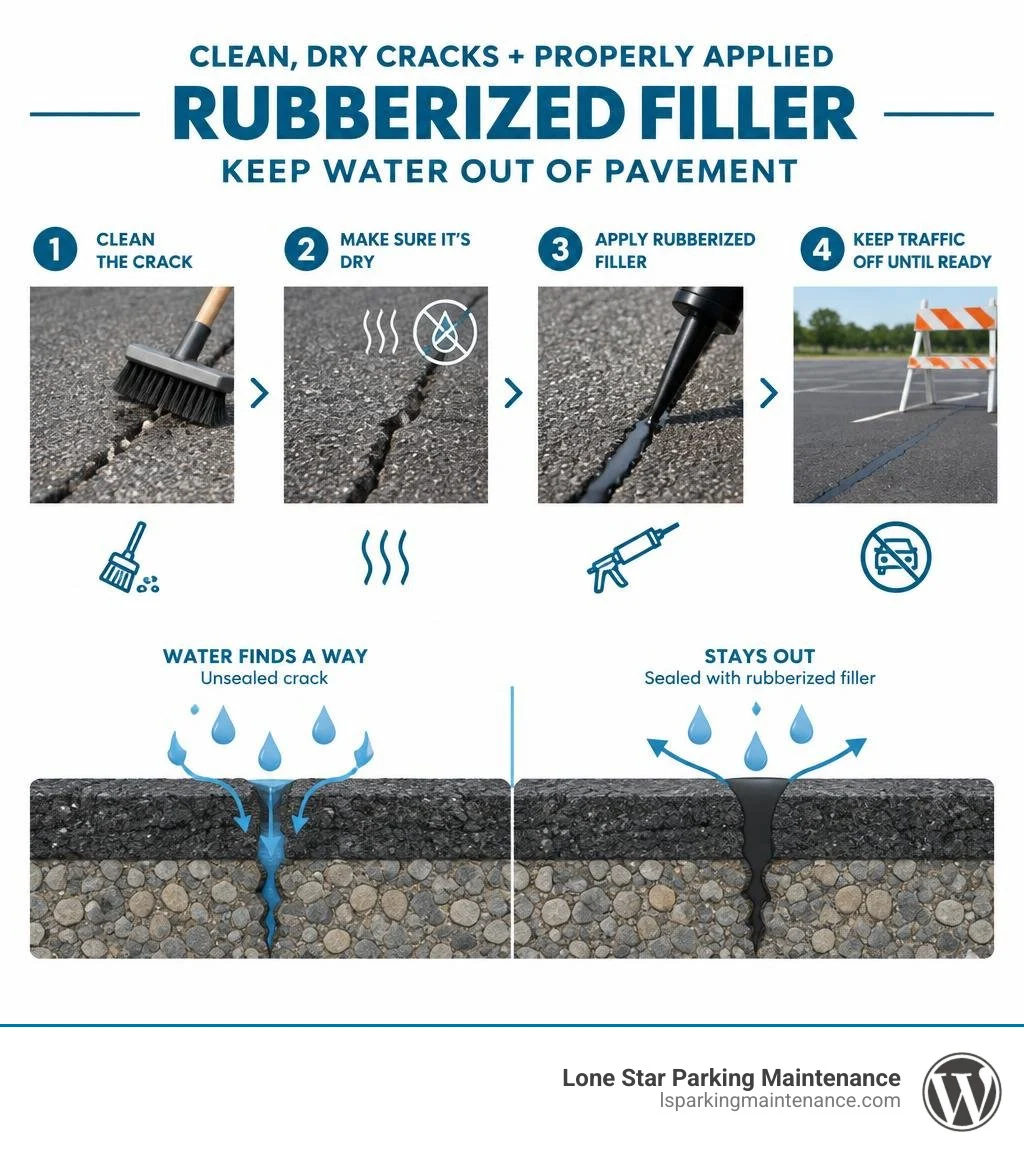
Handy rubberized crack filler terms:
What Is Rubberized Crack Filler and How Does It Protect Commercial Pavement?
Pavement in the Dallas–Fort Worth Metroplex experiences intense environmental stress. Between triple-digit summer heatwaves that bake the surface and sudden winter cold snaps that induce rapid thermal contraction, asphalt is constantly moving. When surface fissures develop, water penetrates into the underlying sub-base. During winter freeze-thaw cycles, trapped water expands, deteriorating the foundation beneath the surface layer and leading to structural depressions, alligatoring, and costly potholes.
Rubberized crack filler acts as an elastomeric bridge across surface separations. Unlike standard asphalt emulsions that dry into rigid, brittle structures, rubberized formulations incorporate specialized polymers that retain elastic memory. When temperatures drop and pavement pulls apart, the sealant stretches without losing adhesion along the sidewalls. When the summer sun expands the asphalt, the filler compresses without pushing upward out of the joint.
| Feature | Standard Asphalt Filler | Professional Rubberized Crack Filler |
|---|---|---|
| Material Base | Basic asphalt emulsion and sand | Polymer-modified asphalt with elastomeric rubber |
| Elastic Memory | Low (cracks under thermal movement) | High (stretches up to 300% without tearing) |
| Sidewall Adhesion | Moderate initial bond, prone to delamination | High-tensile bond strength across asphalt and concrete |
| Freeze-Thaw Resistance | Poor (shrinks and fractures) | Excellent (accommodates joint movement) |
| Average Lifespan | 6 to 12 months | 3 to 10 years (depending on application type) |
Core Material Formulations and Additives
Modern rubberized crack sealants combine asphalt binder with synthetic elastomeric polymers, virgin rubber particles, and refined latex compounds. These polymers impart flexibility, tensile strength, and low shrinkage upon curing.
Contractor-grade formulations are engineered to meet strict transport department standards, such as ASTM D6690 joint sealant standards and AASHTO M324 specifications. These standards verify that the material maintains resilience across low temperatures without cracking and remains firm at high temperatures without tracking across parking stalls. Additionally, modern high-grade emulsions maintain low volatile organic compound (VOC) levels—often below 10 grams per liter—ensuring regulatory compliance without sacrificing performance.
Key Advantages for Asphalt and Concrete Surfaces
Deploying elastomeric sealant across commercial surface lots and parking structures provides several operational advantages:
- Complete Moisture Barrier: Stops surface water from reaching the base aggregate, preserving the load-bearing capacity of your property.
- Pothole and Spalling Prevention: Prevents small surface fractures from developing into structural failures that require deep patch work.
- Debris Rejection: Keeps incompressible materials like dirt, gravel, and weeds from filling the void and causing further cracking during thermal cycles.
- Vehicle Load Distribution: Bends under the rolling weight of delivery trucks and heavy traffic without shattering.
To maximize structural longevity, pairing timely joint sealing with proactive asphalt repair and long-term protection keeps pavement smooth and functional for years.
Comparing Hot Pour vs Cold Pour Repair Methods
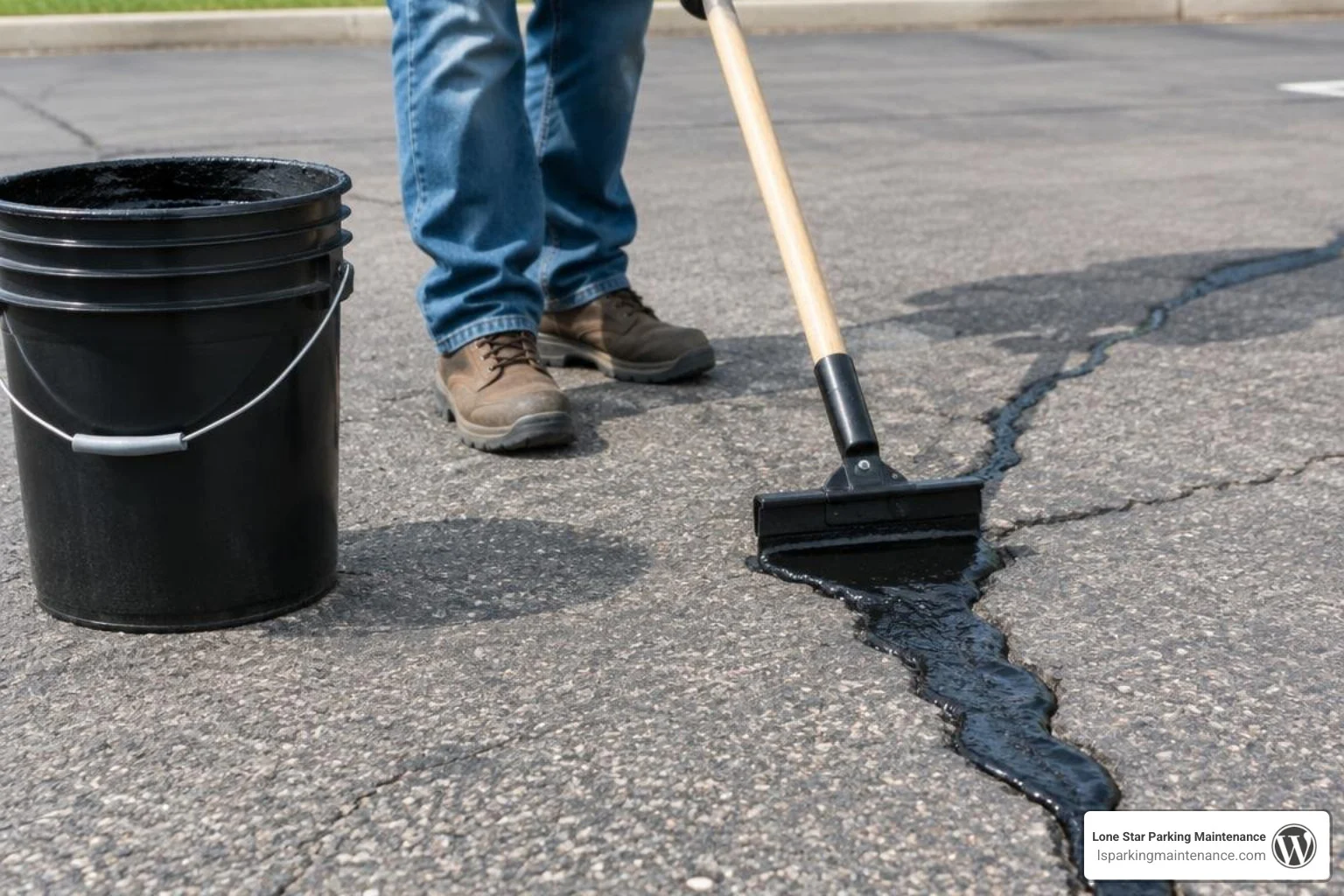
When selecting the best sealant for a commercial parking lot, understanding the difference between hot pour and cold pour application is vital. Both methods have distinct performance profiles, equipment requirements, and curing windows.
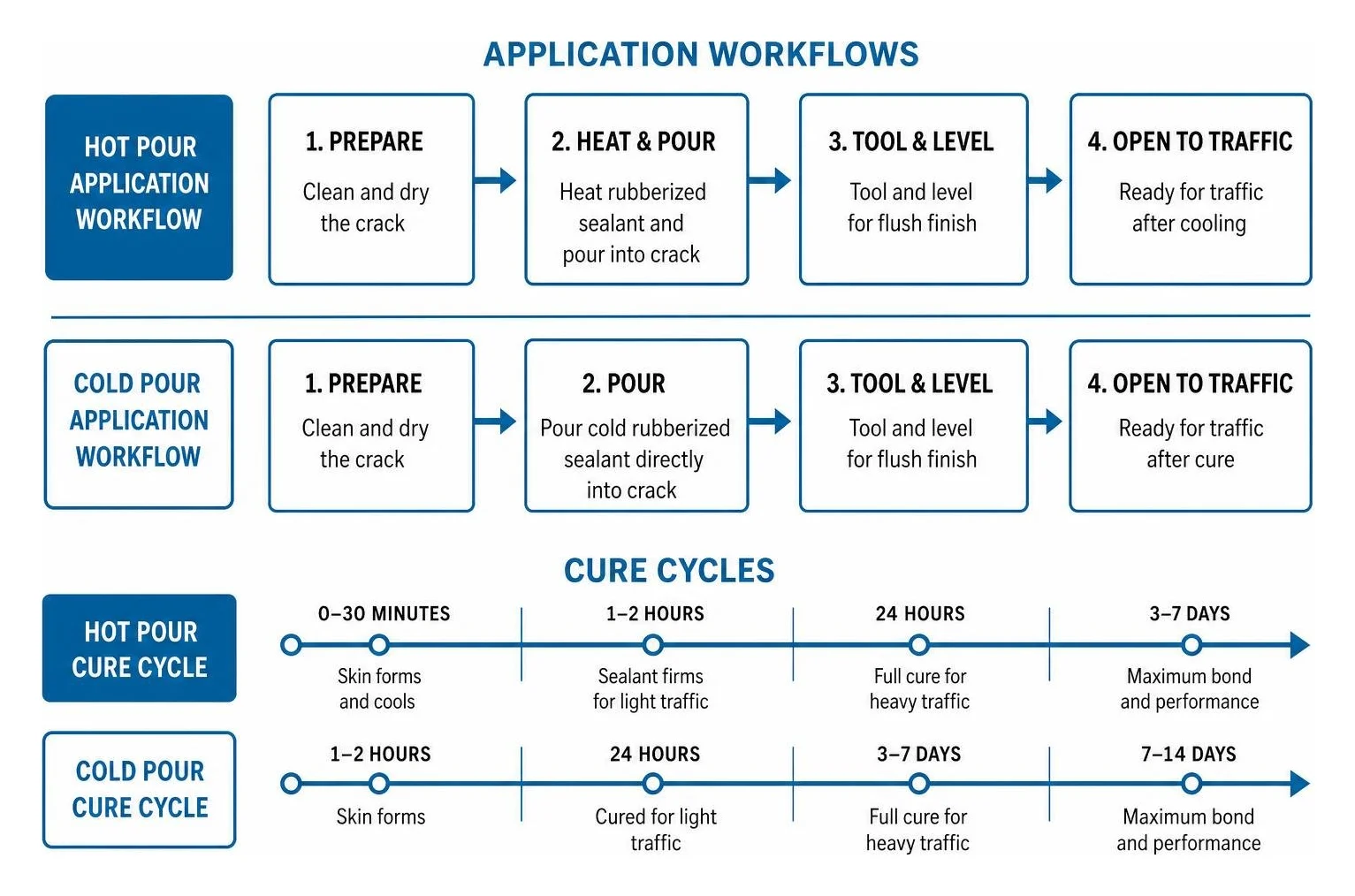
Property owners evaluating hot and cold pour asphalt crack repair methods should balance equipment access, facility downtime requirements, and traffic demands.
Hot Pour Rubberized Crack Filler for High-Traffic Facilities
Hot pour rubber sealant is the industry standard for high-traffic commercial parking lots, retail plazas, and industrial distribution centers across North Texas.
The material arrives as solid blocks in 30-pound boxes and is heated in dedicated direct-fire or oil-jacketed melters to approximately 400°F. At this liquid state, the rubberized binder flows deep into the fissure, creating a permanent chemical and thermal bond with the pavement sidewalls.
Hot pour offers fast turnaround times: it hardens rapidly and can accept vehicular traffic in as fast as 30 to 40 minutes. With an operational lifespan of 3 to 4 years—and up to a decade when high-grade formulations are maintained properly—hot pour delivers the highest return on investment for active facilities.
Cold Pour Emulsions and Pre-Formed Sealant Options
Cold pour crack sealants come ready to use at ambient temperatures without melting equipment. Poured straight from jugs or 5-gallon pails, cold pour products are formulated with fortified latex emulsions. Products like Dalton Coatings Blacktop Crack Filler or pourable emulsion specifications are designed for cracks up to 1/2-inch wide and set up in about 2 hours.
Cold pour materials typically require an ambient temperature of at least 50°F during application and for 24 hours afterward. They take longer to achieve full hardness, with materials like TruFlex requiring 6 to 8 hours to skin over for heavy traffic. While offering an expected lifespan of 12 to 18 months, cold pour remains an accessible option for localized repairs, low-traffic areas, and light maintenance runs.
Step-by-Step Commercial Crack Repair and Preparation Process
Applying rubberized sealant correctly requires thorough preparation. Skipping surface prep will compromise sidewall bonding, causing the material to pull away prematurely.
Following a standardized 5-step asphalt crack repair procedure ensures durable, clean repairs across commercial properties.
Surface Preparation and Crack Routing
- Vegetation and Root Removal: All organic matter must be extracted using mechanical wire-wheel brushes or crack sweepers.
- Debris Cleaning: High-pressure compressed air (minimum 90 psi) clears away fine dust, loose stone, and debris.
- Moisture Removal: Sealants cannot bond to damp asphalt. A hot-air lance delivers dry, compressed heat to remove internal moisture and pre-warm the pavement sidewalls.
- Depth Stabilization: For cracks deeper than 3/4-inch, a heat-resistant foam backer rod or clean silica sand is installed to support the sealant and prevent excessive product consumption.
Applying Rubberized Crack Filler and Surface Leveling
- Material Application: Hot liquid rubber at 400°F is injected directly into the prepared joint from the melter’s delivery wand.
- Strike-Off and Banding: A U-channel or V-shaped squeegee smooths the sealant, creating a uniform, flush overband (typically 2 to 3 inches wide) centered on the crack.
- Flush Finishing: The filler should sit flush or slightly recessed compared to the surrounding surface to avoid snowplow catches or heavy tire scuffing.
- Safety and Staging: Crews utilize high-visibility safety gear, traffic cones, and directional signage to isolate active repair lanes until the material solidifies.
Commercial Cost Analysis and Lifespan Factors in North Texas
Professional crack sealing in commercial properties generally ranges between $3.00 and $5.00 per linear foot, depending on crack dimensions, total linear footage, surface cleanliness, and site accessibility.
Investing in regular commercial parking lot crack filling and sealing prevents small hairline fractures from expanding into major failures that require thousands of dollars in full-depth asphalt replacement.
Weather and Seasonal Application Timing in DFW
The climate of North Texas demands careful scheduling:
- Spring and Autumn: The best seasons for crack repair. Mild ambient temperatures (between 60°F and 80°F) keep cracks moderately open without extreme pavement expansion or contraction.
- Summer Considerations: High surface temperatures above 130°F cause asphalt to expand, closing up crack reservoirs. While hot pour can be applied in warm weather, curing takes slightly longer to cool to a non-tracking state.
- Winter Rules: Cold pour must not be applied below 50°F. While hot pour can be placed in cooler conditions, the crack walls must be pre-heated with a hot-air lance to prevent rapid thermal shock and adhesion failure.
Material Forms: Liquid Bulk, Direct-Heat Sticks, and Tape
Commercial maintenance uses several material formats depending on scope:
- Hot Pour Blocks (30-lb Boxes): The choice for large commercial parking lots. Each 30-pound box provides roughly 200 linear feet of coverage for standard 1/2-inch cracks. Bulk pallet orders deliver up to 76% in material savings.
- Liquid Cold Pour (5-Gallon & 55-Gallon Drums): Ready-to-use emulsions providing 75 to 150 linear feet per gallon on 1/2-inch by 1/2-inch cracks, or up to 300 linear feet per gallon on 1/4-inch fissures.
- Specialized Asphalt Tape: Heat-fused tape provides up to 10 years of service life. It is traffic-ready in as fast as 5 minutes after torch application, making it well suited for utility cuts and rapid single-crack fixes.
Frequently Asked Questions About Commercial Crack Sealing
How long does rubberized crack sealant last under heavy commercial traffic?
Hot pour rubberized crack sealant typically lasts 3 to 4 years under active commercial traffic conditions. High-performance torch-applied asphalt tape can last up to 10 years, while cold pour emulsions typically provide 12 to 18 months of service.
Can crack repairs be performed during winter or rainy conditions?
No. Water prevents proper bonding. Applying filler into wet cracks traps steam and causes premature delamination. Cold pour requires temperatures strictly above 50°F during application and for 24 hours after. Hot pour can be applied in cooler weather only if a thermal hot-air lance is used to thoroughly dry and warm the pavement reservoir.
How quickly can a commercial parking lot reopen after application?
Hot pour crack filler allows vehicle traffic to resume in about 30 to 40 minutes. Specialized asphalt tapes are traffic-ready in about 5 minutes. Cold pour emulsions take anywhere from 2 to 8 hours to skin over and fully dry depending on humidity and airflow.
Conclusion
Proactive crack sealing is the most cost-effective pavement maintenance strategy for commercial property managers. By preventing surface water from penetrating the structural sub-base, rubberized crack fillers stop costly structural failure before it starts.
Our team provides comprehensive maintenance solutions built for the demanding North Texas climate. For complete pavement care, learn more about our comprehensive parking lot maintenance services in DFW and keep your commercial property safe, durable, and clean year-round.