
Why Every DFW Parking Lot Needs Sealcoating and Crack Filling
Sealcoating and crack filling are the two most important maintenance treatments you can apply to an asphalt parking lot — and doing them together is far more effective than either one alone.
Here’s a quick breakdown of what each does:
| Treatment | What It Does | Best For |
|---|---|---|
| Sealcoating | Applies a protective layer over the entire asphalt surface | Blocking UV rays, water, oil, and chemical damage |
| Crack filling | Seals individual cracks with rubberized filler | Stopping water from entering and widening existing cracks |
| Both together | Fills damage and shields the whole surface | Maximum protection and longest pavement life |
The numbers tell a clear story. 75% of unsealed cracks turn into potholes within three years. Seal those same cracks, and that number drops to just 1%. A scheduled program that includes both treatments can more than double the usable life of your asphalt pavement.
For property managers and business owners in the DFW Metroplex, this matters a lot. Texas heat bakes asphalt, UV rays dry it out, and even mild winter temperature swings cause cracks to expand. Left untreated, those hairline fractures become potholes — and potholes become expensive repaving projects.
The good news? Catching problems early is dramatically cheaper than fixing them later. Every dollar spent on crack repair today can save up to six dollars in future repaving costs.
This guide walks you through exactly how to do it right — from choosing the correct materials to timing your application for best results.
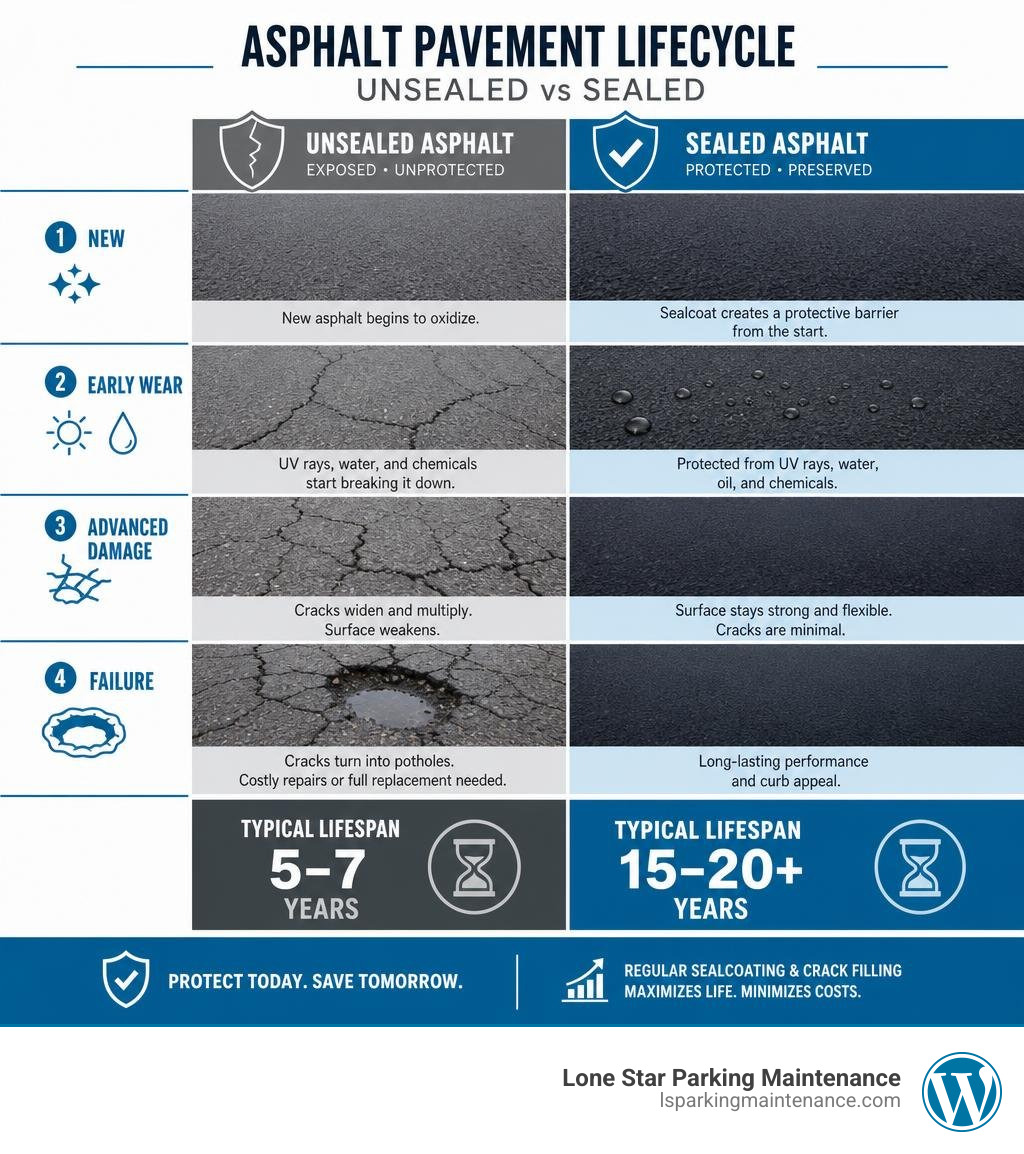
Essential sealcoating and crack filling terms:
The Science of Sealcoating and Crack Filling: How They Work Together
Asphalt is a highly durable material, but it is far from indestructible. At its core, asphalt is a mixture of stone aggregate and a petroleum-based binder. Over time, exposure to environmental factors causes this binder to degrade. The primary culprit in pavement failure is water intrusion, which is heavily accelerated by the harsh Texas climate.
When rain falls on unprotected pavement, it finds any pathway it can into the sub-base. In the DFW Metroplex, our seasonal freeze-thaw cycles — even if relatively brief compared to northern states — cause trapped water to expand and contract. This movement breaks apart the aggregate structure from within.
This is where the combination of sealcoating and crack filling becomes a science. Think of crack filling as a localized, flexible barrier that targets active structural wounds, while sealcoating acts as a broad-spectrum shield for the entire surface. Without crack filling, sealcoat liquid would simply run through the cracks without sealing them. Without sealcoating, the pavement surrounding the filled cracks remains vulnerable to UV oxidation, which dries out the asphalt and creates brand-new cracks.
For a deeper dive into how these two processes preserve your property, explore our detailed breakdown of Parking Lot Sealing And Crack Filling. You can also read more about general preservation standards in the industry from the Asphalt Institute.
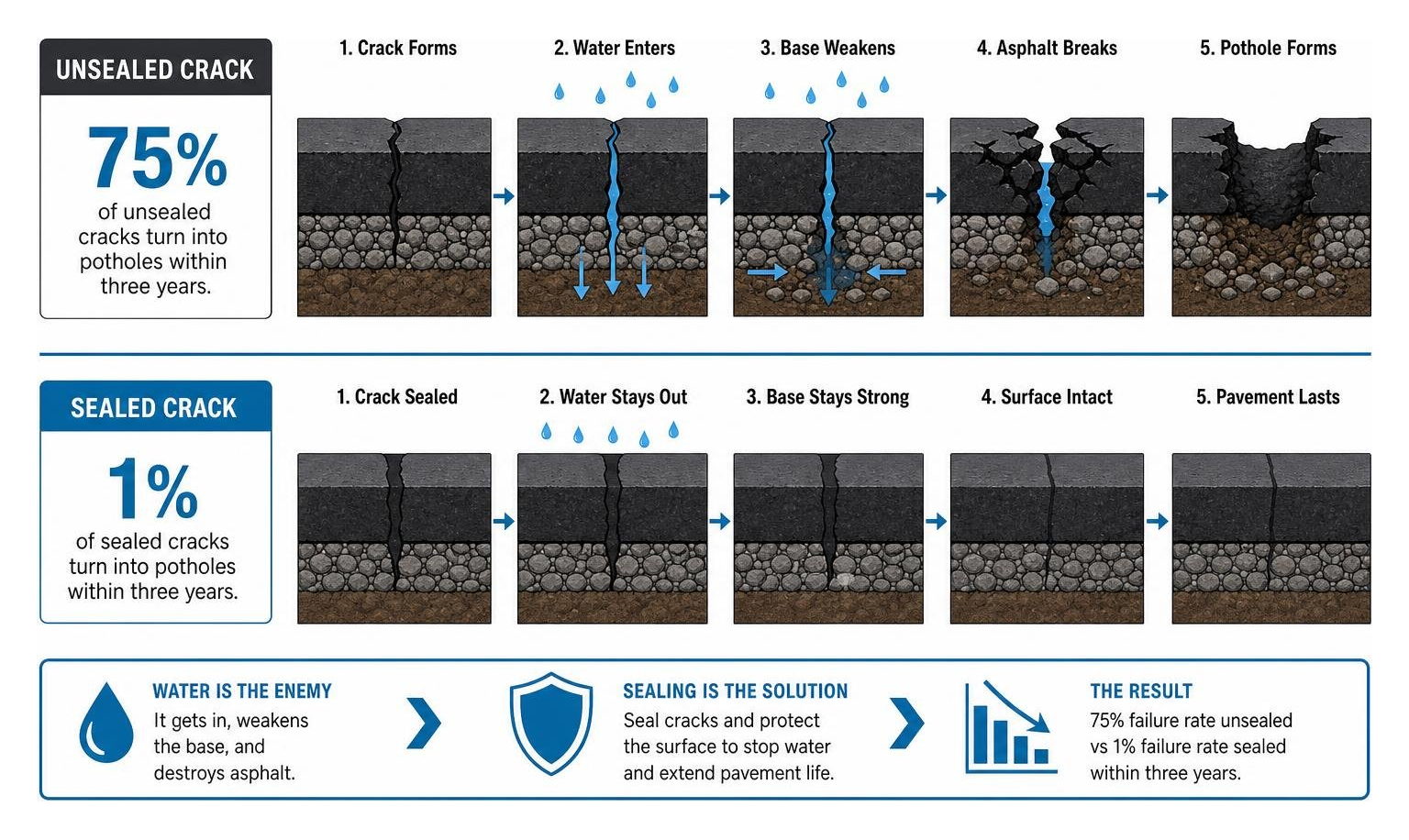
Why Sealcoating and Crack Filling Prevent Potholes
Potholes do not appear overnight; they are the final stage of neglected pavement deterioration. The process begins when water penetrates a crack and softens the supporting soil or sub-base underneath the asphalt. As heavy vehicles drive over this weakened area, the asphalt bends and flexes beyond its structural capacity. Eventually, the asphalt breaks apart, leaving a void that quickly collapses into a pothole.
By blocking water from ever reaching that sub-base, we eliminate the root cause of pothole formation. Utilizing professional sealcoating and crack filling stops this cycle before it starts. The 75% statistic is a stark reminder of what happens when cracks are left open to the elements.
Implementing a proactive maintenance routine is crucial for long-term protection. To understand why this process is so vital for your facility’s safety and curb appeal, check out our resource on Why Is Parking Lot Sealing Important? and discover more about the structural benefits in What Are The Benefits Of Crack Filling?.
Choosing Between Sealcoating and Crack Sealing
How do you know which treatment your asphalt needs? The decision depends on the current age and condition of your pavement.
- Sealcoating is a preventive maintenance technique. It is designed for pavement that is still in relatively good structural shape but is beginning to fade to gray due to oxidation. It should be applied every two to three years to maintain a fresh barrier against UV rays and chemical spills.
- Crack sealing is a corrective repair technique. It is required the moment cracks wider than 1/8 inch begin to appear. It is not designed to fix structural failures, but rather to stabilize existing damage and stop it from spreading.
If your pavement is older and has extensive cracking, sealcoating alone will not save it. Conversely, if you only seal the cracks and neglect to sealcoat, the rest of your parking lot will continue to degrade rapidly. For a diagnostic look at your own asphalt, read our guide on How Do I Know If My Parking Lot Needs Crack Filling?.
Materials and Equipment: Hot-Pour vs. Cold-Applied Crack Fillers
Choosing the right material is the difference between a repair that lasts for several years and one that fails during the next heavy storm. Crack fillers generally fall into two categories: hot-pour rubberized sealants and cold-applied asphalt emulsions.
| Feature | Hot-Pour Rubberized Sealants | Cold-Applied Asphalt Emulsions |
|---|---|---|
| Material Composition | Polymer-modified asphalt rubber | Clay-filled, polymer-modified emulsions |
| Application Temp | Heated to 350°F – 410°F | Applied at ambient temperature |
| Flexibility | Extremely high (expands/contracts) | Moderate to low (hardens to a firm solid) |
| Curing Time | 10 minutes or less | 30 minutes to several hours |
| Best Used For | High-traffic commercial lots, roads | Minor residential driveways, temporary fixes |
| Longevity | 3 to 5 years | 1 to 2 seasons |
For an in-depth comparison of these materials, see Don’t Let It Slide A Beginners Guide To Black Top Crack Filler.
Hot-Pour Rubberized Sealants
Hot-pour rubberized crack sealants are the gold standard for commercial and municipal pavement preservation. These materials consist of asphalt cement combined with synthetic polymers and rubber. To apply them, the rubberized blocks are melted inside a specialized oil-jacketed melter-applicator at temperatures ranging between 350°F and 410°F.
The primary benefit of hot-pour sealant is its incredible elasticity. As the Texas temperature shifts from blistering summer heat to winter freezes, the asphalt pavement naturally expands and contracts. Hot-pour sealant bonds tightly to the inner walls of the crack and stretches along with this movement without tearing or losing its seal.
This commercial-grade approach is highly recommended for high-traffic environments. You can learn more about how we utilize these high-performance materials in The Ultimate Guide To Texas Crack Sealing And Repair Services.
Cold-Applied Asphalt Emulsions
Cold-applied crack fillers are liquid emulsions that can be poured directly from a container at ambient temperatures. They are highly convenient for quick, temporary fixes or small residential driveways.
However, cold-applied fillers have significant limitations. Because they contain water and solvents that must evaporate for the material to cure, they experience significant shrinkage as they dry. They also lack the rubberized polymer network found in hot-pour sealants, meaning they become brittle over time and are prone to cracking under traffic loads. While they are a decent short-term solution, they do not offer the multi-year durability required for commercial properties. To learn more about DIY-friendly applications, read The Ultimate Guide To Filling Every Crack In Your Driveway.
Step-by-Step Guide to Asphalt Repair and Maintenance
Executing a professional-grade repair requires strict adherence to industry best practices. Skipping even a single step can lead to premature material failure.
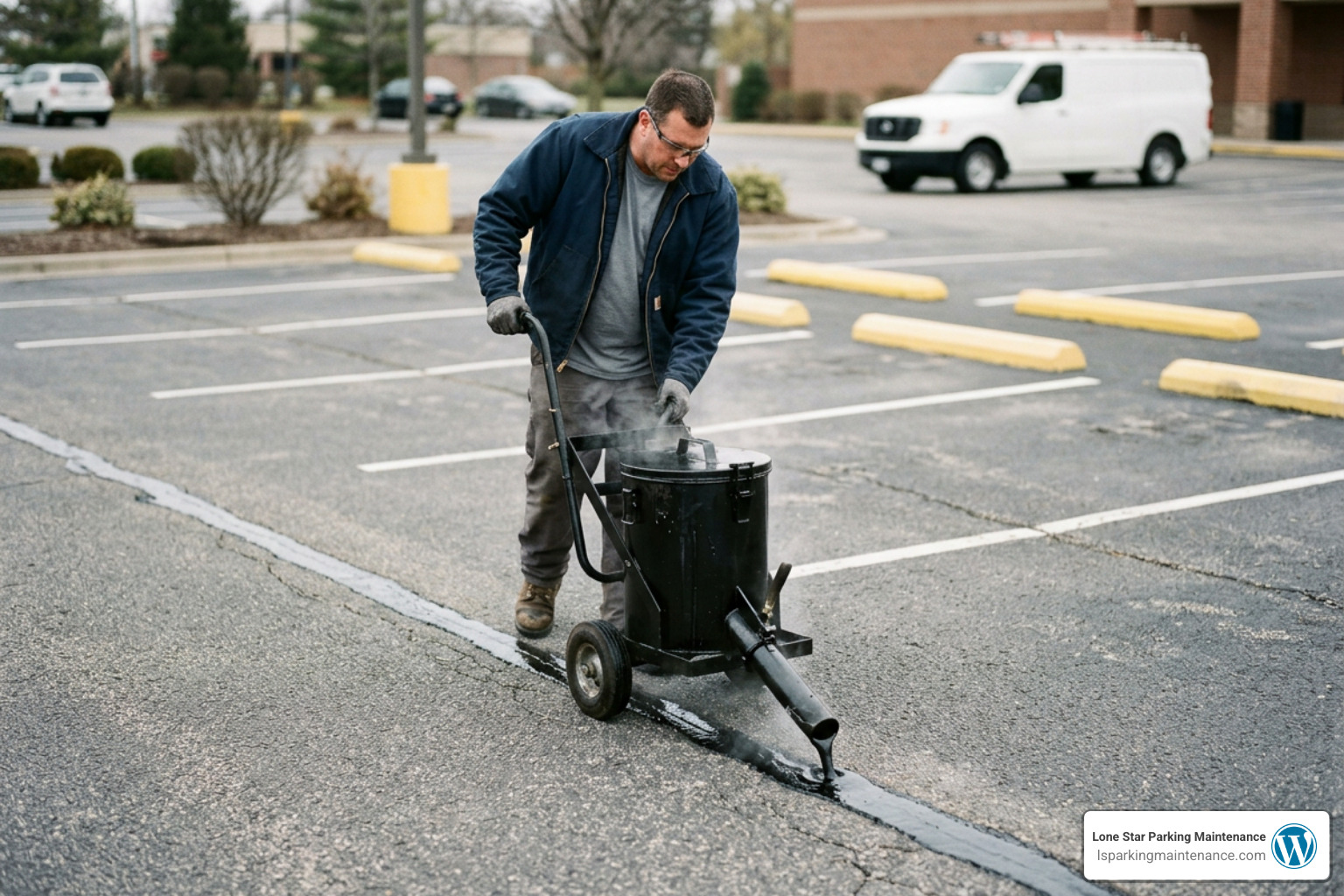
When we perform asphalt maintenance, we follow a rigorous process to ensure safety, durability, and a clean finish. For a broad look at these processes, read Don’t Let Cracks Win With These Asphalt Patching And Sealing Best Practices and check out our specialized advice on Don’t Let Cracks Win With Texas Asphalt Crack Repair Experts.
Crack Preparation and Cleaning Techniques
The single most common cause of crack sealant failure is poor adhesion due to dirt, moisture, or vegetation inside the crack. Sealant will not bond to dusty or damp asphalt.
- Routing (Optional but Recommended): For cracks with a density under 20%, routing a reservoir (typically 3/8 inch wide and 3/8 inch deep) creates clean, vertical asphalt walls. This process can double the service life of the sealant.
- Debris Removal: We use high-velocity compressed air (at a minimum of 90 psi) directed into the crack to blow out all dirt, sand, and organic matter.
- Moisture Removal: If the crack is damp, we use a hot air lance. This tool uses propane-heated compressed air to dry and warm the asphalt walls immediately before the sealant is applied, ensuring a perfect bond.
For a simplified breakdown of this initial phase, read How To Repair Asphalt Cracks In 5 Easy Steps.
Best Practices for Professional Sealcoating and Crack Filling
Once the cracks are clean and dry, the application phase begins:
- Material Melting: We heat the rubberized sealant inside our oil-jacketed melters, keeping it continuously agitated to prevent overheating or separation.
- Application: The sealant is applied from the bottom of the crack upward to avoid air pockets.
- Overbanding: We tool the hot sealant smooth using a squeegee, leaving a thin “band-aid” style overband that is no more than 1/8 inch thick and 2 to 4 inches wide. This helps seal the edges of the crack against water intrusion.
- Sealcoating Application: After the crack sealant has cooled, we apply a commercial-grade coal tar or asphalt emulsion sealer. We often mix our sealers with Tarmax additives for enhanced longevity and silica sand to provide traction and slip resistance.
To discover more about managing this workflow smoothly, see Stop The Crack Madness Easy Blacktop Crack Sealing.
Optimal Weather and Seasonal Timing
Timing is everything when scheduling sealcoating and crack filling. The ideal times to perform crack sealing are during the spring and fall. During these moderate seasons, cracks are at a mid-point in their expansion cycle — meaning they are neither completely open (as in winter) nor completely closed (as in summer). This allows the sealant to settle comfortably and handle future movement.
For sealcoating, the ambient and pavement temperatures must be at least 40°F and rising (ideally above 50°F) for the emulsion to dry and cure properly. High humidity or rain will ruin a fresh sealcoat application. Additionally, applying sealcoat in dry, sunny weather ensures proper UV ray defense activation.
For more details on seasonal scheduling, read How Long Does Parking Lot Sealing Last? and learn about professional application conditions through industry guidelines.
Cost Factors and Return on Investment
While property owners sometimes hesitate at the initial cost of maintenance, the return on investment is undeniable. Crack filling typically costs between $0.50 and $1.50 per linear foot, depending on depth and preparation needs. Sealcoating is priced per square foot and is incredibly cost-effective compared to repaving.
Consider this: completely replacing an asphalt parking lot can cost thousands of dollars. In contrast, a routine program of sealcoating and crack filling costs a mere fraction of that amount and can easily double the lifespan of your existing pavement.
To calculate your potential savings, check out our resource How Much To Seal The Deal On Your Asphalt?. You can also read about the economic benefits of protective coatings in The Magic Shield For Your Asphalt?.
Frequently Asked Questions about Asphalt Maintenance
Below, we answer some of the most common questions regarding the preservation and repair of asphalt surfaces.
Can I fill alligator cracks with standard crack filler?
No. Alligator cracking — which looks like interconnected, web-like cracks resembling the skin of an alligator — is a sign of deep structural sub-base failure.

Because alligator cracking means the foundation beneath the asphalt has lost its load-bearing capacity, standard crack filling is not a viable solution. The material will quickly fail due to excessive pavement movement. The only correct fix for alligator cracking is to cut out the failed section, repair the underlying sub-base, and install a new asphalt patch.
How long does it take for crack filler and sealcoat to dry?
Drying and curing times depend heavily on weather conditions, including temperature, humidity, and direct sunlight:
- Hot-pour crack filler cools and sets incredibly fast — often in 10 minutes or less. It can be driven on almost immediately once it reaches ambient temperature.
- Sealcoating requires more patience. While it may feel dry to the touch within a few hours, we recommend keeping vehicle traffic off freshly sealed pavement for at least 24 hours to allow the material to fully cure and prevent tire scuffing.
Can I perform crack filling and sealcoating as a DIY project?
While homeowners can successfully tackle small driveways using cold-applied products from a local hardware store, commercial properties and larger parking lots require professional intervention.
Commercial-grade sealants require specialized equipment, such as oil-jacketed melters, high-pressure air compressors, and professional spray rigs, to achieve a uniform application. Additionally, commercial properties require heavy-duty coal tar or asphalt emulsions mixed with silica sand to ensure pedestrian safety and traction — materials that cannot be applied properly without professional training.
Conclusion
Proactive asphalt maintenance is the single best way to protect your physical investment and maintain a safe, attractive property. By combining the surface-level shield of sealcoating with the deep-sealing moisture protection of hot-pour crack filling, you can prevent potholes, stop water intrusion, and more than double the lifespan of your pavement.
At Lone Star Parking Maintenance, we are dedicated to helping property owners across the DFW Metroplex preserve their parking lots and garages. Using top-quality materials, adhering to strict industry standards, and maintaining an unwavering commitment to safety and customer satisfaction, we ensure your pavement stands up to the toughest Texas weather.
Ready to protect your asphalt and boost your property’s curb appeal? Visit our Parking Lot Sealing And Crack Filling page today to learn more, or read Everything You Need To Know About DFW Metro Asphalt Sealing to get started on your customized maintenance plan.