
Protect Weathered Asphalt Before Small Cracks Get Worse
An asphalt filler sealer is a protective coating for weathered blacktop that also helps bridge tiny surface cracks, usually up to about 1/8 inch wide. For best results, clean the pavement, repair larger cracks and potholes first, then apply the sealer evenly with the applicator specified by the manufacturer – often a driveway squeegee or brush. Keep traffic off until the coating has fully cured.
Unlike a thin cosmetic topcoat, filler sealer has more body. Many formulas use asphalt emulsion, polymers, and fine mineral or sand additives to restore a darker finish, improve traction, slow water intrusion, and protect the asphalt binder from sun and oxidation.
This is preventive maintenance, not a structural repair. If the pavement has wide cracks, loose areas, deep depressions, or drainage failures, those problems need dedicated repair before sealing.
I am Cason, and I will walk you through choosing, preparing for, and applying the right filler sealer for your asphalt surface.
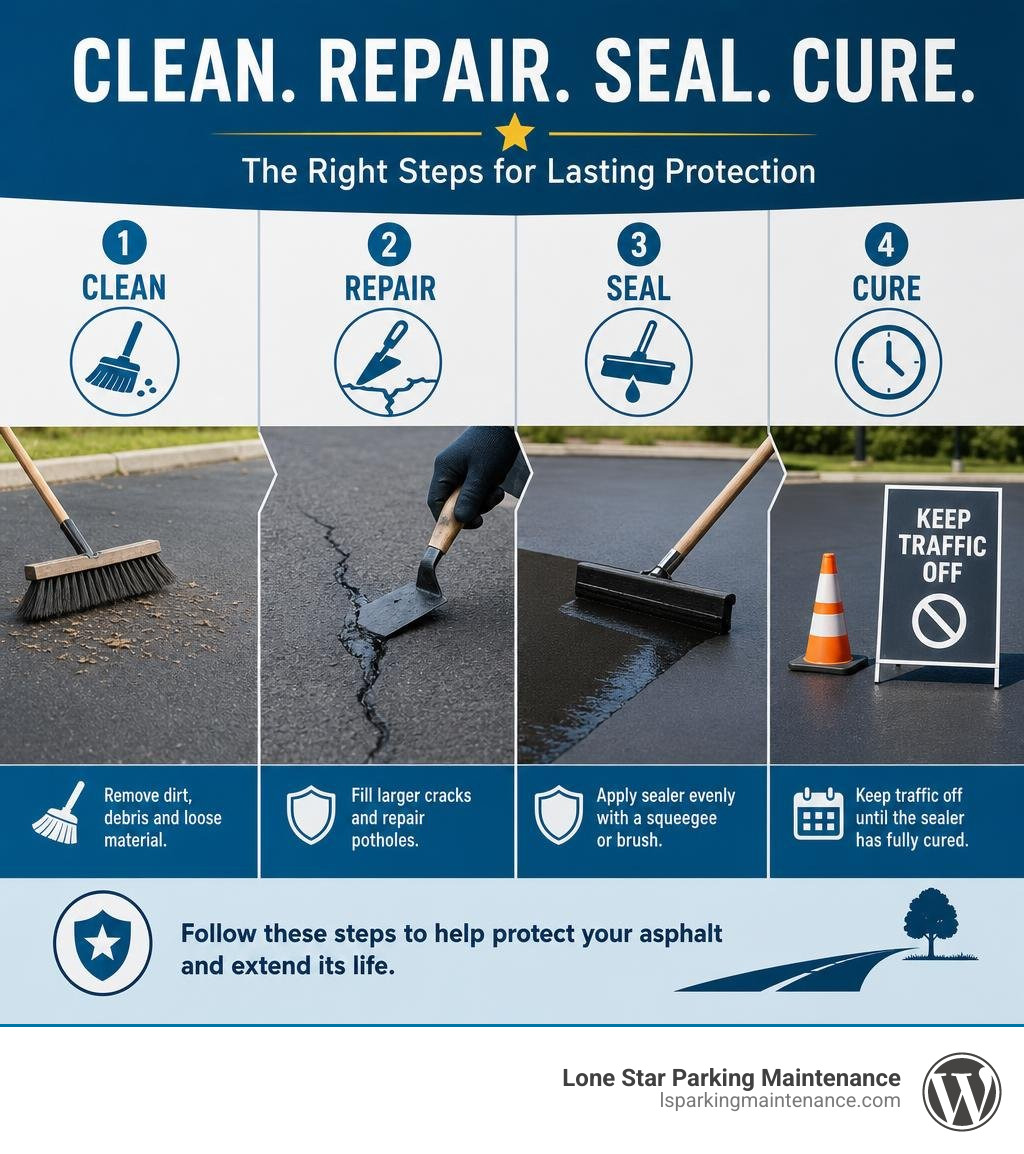
Asphalt filler sealer terms explained:
Understanding Asphalt Filler Sealer vs Standard Sealers
When you look at an aging driveway or parking area, the first sign of trouble is usually graying, oxidized blacktop and a web of shallow surface fractures. Asphalt binder breaks down under intense solar radiation and constant exposure to the elements, allowing aggregate to loosen (a process called raveling) while moisture creeps into the subbase.

Standard driveway sealers function primarily as a thin cosmetic paint layer. They refresh the dark color and offer a light shield against light moisture, but they lack the physical body to seal micro-fissures. An asphalt filler sealer, by contrast, is formulated with higher solids, mineral aggregates, and specialized clays (such as bentonite, slate, and kaolin) to physically bridge gaps. Understanding how these heavy-duty coatings work is central to the essential guide to asphalt repair and protection.
Micro-Crack Filling and Aggregate Body
The primary mechanical advantage of a quality filler sealer is its ability to span hairline fractures. Most standard filler-sealers are engineered to handle surface fissures up to a 1/8-inch threshold without requiring a dedicated bottle of crack sealant.
These coatings integrate silica sand, slate dust, and polymer additives that produce several key benefits:
- Elastomeric Bridging: Flexible polymers allow the dried film to expand and contract across seasonal temperature swings without splitting.
- Skid Resistance: Embedded sand aggregates create a textured, non-skid surface that improves tire traction on steep driveways and ramps.
- Wear Layer Building: Rather than washing away after a single season, the inorganic fillers form a resilient protective barrier over raw aggregate.
- Halting Raveling: The rich emulsion encapsulates loose rock chips, preventing them from breaking free under power steering friction.
Asphalt Filler Sealer vs Standard Topcoat Formulations
Different pavement conditions require different coating thicknesses. Standard liquid emulsions work well for newer blacktop, dual-action filler-sealers fit weathered surfaces, and heavy-duty restorative membranes handle severely oxidized asphalt.
| Product Category | Typical Film Build / Coverage | Key Ingredients | Best Application Use |
|---|---|---|---|
| Standard Liquid Sealcoat | 70–100 sq. ft. / gal (Thin film) | Asphalt emulsion, water, light polymers | Smooth, previously sealed blacktop with zero surface cracking |
| Asphalt Filler Sealer | 30–80 sq. ft. / gal (Medium body) | Asphalt emulsion, silica aggregate, slate/bentonite clay | Weathered blacktop with hairline cracks up to 1/8″ thick |
| Restorative Membrane Coating | 15–50 sq. ft. / gal (Heavy build) | Elastomeric polymers, high-solids rubber, mineral fillers | Severely oxidized pavement requiring a thick waterproof barrier |
When reviewing technical specifications for asphalt sealers, property owners will notice that commercial-grade formulations often allow custom sand-loading (up to 30 lbs of silica sand per 10 gallons) to fine-tune anti-skid properties.
Comparing Formulations: Emulsion, Polymer-Modified, and Acrylic
Not all sealers are blended the same way. In past decades, coal-tar-based sealers dominated the market because of their resistance to automotive fluids. However, due to high polycyclic aromatic hydrocarbon (PAH) levels and strict environmental restrictions, modern maintenance relies on safer, eco-friendly alternatives.
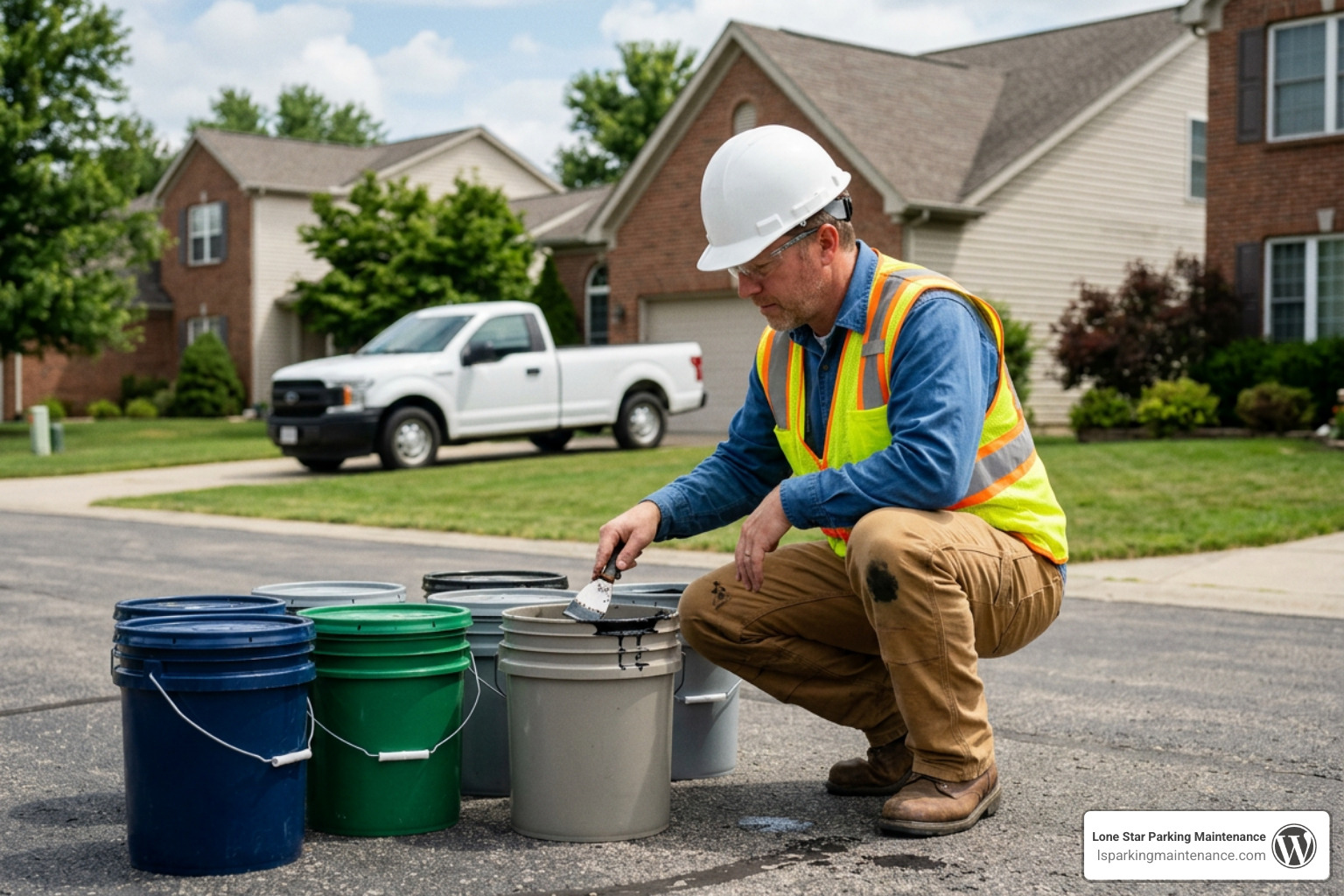
Following proper crack repair and sealing best practices means choosing a formula that aligns with your property’s environmental needs and traffic demands:
- Asphalt Emulsion Blends: Water-based formulas that bond naturally to the asphalt substrate. They release negligible volatile organic compounds (VOCs < 50 g/L), emit very low odor, and are safe to apply around residential properties.
- Polymer-Modified & Gel Sealers: These formulas incorporate specialized synthetic rubbers and fast-drying gel agents. Brands using gel systems (like fast-dry EZ-GEL chemistry) allow surfaces to handle foot traffic in as little as 1 hour while accommodating lower application temperatures down to 40°F.
- Pure Acrylic & Elastomeric Restorers: Acrylic coatings offer exceptional color retention and UV protection. Products like water-based elastomeric restorers build an ultra-thick membrane that cures to a flexible barrier, making them popular for high-traction sports courts and driveways.
Choosing the Best Asphalt Filler Sealer for Driveway Conditions
Selecting the right product depends on the condition and age of your pavement:
- Unsealed, Porous Asphalt (Over 1 Year Old): Requires a heavy-bodied asphalt emulsion with aggregate body. The dry, porous surface will drink up the liquid rapidly.
- Previously Sealed, Smooth Blacktop: Requires a lighter-bodied polymer-modified sealer to avoid excessive build-up and surface flaking.
- Heavily Weathered Blacktop with Hairline Cracking: Choose a high-solids filler sealer like Henry 175 Driveway Asphalt Filler and Sealer: Repair and Protect Your Driveway or Asphalt Emulsion Fill ’N Seal – Asphalt Products, which are formulated to seal surface cracks up to 1/8″ wide.
- Steep Ramps and Driveways: Look for an aggregate-fortified mixture to deliver slip resistance during rain. Check our updated blacktop crack filler guide for 2026 for pairing considerations.
Pay attention to manufacturer warranties. Entry-level products typically offer a 3-year limited warranty, while high-performance polymer formulas (such as high-end 4.75-gallon retail buckets) can carry up to a 10-year warranty when applied strictly according to directions.
Coverage Calculations and Porosity Factors
Estimating material needs accurately prevents mid-project supply runs and messy bucket transitions. The amount of product you need depends directly on surface roughness:
- Smooth / Previously Sealed Blacktop: A 4.75 to 5-gallon pail covers approximately 400 to 500 sq. ft. per coat (or roughly 75–100 sq. ft. per gallon).
- Rough / Porous / Never-Sealed Asphalt: Coverage drops to 200 to 400 sq. ft. per 5-gallon pail (or 30–50 sq. ft. per gallon for ultra-thick elastomeric membranes).
- Commercial Sizing: For large areas, a 55-gallon drum yields roughly 4,000 to 5,500 sq. ft. of single-coat coverage on standard pavement.
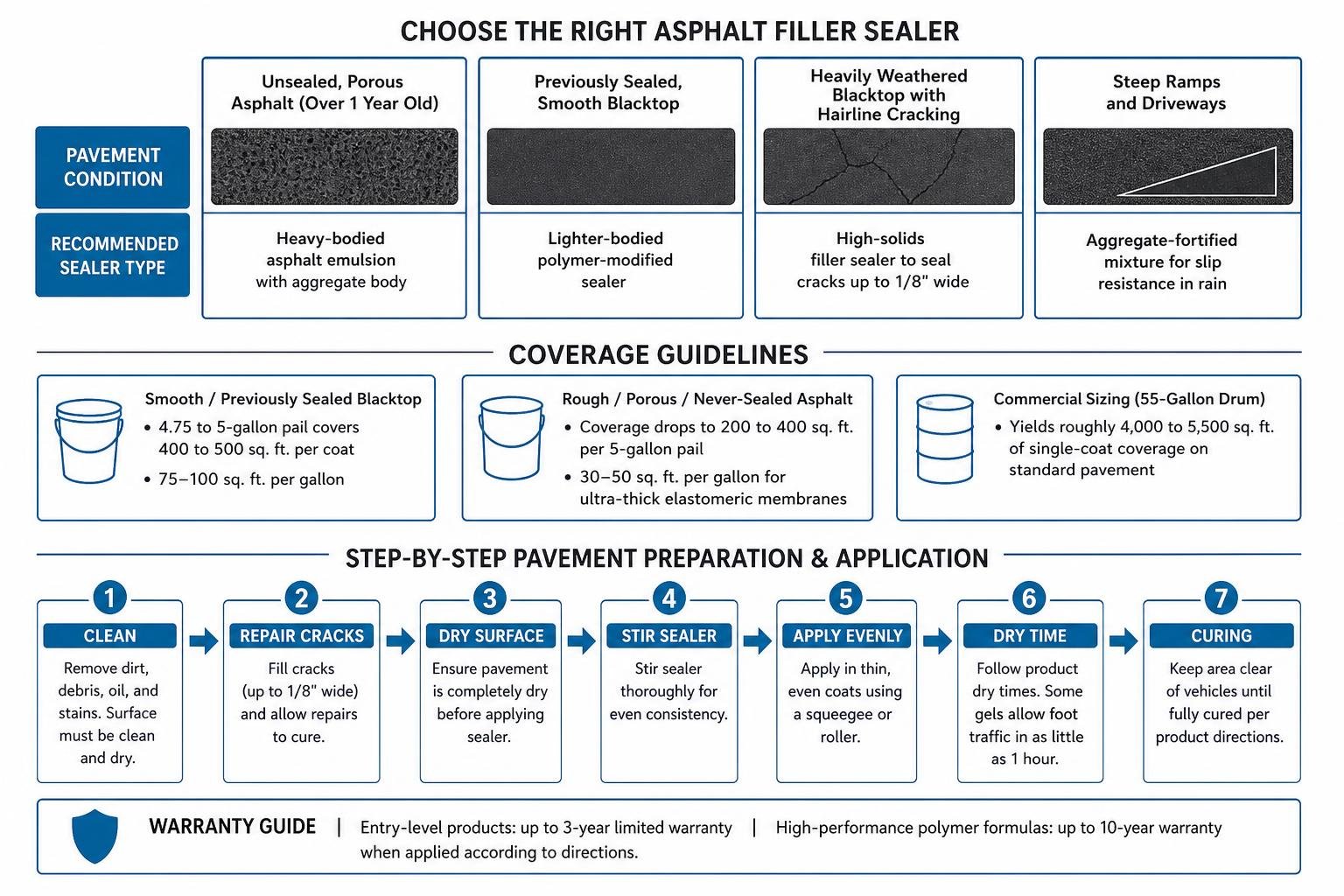
How to Prepare and Apply Blacktop Sealers Step-by-Step
Application technique determines whether your new sealcoat lasts for years or peels up after the first hard freeze. Even the highest-grade polymer coating will fail if applied over dirt, moisture, or oil slicks.
Pavement Cleaning and Deep Crack Preparation
Before opening a single bucket of coating, prepare the substrate:
- Surface Debris Removal: Clear the area of all loose aggregate, gravel, and organic matter. Use a stiff-bristled wire broom followed by a commercial leaf blower or pressure washer.
- Oil & Fluid Stain Degreasing: Oil spots dissolve asphalt binder. Scrub automotive fluid stains with a heavy-duty degreaser or asphalt-safe detergent, rinse thoroughly, and apply an oil-spot bonding primer before sealing.
- Deep Crack Routing and Filling: Filler sealers can only bridge fractures up to 1/8 inch wide. Any crack exceeding 1/8 inch requires dedicated crack repair before you apply surface sealer. For cracks between 1/8 inch and 3/8 inch wide, extrude a cold-pour rubberized sealant, as outlined in the ultimate guide to filling every crack in your driveway.
- Backer Rod Installation: According to commercial joint sealant application data, cracks or expansion joints exceeding 3/8 inch in depth must be fitted with a foam backer rod before filling to prevent joint failure. Allow pourable crack repair compounds to cure for at least 24 hours prior to sealcoating.
Proper Application Technique and Tool Selection
Applying the coating requires the correct tools:
- Use a Rubber Driveway Squeegee: A 14-inch to 24-inch rubber squeegee (often with a 1/8-inch notched blade) is the industry standard for applying filler-sealers. The squeegee forces the mineral body into hairline cracks and surface voids while leaving a uniform film on the surface.
- Avoid Paint Rollers: Many manufacturers explicitly warn that applying heavy filler-sealers with a paint roller applies the coating too thin or produces uneven ridges, which can void the product warranty.
- Application Method: Pour a continuous ribbon of sealer along the highest elevation of the pavement. Working in manageable sections, pull the squeegee in a smooth, overlapping motion, maintaining a wet edge.
- Tool Clean-Up: Keep a hose and bucket of warm soapy water nearby. Clean tools immediately after use before the emulsion coalesces and hardens.
Frequently Asked Questions About Driveway Sealing
How long does blacktop sealer take to cure before vehicle traffic?
Curing happens in stages:
- Tack-Free / Foot Traffic: Most fast-drying gel formulas dry to the touch in 1 to 4 hours under direct sunlight.
- Vehicle Traffic: Keep vehicles off the freshly sealed surface for a minimum of 24 to 48 hours. Driving on uncured sealer causes tire scuffing, tracking, and premature wear.
- Humid or Shaded Conditions: If humidity exceeds 70% or the surface sits in deep shade, extend vehicular cure time to 72 hours.
What is the maximum crack size a filler sealer can repair?
Filler sealers are engineered strictly for surface hairline fissures up to 1/8 inch wide. Attempting to fill cracks wider than 1/8 inch with topcoat sealer will result in shrinkage, surface depressions, and cracking during the first winter freeze-thaw cycle. Cracks larger than 1/8 inch must be repaired with dedicated cold-pour or hot-applied rubberized crack fillers.
At what temperatures can driveway sealers be safely applied?
Temperature and weather thresholds for successful sealcoating include:
- Standard Temperature Range: Apply when ambient and pavement temperatures are between 50°F and 90°F.
- Low-Temp Formulations: Certain specialty thermal products can cure down to 40°F, allowing for late-autumn maintenance.
- Rain Forecasts: Never apply sealer if rain is predicted within 24 hours. The emulsion requires evaporation to coalesce, and unexpected rain will wash uncured product into storm drains.
Conclusion
Routine sealcoating with a quality asphalt filler sealer protects your blacktop against oxidation, UV degradation, chemical spills, and water penetration. By repairing deep cracks first and applying an aggregate-reinforced emulsion with a squeegee, you can significantly extend the functional lifespan of your asphalt surface while restoring dark curb appeal.
For extensive commercial asphalt surfaces, multi-tenant parking facilities, or large residential projects in the DFW Metroplex, our team at Lone Star Parking Maintenance delivers industry-leading pavement solutions. Contact us today to schedule our professional parking lot sealing and crack filling services and keep your pavement protected year-round.