
How Curb Markings Help Emergency Crews Find and Reach Your Property
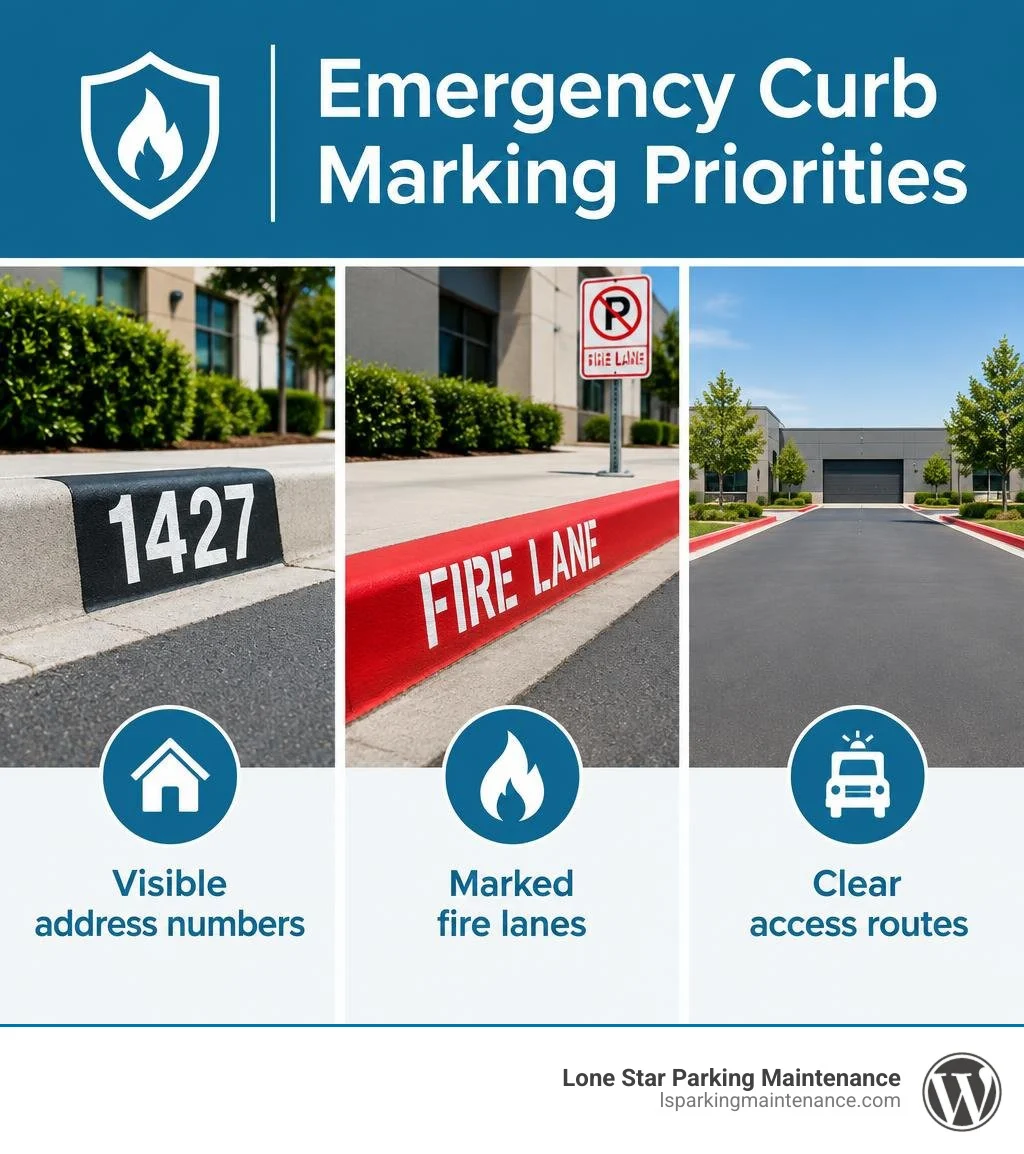
To make your property easier for emergency crews to find and reach, paint address numbers in a high-contrast color, mark approved fire lanes clearly, and keep access routes free of parked cars. Make sure the numbers are readable from the road, day or night. Use red curb paint and clear no-parking signs where your local fire authority requires them; paint alone may not meet local rules.
Check the markings after heavy traffic or bad weather. If drivers can no longer read them, neither can a crew arriving in a hurry.
I’m Cason, and I’ll show you how proper curb painting emergency access planning keeps your facility fully compliant and easily accessible when seconds count.
Curb painting emergency access glossary:
Standard Color Codes for Curb Painting Emergency Access
When first responders roll up to a commercial facility or multi-family complex, they rely on standardized visual signals to navigate access drives instantly. A split second spent guessing where an apparatus can stage is a split second lost during a structure fire or medical emergency. Following clear standards for curb painting emergency access routes ensures that drivers, visitors, and emergency crews understand exactly what can and cannot happen along any given stretch of curb.
Across standard traffic engineering guidelines—including regional benchmarks like the San Diego Fire-Rescue emergency access guidelines—curb colors operate as universal traffic control devices. Knowing these colors helps property managers balance daily operational convenience with the non-negotiable rule of keeping access paths clear for first responders.
Red Curbs: Designating Fire Lanes and Apparatus Clearances
Red is the universal signal for emergency apparatus access. A solid red curb indicates an absolute no-parking, no-stopping, and no-standing zone dedicated entirely to emergency vehicles.
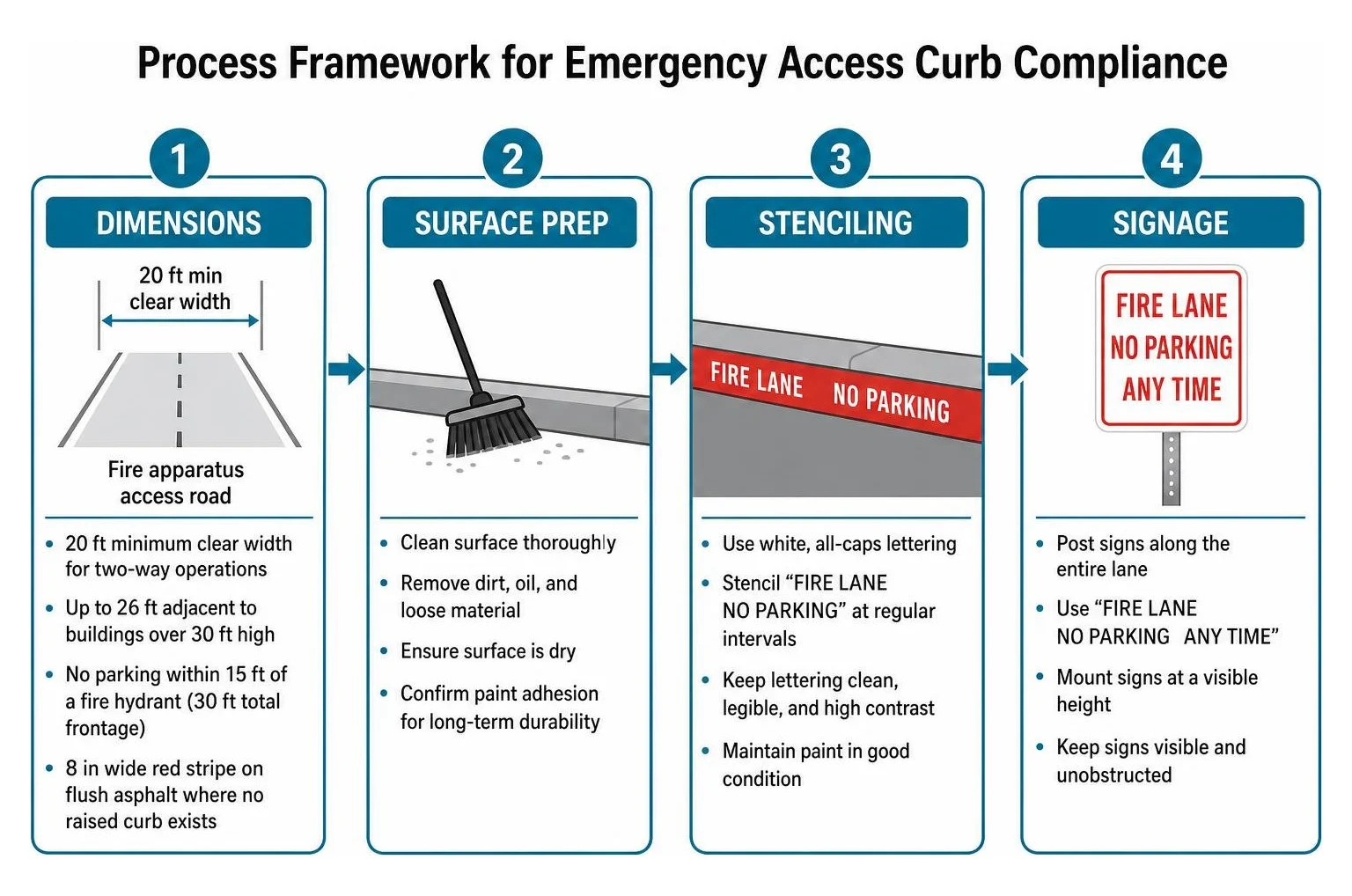
Beyond standard building frontages, red curb markings protect critical utility infrastructure. For example, municipal fire codes mandate that no vehicle may park within 15 feet of a fire hydrant. Painting the curb red along this 30-foot total frontage (15 feet in each direction from the hydrant stem) gives drivers an unmistakable visual boundary.
In commercial developments where a physical raised curb does not exist—such as flush asphalt loading aprons or industrial access drives—fire marshals require an equivalent 8-inch-wide solid red pavement stripe painted directly on the driving surface to outline the required access corridor. If your facility needs updated demarcations, choosing dedicated fire lane striping services ensures your pavement meets exact local standards.
Blue, Yellow, White, and Green Curbs: ADA, Loading, and Staging Zones
While red takes precedence during an active fire call, secondary curb colors organize routine traffic so access drives remain unobstructed:
- Blue Curbs: Designate accessible parking spaces and ADA passenger loading zones. Blue markings outline accessible stalls, access aisles, and curb ramps. Obstructing an accessible access aisle with parked cars or delivery trucks is a serious violation that carries steep municipal fines, often ranging from $250 to $450 for first offenses.
- Yellow Curbs: Indicate commercial loading zones. These allow commercial vehicles to actively load or unload freight for a limited time (typically 20 to 30 minutes). Unauthorized personal vehicles are prohibited.
- White Curbs: Designate passenger pick-up and drop-off zones. Vehicles may stop only long enough to deposit or pick up passengers, and drivers must generally remain with the vehicle.
- Green Curbs: Mark short-term general parking, usually limited to 10 to 30 minutes, commonly placed outside leasing offices or package lockers.
Properly coordinating these zones through mastering curb painting and directional arrows keeps delivery vans and visitors from staging in primary red zones.
Fire Lane Dimensions, Stenciling, and Signage Standards
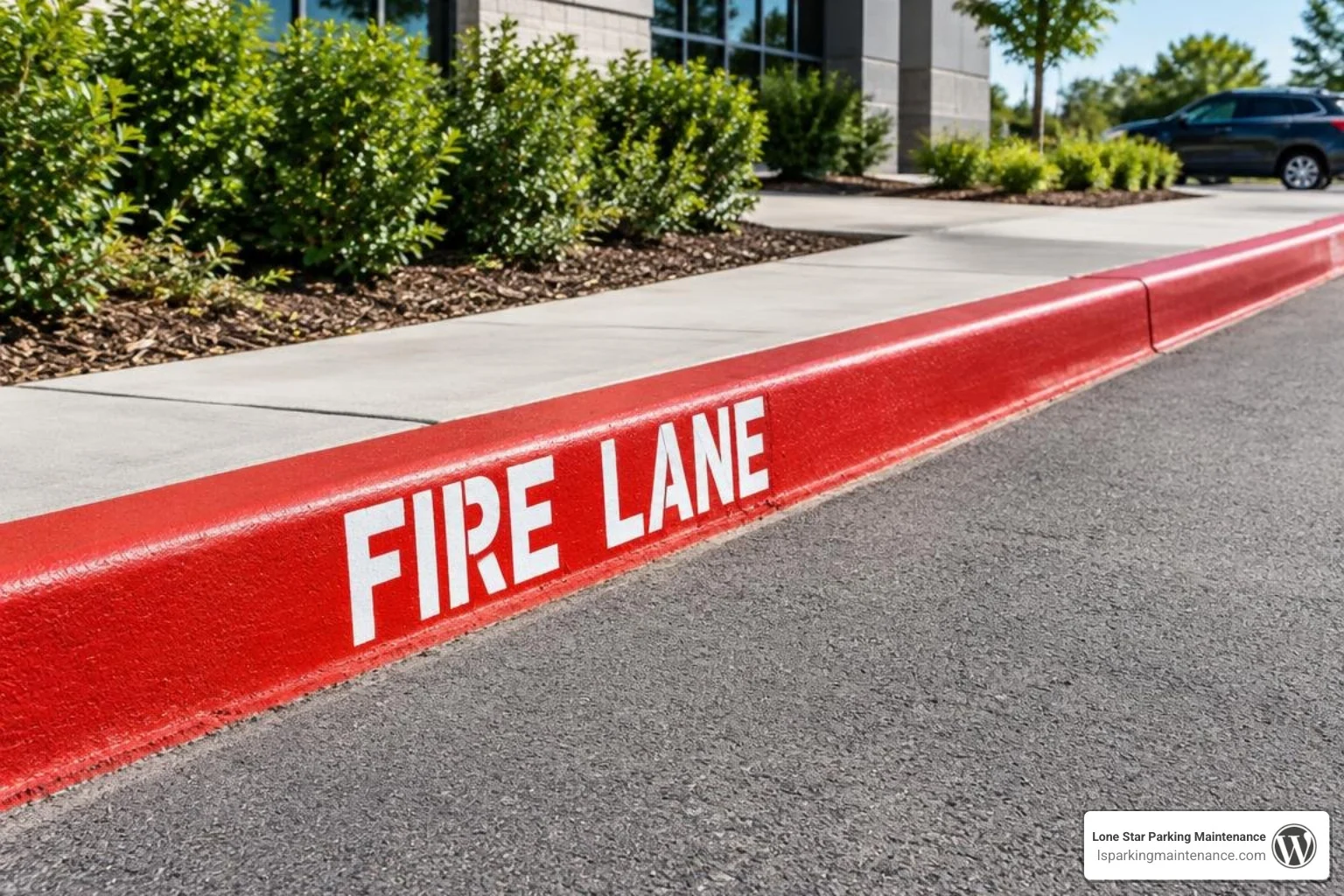
Marking a fire lane involves far more than simply applying red paint to concrete. Fire apparatus access roads must be engineered and visually reinforced according to national baseline codes, such as the NFPA 1 Fire Code, as well as local municipal fire amendments. If an access lane looks narrow or confusing on paper, a 75,000-pound aerial ladder truck will struggle to maneuver it in real life.
Critical Clearance Rules in Curb Painting Emergency Access
NFPA 1 and local fire codes dictate clear physical boundaries for any access route:
- Minimum Width: Fire apparatus access roads must maintain a continuous, unobstructed minimum width of 20 feet for two-way operations (and up to 26 feet adjacent to buildings exceeding 30 feet in height).
- Vertical Clearance: The entire 20-foot width must maintain at least 13 feet 6 inches of overhead vertical clearance, free of low-hanging tree branches, canopies, or utility lines.
- Apparatus Reach: Fire access roads must extend to within 150 feet of all exterior portions of a building’s ground floor (or within 200 feet for buildings equipped with an approved automatic sprinkler system).
- Turning Radii and Dead Ends: Fire engines require a minimum turning radius of 28 feet inside and 48 to 50 feet outside. Any dead-end fire lane longer than 150 feet must provide an approved turnaround loop (such as a 96-foot-diameter cul-de-sac or a standard hammerhead turnaround).
Stencil Lettering and Retroreflective Sign Specifications
To establish legal authority against illegal parking, red curbs must feature bold lettering paired with upright vertical signage.
Curbs must be stenciled in crisp, high-contrast white capital letters reading “NO PARKING – FIRE LANE” (or local municipal equivalents like “FIRE LANE – TOW AWAY ZONE”). The lettering must be at least 4 inches high (scaled up to 8 inches in high-clearance loading dock zones) and repeated at regular intervals of 25 to 50 feet along the red curb face.
Additionally, upright reflective metal signs (standard MUTCD R8-3a style) must be installed along the route:
- Spacing: Mounted every 100 feet along the lane, facing oncoming traffic, and closer on tight curves.
- Mounting Height: Installed at a bottom height of 7 feet above the walking surface to ensure visibility over parked cars and prevent pedestrian head injuries.
- Municipal Guidelines: Cities establish exact wording codes for both house numbers and commercial properties, as seen in the City of Fort Worth municipal code on curb markings.
When laying down fresh stencils, using wear-resistant curb stencils ensures that lettering remains sharp and legible through seasonal weather shifts.
Paint Selection, Durability, and Surface Preparation
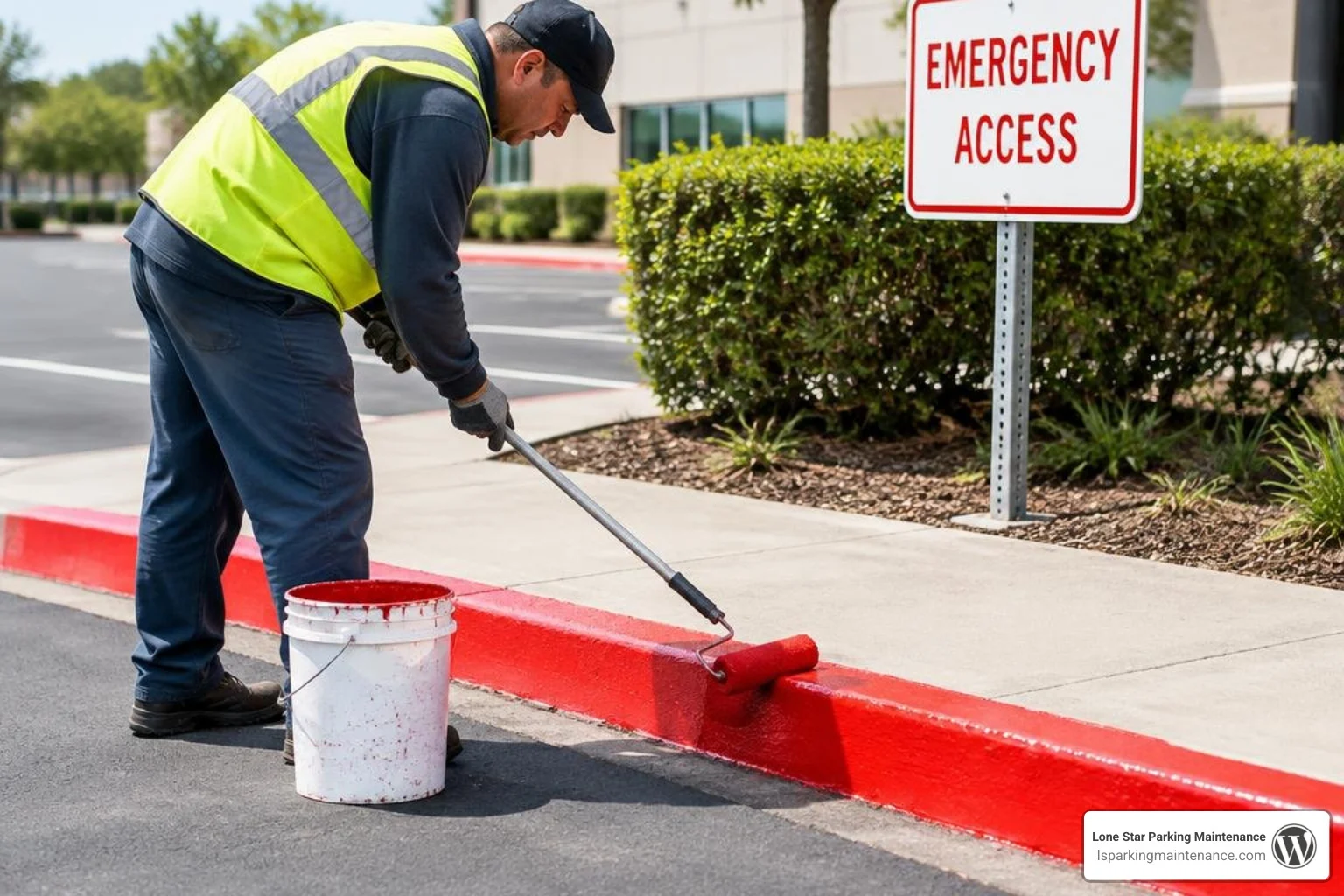
Curb paint takes a brutal beating from automotive tires, lawn equipment, standing water, and direct sunlight. Choosing the right coating and prepping the concrete correctly is the difference between crisp compliance and peeling eyesores.
Durable Materials and Surface Prep for Curb Painting Emergency Access
Concrete is naturally porous and prone to collecting road grime, tire rubber, and organic buildup. Applying traffic paint over dirty or damp concrete guarantees premature failure.
Before opening a single can of paint, our crews follow strict prep protocols:
- Pressure Washing & Degreasing: We thoroughly power-wash curbs to strip away dirt, grease, moss, and loose paint flakes.
- Efflorescence & Laitance Removal: New concrete must cure for at least 30 days before painting, followed by light scarification or cleaning to remove surface salts.
- Coating Selection: Reviewing the best paint for curbs helps property owners choose between standard acrylic waterborne traffic paint and heavy-duty solvent-based alkyd paints.
- Glass Bead Integration: Embedding Type 1 retroreflective glass beads into wet red paint dramatically boosts nighttime reflectivity, helping headlights catch the curb instantly.
Proper debris removal and surface prep techniques guarantee strong mechanical adhesion so coatings do not peel after heavy seasonal rains.
Repaint Frequency and Maintenance Cycles
Red pigments contain organic compounds that degrade faster under intense UV exposure than yellow or white pigments. In high-sun regions, red curb paint begins chalking and fading long before standard white parking stalls show wear.
| Paint / Coating Type | Expected Curb Lifespan | Typical Dry Time | UV & Abrasion Resistance | Recommended Use Case |
|---|---|---|---|---|
| Waterborne Acrylic Traffic Paint | 8 – 12 Months | 15 – 30 Minutes | Moderate | Standard parking fields, quick turnarounds |
| Solvent-Based Alkyd Traffic Paint | 12 – 18 Months | 30 – 60 Minutes | High | Commercial fire lanes, industrial aprons |
| Thermoplastic / Bead-Injected Coatings | 24 – 36 Months | 5 – 10 Minutes (Heat) | Exceptional | High-impact loading zones, highway curbs |
As a general rule of thumb, commercial property managers should plan on inspecting fire lanes annually and repainting red curbs every 12 to 18 months. Upright reflective signs typically maintain compliant retroreflectivity for 7 to 10 years before requiring replacement, while their galvanized steel posts can last 15 to 20 years.
Legal Compliance, Enforcement, and Property Jurisdiction
Maintaining fire lane curb markings isn’t just about keeping the local fire marshal happy during annual walk-throughs—it is a cornerstone of commercial premises liability management. If an emergency vehicle cannot access a commercial building due to blocked lanes and faded curbs, property owners face severe legal and financial exposure.
Public Streets vs. Private Property Obligations
On public municipal streets, the city manages curb painting and sign installation. In many jurisdictions, public streets with red curbs are exempt from needing white stenciled lettering because municipal ordinances automatically govern street parking.
On private property—such as retail shopping centers, office parks, apartment complexes, and industrial distribution hubs—the legal burden falls entirely on the property owner. Property managers are required by law to maintain fire lanes according to the approved site plan on file with the local fire department. During routine inspections, fire marshals issue citations and compliance deadlines for:
- Faded or illegible red paint.
- Missing or damaged R8-3a metal signage.
- Overgrown landscaping encroaching on the 13-foot-6-inch vertical clearance envelope.
- Unpainted pavement where fire access routes exist.
Towing Authority and Private Property Enforcement
Property owners cannot legally tow an unauthorized vehicle from a private fire lane unless the area is marked in strict compliance with state and municipal towing notification statutes.
To exercise immediate non-consent towing rights:
- Curbs must be painted bright red with clear, compliant stencils.
- Upright tow-away warning signs (containing the specific statutory towing language, maximum fee limits, and local police/towing contact information) must be posted at all property entrances and along the designated fire lane at required intervals.
- Signage and curb markings must be unobstructed by foliage or building features.
When your markings meet exact statutory standards, parking enforcement and towing operators can legally remove blocking vehicles without exposing your business to improper towing claims.
Frequently Asked Questions About Emergency Curb Markings
What are the minimum width and vertical clearance requirements for a fire lane?
Under NFPA 1 standards, fire apparatus access roads must provide a minimum continuous width of 20 feet for two-way operations, expanding up to 26 feet for multi-story structures requiring aerial ladder deployment. The lane must maintain a minimum overhead vertical clearance of 13 feet 6 inches, clear of all trees, wires, and building canopies.
How often should commercial property managers repaint red fire lane curbs?
Commercial properties should budget for a red curb repaint cycle every 12 to 18 months. Red traffic paint pigments fade rapidly under intense solar radiation and weather cycles. An annual facility audit ensures curbs remain visually striking, legally enforceable, and fully compliant with local fire marshal standards.
What are the standard stenciling requirements on red emergency access curbs?
Standard compliance requires sharp white capital lettering reading “NO PARKING – FIRE LANE” (or “FIRE LANE – TOW AWAY ZONE”). Letters must be a minimum of 4 inches high and stenciled along the red curb face at intervals of 25 to 50 feet.
Conclusion
Clear, vibrant emergency access markings protect lives, protect property, and shield commercial owners from crippling liability. When fire crews respond to a call, they need clear access paths, readable address numbers, and open fire hydrant clearances.
At Lone Star Parking Maintenance, we keep commercial surface lots and parking garages compliant across the DFW Metroplex with top-quality materials, expert striping, and dependable maintenance. From fresh fire lane striping to protective pole covers and curb stop installations, we ensure your property remains safe, accessible, and fully prepared for any emergency inspection. Reach out to our team today to audit your curb markings and schedule your next service.