
What Does It Cost to Seal Driveway Cracks?
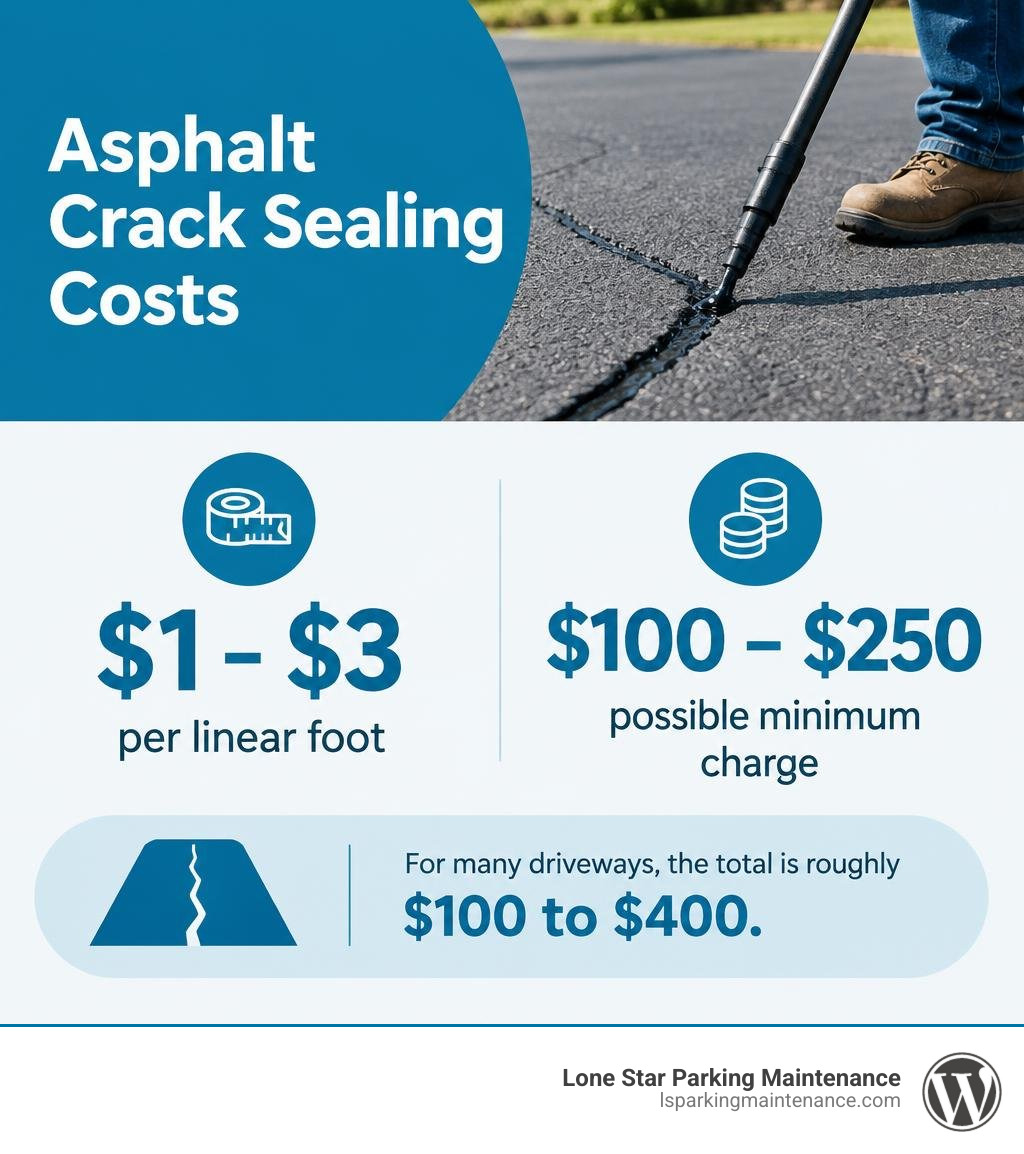
In 2026, the cost to seal driveway cracks in asphalt is about $1 to $3 per linear foot. A small professional job may still cost $100 to $250 because of a minimum service charge. For many driveways, the total is roughly $100 to $400. Measure the length of the cracks, not the driveway’s square footage, to make a first estimate.
In the DFW Metroplex, the final price depends on crack size, cleaning, and whether the pavement needs more than a surface repair. I’m Cason, and I’ll help you see what belongs in a quote before you pay for the work.
Cost to seal driveway cracks definitions:
Introduction
Driveways in North Texas endure extreme punishment throughout the year. Between sizzling summer heatwaves that push surface temperatures well past 140 degrees and winter cold snaps bringing unpredictable freeze-thaw cycles, asphalt expands and contracts constantly. Over time, that movement leads to surface fractures.
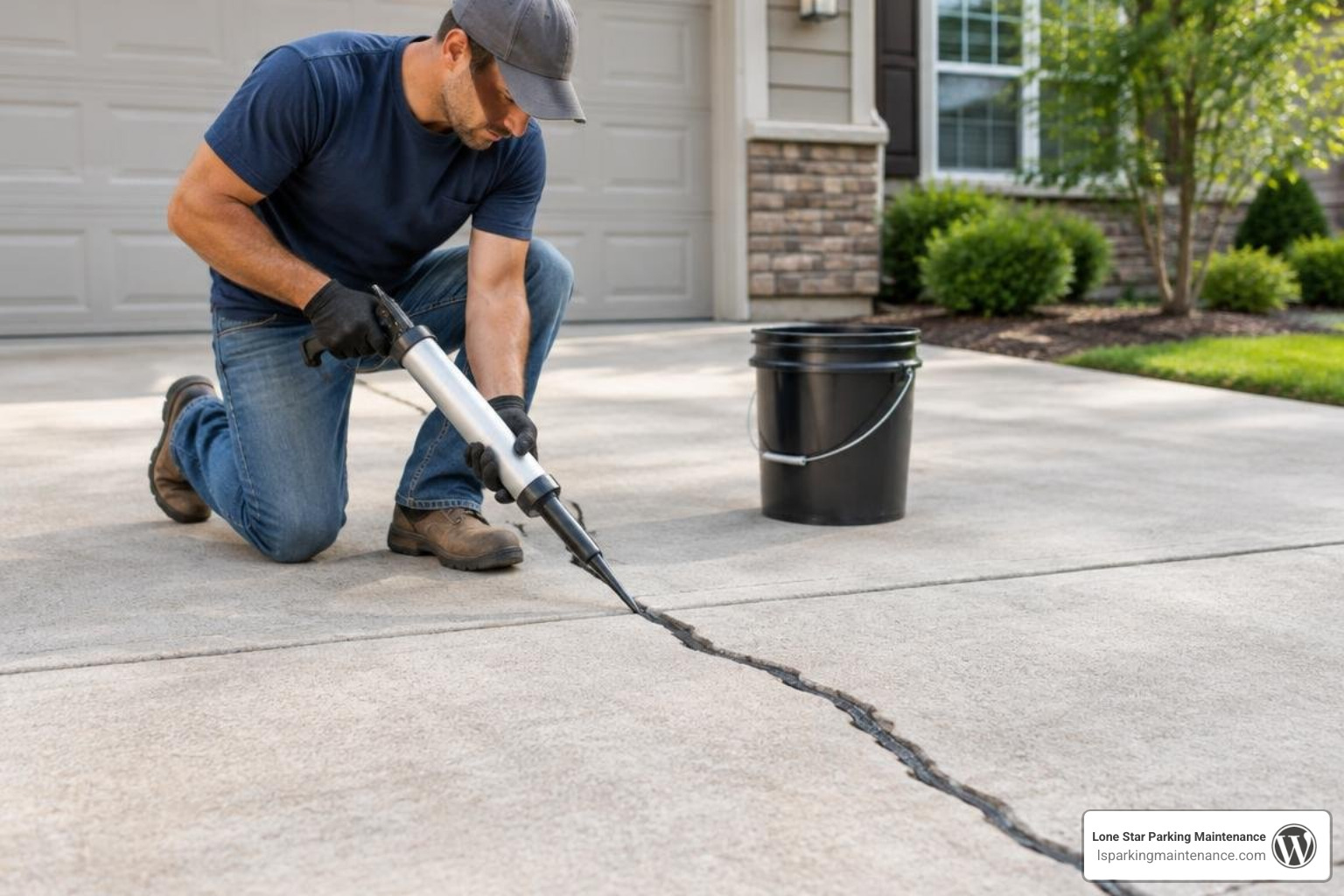
When left open, tiny hairline fractures act as funnels for rainwater, engine fluids, and organic debris. Water seeps past the surface layer and settles directly into the crushed-aggregate base beneath your pavement. As that subbase erodes or shifts during seasonal freezes, cracks rapidly expand into structural chasms and deep potholes. Ignoring a simple fissure for a couple of years can easily turn a quick touch-up into an extensive repair bill running between $500 and $1,500.
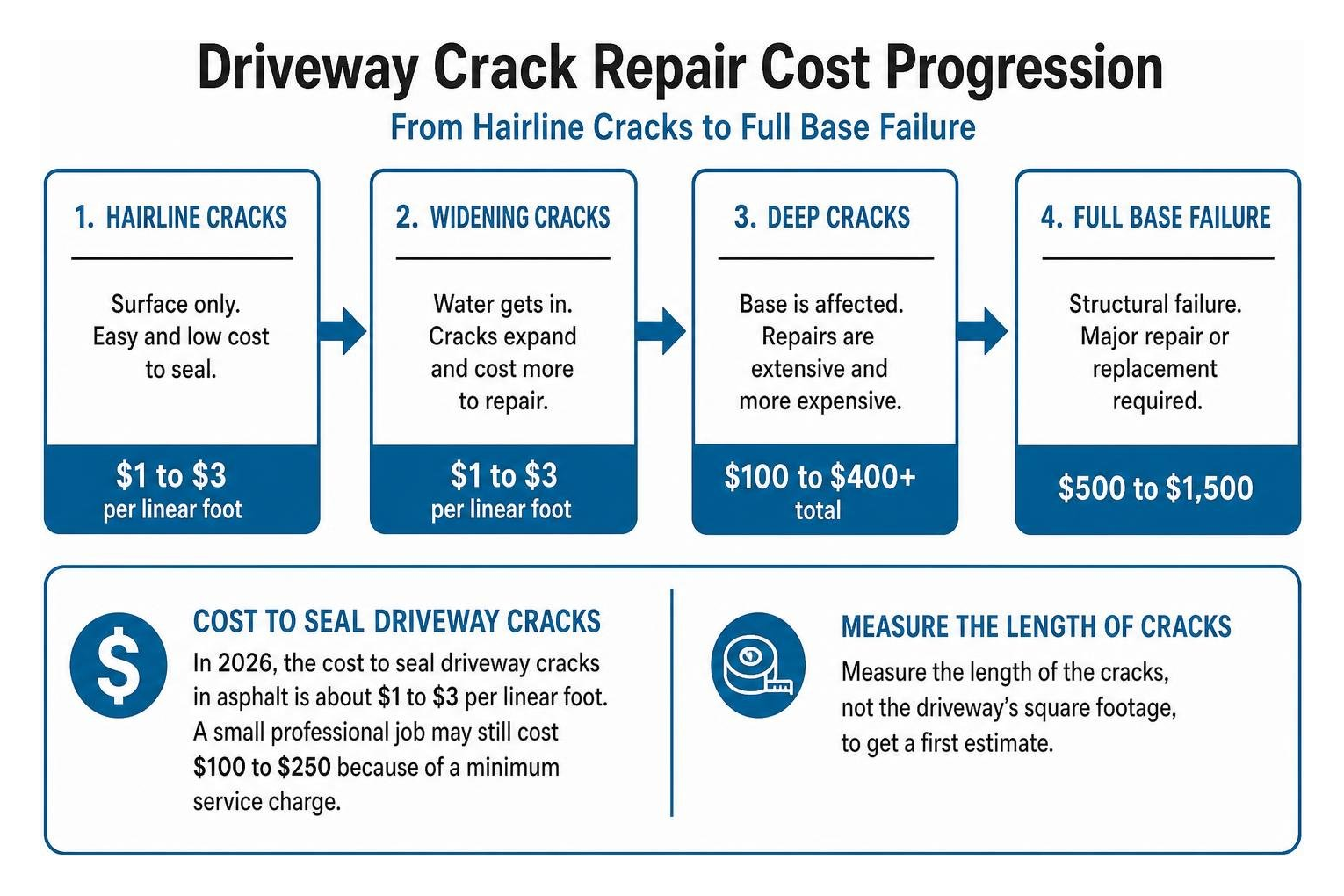
Understanding the real price of timely pavement care helps you protect both your property’s curb appeal and your wallet. By following a smart preventive maintenance schedule, you keep small flaws from snowballing into catastrophic structural failures.
Understanding the True Cost to Seal Driveway Cracks in 2026
When budgeting for pavement repairs, the price you pay depends on whether you are filling isolated lines or applying a protective topcoat across the entire surface. Industry benchmarks such as asphalt repair cost benchmark data illustrate that repair methods vary significantly in scope and pricing.
| Repair Scope / Material Type | Crack Severity / Width | Average Cost (DIY) | Average Cost (Professional) | Typical Lifespan |
|---|---|---|---|---|
| Cold-Pour Emulsion Filler | Hairline to 1/4 inch | $5 – $15 per bottle (24 linear ft) | $1.00 – $2.00 per linear ft | 1 – 2 Years |
| Hot-Pour Rubberized Sealant | 1/4 inch to 1 inch | $40 – $80 (jug / torch rope) | $1.50 – $3.00 per linear ft | 3 – 5+ Years |
| Polyurethane Caulk / Sealant | Hairline to 3/8 inch | $8 – $20 per cartridge | $2.00 – $4.00 per linear ft | 3 – 6 Years |
| Hot Asphalt Patching | Potholes & wide breaks | $20 – $50 (cold patch bag) | $2.00 – $5.00 per sq ft ($250+ per patch) | 5 – 8 Years |
| Full Driveway Sealcoating | Surface oxidation / micro-fissures | $0.10 – $0.20 per sq ft | $0.15 – $0.40 per sq ft ($200 – $500 total) | 2 – 4 Years |
Per Linear Foot and Square Foot Pricing Breakdowns
Contractors price targeted crack work by the linear foot rather than square footage. For asphalt driveways, professional crack sealing runs from $1 to $3 per linear foot. If you have roughly 100 linear feet of cracks across your driveway, you can anticipate spending between $100 and $300 for the crack work itself.
Square-foot pricing ($0.15 to $0.40 per sq ft) comes into play when you apply a topical sealcoat across the whole driveway or patch wide areas of sunken pavement ($2 to $5 per sq ft). Because contractors incur fixed travel, crew, and equipment mobilization expenses, most reputable teams set a minimum dispatch charge between $100 and $250.
Factors That Increase the Cost to Seal Driveway Cracks
Several real-world site conditions can push your quote toward the higher end of the pricing spectrum:
- Crack Width and Depth: Fissures deeper than half an inch require backer rod foam or silica sand aggregate before applying sealant, increasing material usage and labor time. Following proper DFW crack maintenance best practices prevents these deep voids from forming in the first place.
- Subbase Erosion and Voids: If water has washed away the underlying foundation, the void must be stabilized to prevent the new repair from sinking.
- Tree Root Intrusion: Invasive tree roots lifting and cracking pavement slabs require root pruning and subbase leveling before any surface sealing can hold.
- Severe Edge Breakdown: Broken or unconfined driveway edges need structural rebuilding rather than simple liquid sealant.
- Seasonal Surges and Labor: Emergency winter patching or peak summer scheduling can lead to modest labor premiums based on regional contractor demand.
Crack Filling vs. Crack Sealing vs. Driveway Sealcoating
Many property owners use these terms interchangeably, but they describe three distinct asphalt maintenance procedures designed for different stages of wear.
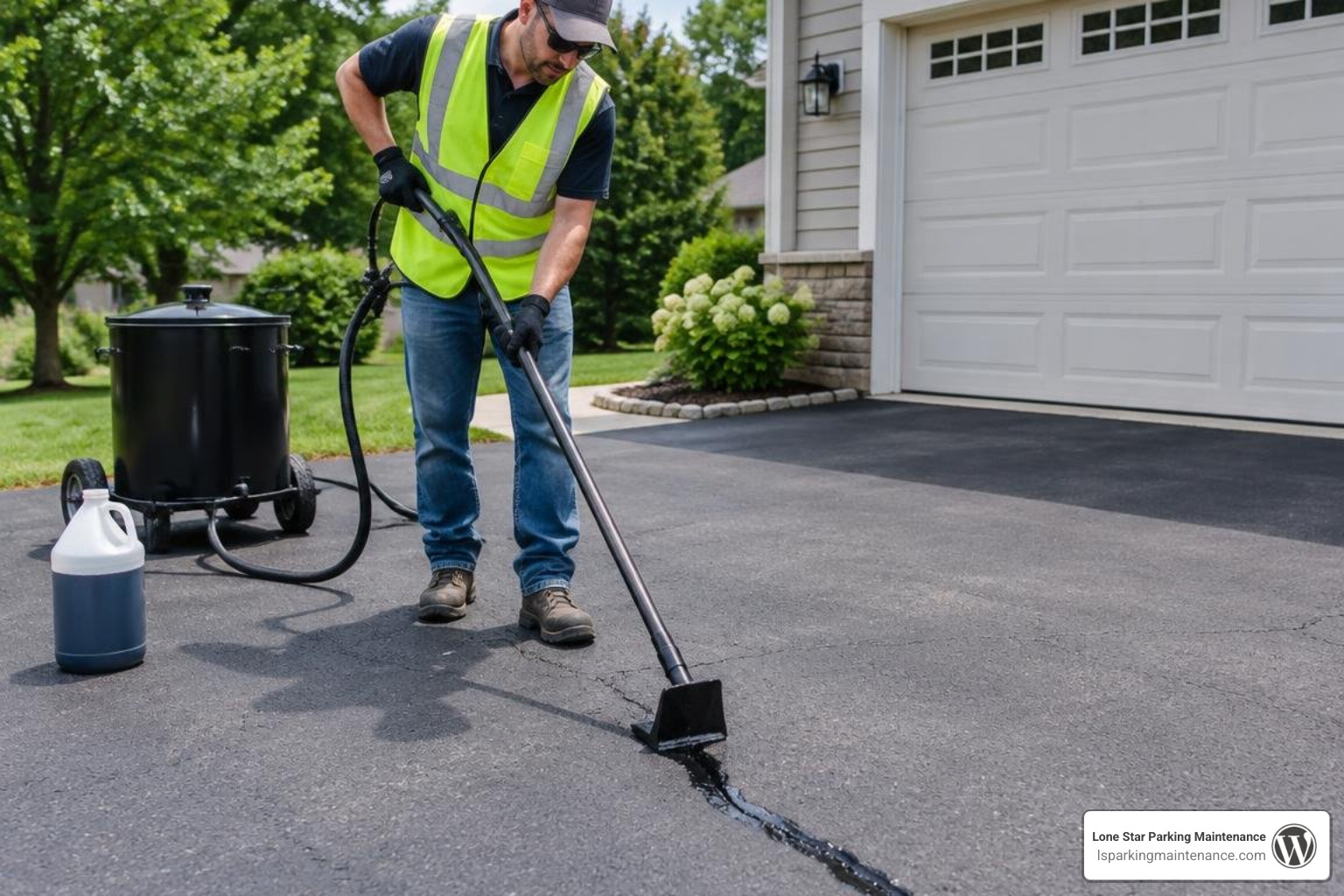
- Crack Filling: Intended for static, non-working cracks (cracks that do not expand or contract significantly with temperature swings). Rigid or semi-rigid compounds fill the opening to stop moisture from entering.
- Crack Sealing: Specifically designed for active, working cracks that widen in winter and narrow in summer. A highly flexible, rubberized compound is applied hot, allowing it to stretch without tearing away from the asphalt sidewalls.
- Driveway Sealcoating: A thin, liquid protective barrier squeegeed or sprayed across the entire driveway. It shields the blacktop from sunlight oxidation, gasoline drips, and rain, but it is not engineered to bridge or bridge open cracks on its own.
Choosing Between Hot-Pour and Cold-Pour Fillers
The type of filler you choose determines how often you will have to repeat the repair. We routinely compare hot-pour versus cold-pour crack filling methods to ensure our clients get the right longevity for their budget.
- Cold-Pour Sealants: Packaged in jugs at home improvement centers, these water- or emulsion-based sealants are convenient for DIY repairs on minor gaps under a quarter-inch. However, as volatile liquids evaporate during curing, the material shrinks and becomes brittle. Cold-pour repairs generally last 1 to 2 years under Texas temperature shifts.
- Hot-Pour Rubberized Sealants: Commercial-grade rubberized asphalt blocks are melted at temperatures exceeding 375 degrees Fahrenheit and injected directly into cracks. The heated material bonds thermally to the asphalt edges and remains flexible through extreme weather swings. A professional hot-pour application lasts 3 to 5 years or longer. Reviewing a blacktop crack filler selection guide can help you select the ideal grade for your driveway’s layout.
Full Sealcoating Costs vs. Targeted Crack Repairs
Treating individual cracks stops water intrusion at specific failure points, but it does not protect the surrounding surface from weather exposure. As asphalt ages, UV rays oxidize the binding oils, turning deep black pavement into a dry, brittle gray surface prone to micro-fissuring.
Applying a protective sealcoat costs roughly $0.15 to $0.40 per square foot (or $200 to $500 for a typical two-car driveway). By sealing the entire surface every two to three years, you provide an impermeable membrane that locks in essential asphalt binders. To tackle existing damage before laying down a topcoat, follow practical steps on how to repair asphalt cracks in 5 easy steps to ensure proper adhesion.
Professional Crack Sealing Costs and Preparation
Hiring a professional crew involves more than just pouring rubber into a crevice; high-performance results rely heavily on commercial equipment and rigorous surface preparation.
How Preparation Affects Professional Crack Sealing Costs
Commercial equipment makes a major difference in durability. Professional crews utilize direct-fire or oil-jacketed melters that maintain consistent sealant temperatures, ensuring maximum flow, penetration, and sidewall adhesion.
Commercial elastomeric sealants contain synthetic polymers that provide superior elasticity compared to store-bought cold mixtures. Because professionals use high-grade materials and proven application standards, they often back their work with warranties that protect your investment against premature peeling or tracking.
Critical Preparation and Hidden Repair Expenses
Proper prep work accounts for up to half of total job labor. Skipping these essential steps almost guarantees bond failure:
- Wire Wheel Routing or Heat Lancing: Deeply entrenched dirt, moss, and roots must be scrubbed out using mechanical wire wheels or blasted with a 2,000-degree thermal heat lance to vaporize internal moisture.
- High-Pressure Air Blowout: High-CFM compressors blast loose stone dust and grit out of the crack channel.
- Oil and Chemical Spot Priming: Vehicle fluid stains must be scrubbed and coated with an oil-spot primer; otherwise, hot sealant and topcoats will peel right off.
- Subgrade Void Stabilization: Deep fissures over half an inch are filled with clean silica sand or foam backer rod to establish a stable base, preventing expensive sealant from sinking down to the dirt.
When to Seal or Assess Your Driveway
Not all cracks are simple candidates for a tube of rubberized filler. Recognizing the difference between benign cosmetic blemishes and deep structural failure ensures you do not waste money masking serious problems.
Repairing Minor Surface Cracks vs. Structural Failures
- Hairline & Longitudinal Cracks: Straight, clean cracks running down or across the driveway are generally caused by shrinkage or minor settling. These are prime candidates for hot-pour rubberized sealing.
- Alligator (Fatigue) Cracking: Interconnected patterns resembling reptile skin indicate that the subbase beneath the asphalt has destabilized or collapsed under heavy vehicle loads. Pouring crack sealant over alligatoring is only a temporary band-aid; damaged areas require full-depth saw-cutting, subbase re-compaction, and hot-mix patching ($2 to $5 per square foot).
- Extensive Heaving or Sinking: Significant vertical displacement (where one slab sits an inch higher than the next) signals severe subbase shifting or tree root intrusion that requires structural leveling.
Long-Term ROI of Preventive Crack Sealing
Routine preventive maintenance pays for itself many times over. Replacing a standard two-car asphalt driveway can easily run between $3,500 and $8,000.
Investing $150 to $300 every few years for timely crack sealing and basic topcoating prevents moisture from destroying the foundation, easily extending your driveway’s usable lifespan from 12 years to well over 20 years. That translates to thousands of dollars in cumulative savings over your homeownership lifecycle.
Frequently Asked Questions About Driveway Crack Sealing Costs
How long does driveway crack sealing take to dry before parking?
Hot-pour rubberized sealant cools quickly and is typically dry to foot traffic within 30 to 60 minutes. However, we advise keeping passenger vehicles off the newly treated cracks for 24 to 48 hours. Heavy vehicle weight and turning tires on fresh repairs can cause tire marks or pull uncured sealant out of wider cracks, especially during hot summer afternoons.
How often should driveway cracks be sealed and maintained?
Inspect your driveway twice a year—ideally in late spring and early autumn before the arrival of wet, freezing weather. Fill new cracks as soon as they appear. Whole-driveway sealcoating should be scheduled every 2 to 3 years, depending on direct sun exposure, traffic volume, and local weather conditions.
Does sealing cracks eliminate the need for a full sealcoat?
No. Crack sealing addresses localized structural fractures, while sealcoating protects the broad pavement surface from solar oxidation, water penetration, and automotive fluid spills. For complete protection, seal all individual cracks first, allow them to cure fully, and then apply a high-quality sealcoat across the entire driveway.
Conclusion
Taking care of small pavement cracks today is the smartest way to avoid expensive driveway replacements down the road. By budgeting roughly $1 to $3 per linear foot for professional repairs—or tackling minor hairline touch-ups early—you keep water where it belongs and protect your pavement foundation for years to come.
When managing larger surfaces, commercial parking lots, or complex residential driveways across the DFW Metroplex, our team at Lone Star Parking Maintenance delivers industry-leading durability with commercial-grade equipment and premium materials.
Contact us today to schedule your pavement assessment or explore our professional parking lot sealing and crack filling services to keep your property safe, functional, and looking its absolute best.