
How to Choose and Use an Asphalt Driveway Crack Sealer
Start with the crack, not the product. Clean out loose debris and let the crack dry fully. For narrow cracks, choose a cold-applied filler or spray rated for the crack’s size. Wider cracks may need a meltable rope filler or professional hot-pour sealant. Apply it only in the weather range on the label, then keep traffic off until the product is ready.
Sealing a crack helps keep water out, but the right material and good surface prep matter more than a quick application. I’m Cason, and I’ll help you compare your options before you start.
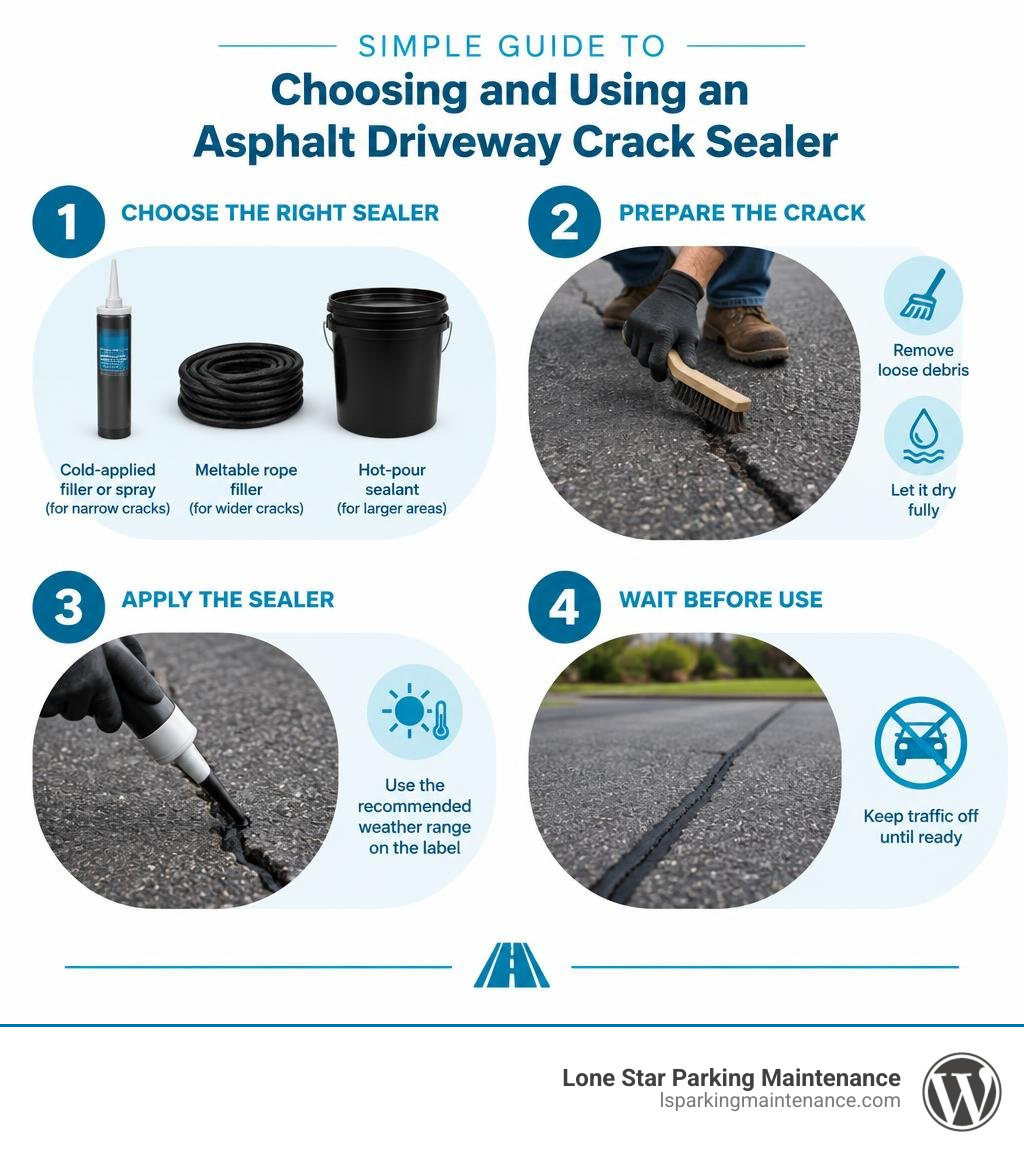
Asphalt driveway crack sealer definitions:
Comparing Every Type of Asphalt Driveway Crack Sealer
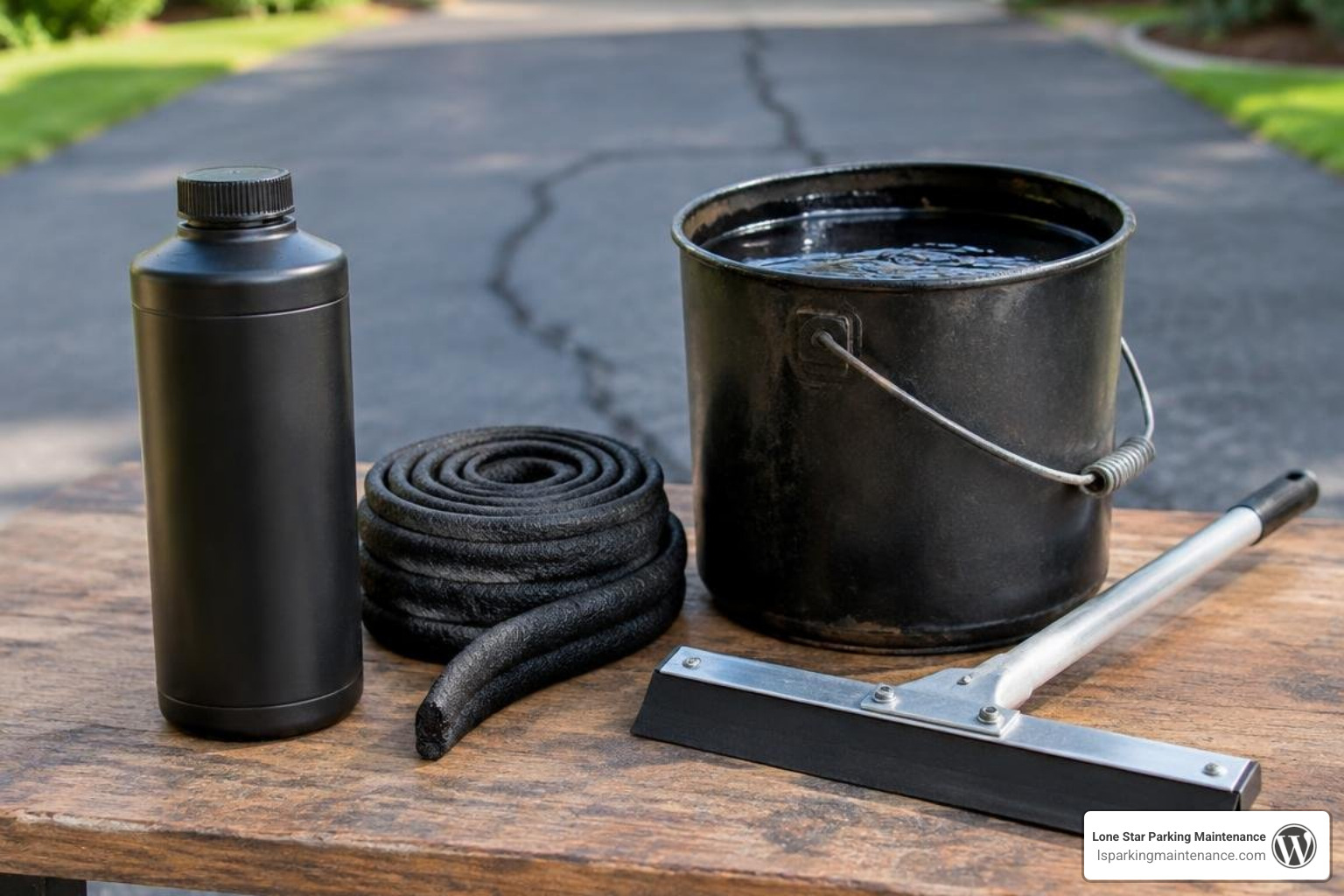
Choosing the correct product begins with understanding chemical formulation differences. You can permanently fix asphalt driveway cracks with cold and hot pour methods, but each category serves distinct pavement conditions. Asphalt crack sealers rely on specific bonding agents—such as polymer modification and vulcanized crumb rubber—to remain elastic as seasonal temperatures fluctuate.
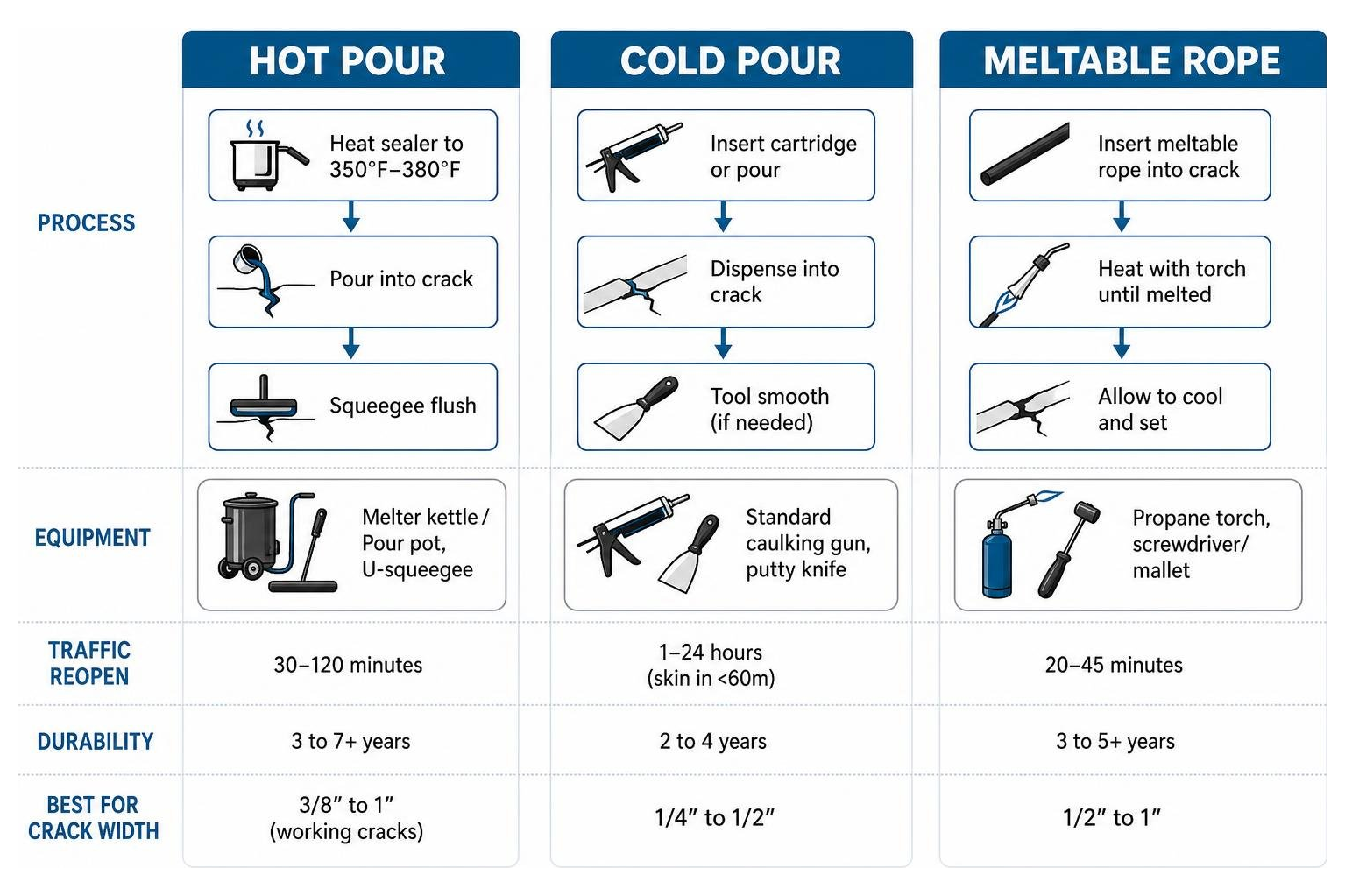
| Sealer Type | Primary Application Method | Key Equipment Needed | Traffic Reopen Time | Expected Durability | Best Suited Crack Width |
|---|---|---|---|---|---|
| Hot-Pour Rubberized | Heated pour at 350°F–380°F | Melter kettle / Pour pot, U-squeegee | 30–120 minutes | 3 to 7+ years | 3/8″ to 1″ (working cracks) |
| Cold-Applied Hybrid | Cartridge extrusion or pour | Standard caulking gun, putty knife | 1–24 hours (skin in <60m) | 2 to 4 years | 1/4″ to 1/2″ |
| Meltable Rope | Direct-torch melt into void | Propane torch, screwdriver/mallet | 20–45 minutes | 3 to 5+ years | 1/2″ to 1″ |
| Pressurized Aerosol | Direct inverted spray | None (pressurized can) | 30 minutes (full in 12h) | 1 to 2 years | Micro to 3/8″ |
Hot-Pour Rubberized Asphalt and Direct-Fire Sealants
Hot-pour sealers represent the gold standard for highway-grade structural pavement defense. These products blend paving-grade asphalt with virgin polymers and vulcanized crumb rubber to deliver superior elasticity and thermal bonding. Applied via direct-fire or oil-jacketed melters and dispensed using a pressure-feed wand or handheld pour pot, hot sealants penetrate deep into open fissures to weld sidewalls together.
Industry benchmarks like CrackMaster 5078 specifications demonstrate formulations engineered to satisfy ASTM D5078 requirements, maintaining flexibility at temperatures as low as -40°F. Similarly, contractor favorites such as Crafco Flex-A-Fill sealant meet ASTM 6690 quality controls, offering a rapid two-hour set time with zero volatile organic compounds (VOCs). Another high-performance option is CR-90, a hot-applied compound that softens at 205°F and sets quickly enough to allow vehicular traffic in under 30 minutes.
Cold-Applied Elastomeric and Hybrid Liquid Sealants
Cold-applied sealers provide practical DIY convenience because they do not require open flames or dedicated melting kettles. Modern elastomeric formulas, such as those detailed in the Sikaflex-410 technical data, utilize moisture-curing hybrid polyurethane chemistry that delivers a self-leveling finish.
These products dispense from standard caulking cartridges directly into the fissure. Once conditioned to room temperature (65°F–75°F), the material flows smoothly to maintain an ideal 2:1 width-to-depth joint ratio. These sealants skin over in less than 60 minutes while providing reliable expansion and contraction capabilities across residential driveways.
Meltable Rope Fillers and Targeted Aerosol Sprays
For homeowners seeking commercial-grade durability without investing in melter kettles, rubberized rope products provide an effective middle ground. The 30ft Pli-Stix permanent filler is packed in a melt-away plastic casing that you wedge directly into voids measuring 1/2-inch to 1-inch wide. A handheld propane torch liquefies the compound directly inside the void, forming an airtight, watertight bond.
For shallow hairline checks, non-rubberized pressurized sprays like Seymour Asphalt Renew allow clean, pinpoint application. These aerosol products penetrate voids up to 3/8-inch wide and 1/2-inch deep without requiring squeegee cleanup or tool maintenance.
How to Choose the Right Product for Your Driveway
Selecting the ideal asphalt driveway crack sealer depends on crack severity, climate movement, joint geometry, and available tools. Consulting a detailed blacktop crack filler guide can help prevent premature material failure and avoid costly repeat repairs.
Matching Your Asphalt Driveway Crack Sealer to Crack Width and Depth
Matching product chemistry to void dimensions prevents joint failure:
- Hairline Fissures (< 1/4 inch): Use low-viscosity aerosol sprays or pourable liquid sealers. Their high flow rates allow them to penetrate tight crevices without pooling on top of the surface.
- Medium Working Cracks (1/4 inch to 1/2 inch): Select cold-applied hybrid sealants or hot-pour compounds. Maintain a 2:1 width-to-depth ratio (minimum 1/4-inch depth) to ensure proper elastomeric performance.
- Severe Voids (1/2 inch to 1 inch): Install a heat-resistant closed-cell backer rod or clean silica sand base to establish depth control at 1/2 inch, then apply meltable rubber rope or hot-pour rubberized sealant.
Climate Resistance, Flexibility, and Movement Ratings
Driveways expand and contract as temperatures change throughout the year. Hot summer sun softens pavement binders, while winter freezes cause thermal contraction:
- Movement Accommodation: Premium cold hybrid sealers provide ±25% movement capability with a Shore Hardness of 20 ±5 (ASTM D 2240), isolating stress at pavement joints.
- Sub-Zero Elasticity: Hot-pour rubberized formulas such as CrackMaster 5078 withstand temperatures down to -40°F and pass bond elongation tests at 0°F across multiple expansion cycles without losing adhesion.
- Summer Tracking Resistance: Look for products with high softening points (200°F+) that will not track onto tires or shoe soles during hot summer afternoons.
Evaluating Top-Rated Asphalt Driveway Crack Sealer Products
Reviewing third-party ratings helps confirm real-world performance. You can review tested and reviewed top options to evaluate field reliability:
- Pli-Stix: Backed by lifetime performance guarantees, holding strong homeowner feedback for driveway crack restoration.
- Crafco Flex-A-Fill: Holds a 4.4 out of 5-star rating across commercial user reviews, recognized for long-term resistance to winter cracking and summer pickup.
- Sikaflex-410: Regarded for its self-leveling capabilities and strong adhesion between asphalt and concrete edges.
Step-by-Step Surface Preparation and Application Process
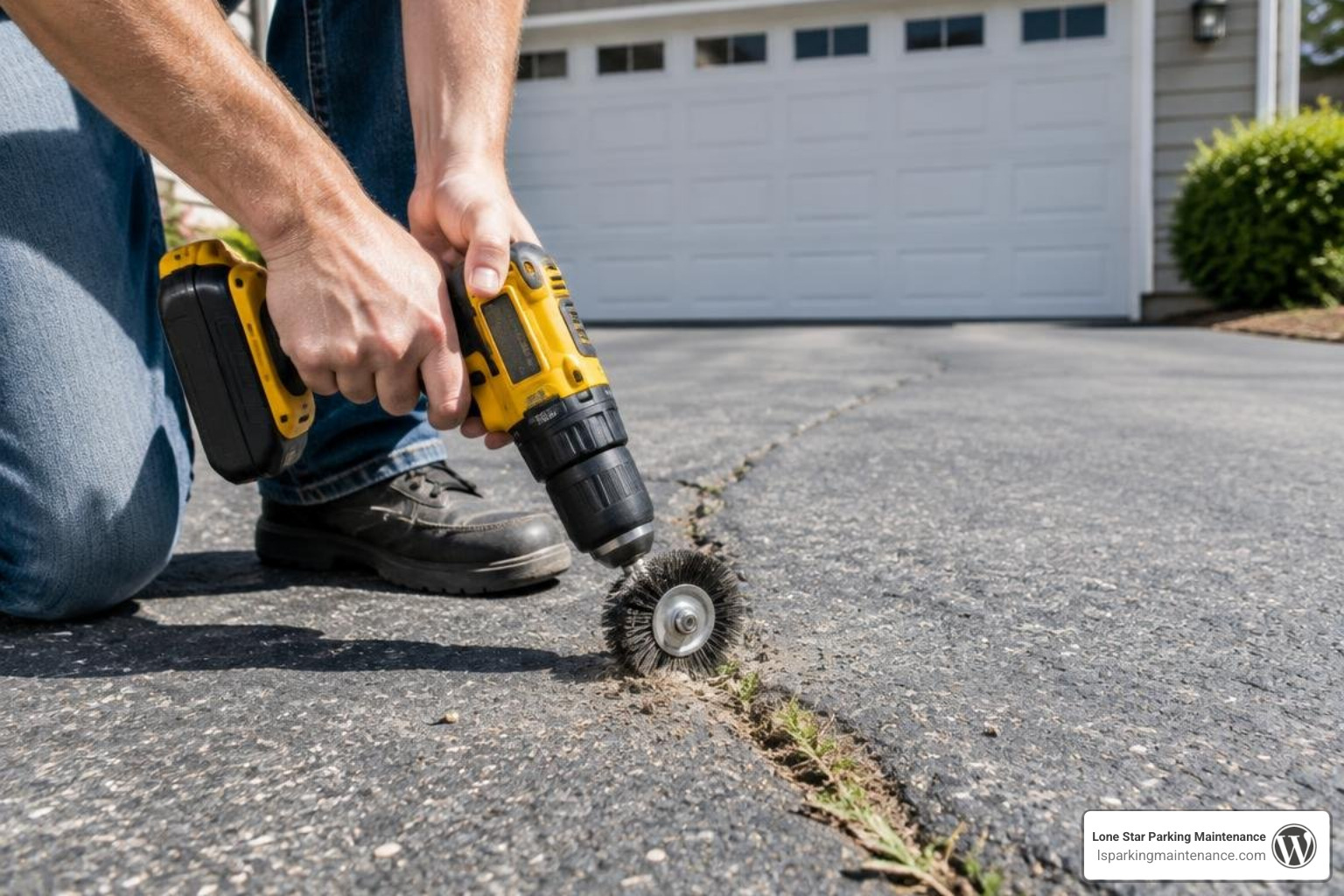
Thorough surface preparation is essential for a lasting repair. To achieve durable results, follow proven 5 easy steps for asphalt crack repair before opening any product container.
Surface Prep and Backer Rod Installation
- Vegetation Removal: Scrape out weeds, roots, and organic matter using a crack-weeding tool, rotary wire wheel, or stiff wire broom.
- Debris Routing and Clearing: Open narrow fissures to a minimum 1/2-inch width if using hot-pour materials. Blow out all dust, fractured aggregates, and loose laitance using clean, oil-free compressed air.
- Moisture Extraction: Pavement fissures must be bone dry. Use a hot-air lance or propane torch to evaporate trapped moisture and preheat crack sidewalls.
- Depth Regulation: If cracks exceed 1/2-inch depth, compress a closed-cell backer rod tightly into the void, seating it 1/4 to 1/2 inch below the asphalt surface.
Safe Application Using Torches, Melters, and Squeegees
- Applying Hot-Pour Compounds: Heat material in an oil-jacketed melter to 350°F–380°F (never exceed 400°F). Pour the liquefied rubber into the crack using a pour pot. Overfill slightly, then draw a U-shaped rubber squeegee across the seam to leave a neat 3 to 4-inch overband wipe flush with the surface.
- Applying Meltable Rope: Firmly seat the rope into the joint using a screwdriver or rubber mallet. Hold a propane torch flame at a 45-degree angle, maintaining a 3 to 4-inch distance. Sweep the blue flame back and forth in 1-foot segments for 1 to 2 minutes until the wrapper melts away and the compound liquefies completely into the void.
- Safety Protocols: Always wear protective eyewear, heat-resistant safety gloves, long sleeves, heavy pants, and closed-toe leather work boots when working with open flames or molten rubber.
Coverage Calculations, Cure Times, and Common Mistakes to Avoid
Proper planning prevents material shortages and ensures your repair cures without disruption. Reviewing our guide to filling driveway cracks will help you calculate accurate material estimates.
Estimating Material Quantities by Joint Dimensions
| Joint Dimensions (Width x Depth) | CrackMaster 5078 Yield | CR-90 Yield | Sikaflex-410 Cartridge Yield |
|---|---|---|---|
| 3/8″ x 3/8″ | ~6.2 lbs per 100 ft | ~7.2 lbs per 100 ft | ~14.4 linear ft per 9 oz |
| 3/8″ x 1/2″ | ~8.3 lbs per 100 ft | ~9.6 lbs per 100 ft | ~10.8 linear ft per 9 oz |
| 1/2″ x 1/2″ | ~11.0 lbs per 100 ft | ~12.73 lbs per 100 ft | ~8.1 linear ft per 9 oz |
| 1/2″ x 1″ (unbacked) | ~22.1 lbs per 100 ft | ~25.5 lbs per 100 ft | ~4.0 linear ft per 9 oz |
| 3/4″ x 1/2″ | ~16.5 lbs per 100 ft | ~19.1 lbs per 100 ft | ~5.4 linear ft per 9 oz |
| 3/4″ x 3/4″ | ~24.8 lbs per 100 ft | ~28.6 lbs per 100 ft | ~3.6 linear ft per 9 oz |
Rule of thumb: Add a 10% to 15% safety buffer for overbanding waste, uneven sidewalls, and fissure depth irregularities.
Understanding Drying Times vs. Full Cure Windows
Drying and curing happen in distinct phases depending on the chemistry used:
- Hot-Pour Compounds: Cool and solidify rapidly via thermal dissipation. Products like CR-90 allow traffic in under 30 minutes, while heavier pours like Flex-A-Fill set fully within 2 hours.
- Aerosol Sprays: Dry to the touch in 30 minutes, reaching full cure in 12 hours.
- Cold Hybrid Cartridges: Skin over in under 60 minutes (at 73°F and 50% relative humidity), but require 24 hours for foot traffic and a full 7-day cure before water submersion or topcoating.
Critical Application Mistakes to Avoid
- Applying Over Moisture: Trapped water turns into steam beneath hot rubber, creating air pockets and destroying adhesion.
- Kettle Overheating: Exceeding 400°F or maintaining high temperatures for over 12 to 15 hours degrades polymers, causing irreversible gelation.
- Skipping Backer Rods: Pouring sealant into deep chasms wastes material and creates excessive tensile stress that causes premature tearing.
- Excessive Overbanding: Leaving wide, thick bands on the surface creates unsightly bumps and exposes edges to snowplow and tire damage.
Frequently Asked Questions About Driveway Crack Sealing
Can I use asphalt crack sealer on concrete driveways and aprons?
Yes. Quality hot-pour rubberized sealants and hybrid elastomeric sealants adhere well to both asphalt and Portland cement concrete. They are well-suited for expansion joints and transition seams between asphalt driveways and concrete garage aprons. The repair will dry to a black finish, creating a visual contrast against grey concrete.
What is the minimum temperature required to seal asphalt cracks?
Most hot-pour sealers require dry air and substrate temperatures of at least 40°F and rising. Cold-applied hybrid cartridges require ambient temperatures between 50°F and 100°F to ensure smooth dispensing and proper moisture curing. Avoid sealing if rain or freezing temperatures are forecast within 24 hours.
How long should I wait after crack sealing before applying a driveway sealcoat?
Hot-pour rubberized sealants can be sealcoated after 24 to 48 hours of cooling and setting. Cold-applied elastomeric sealants require a full 7-day cure to allow complete polymer cross-linking and solvent outgassing before you apply a water- or oil-based driveway sealcoat.
Conclusion
Sealing pavement cracks early prevents water infiltration, halts base erosion, and extends the lifespan of your asphalt driveway. Selecting the right product and following proper surface preparation ensures repairs stay durable and flexible through every season.
For commercial properties, expansive parking lots, or complex pavement repairs across the DFW Metroplex, our team at Lone Star Parking Maintenance delivers expert solutions using top-quality materials and industry standards. Explore our parking lot sealing and crack filling services to protect your pavement investment.