
Choosing Wheel Stops for DFW Stadium Parking
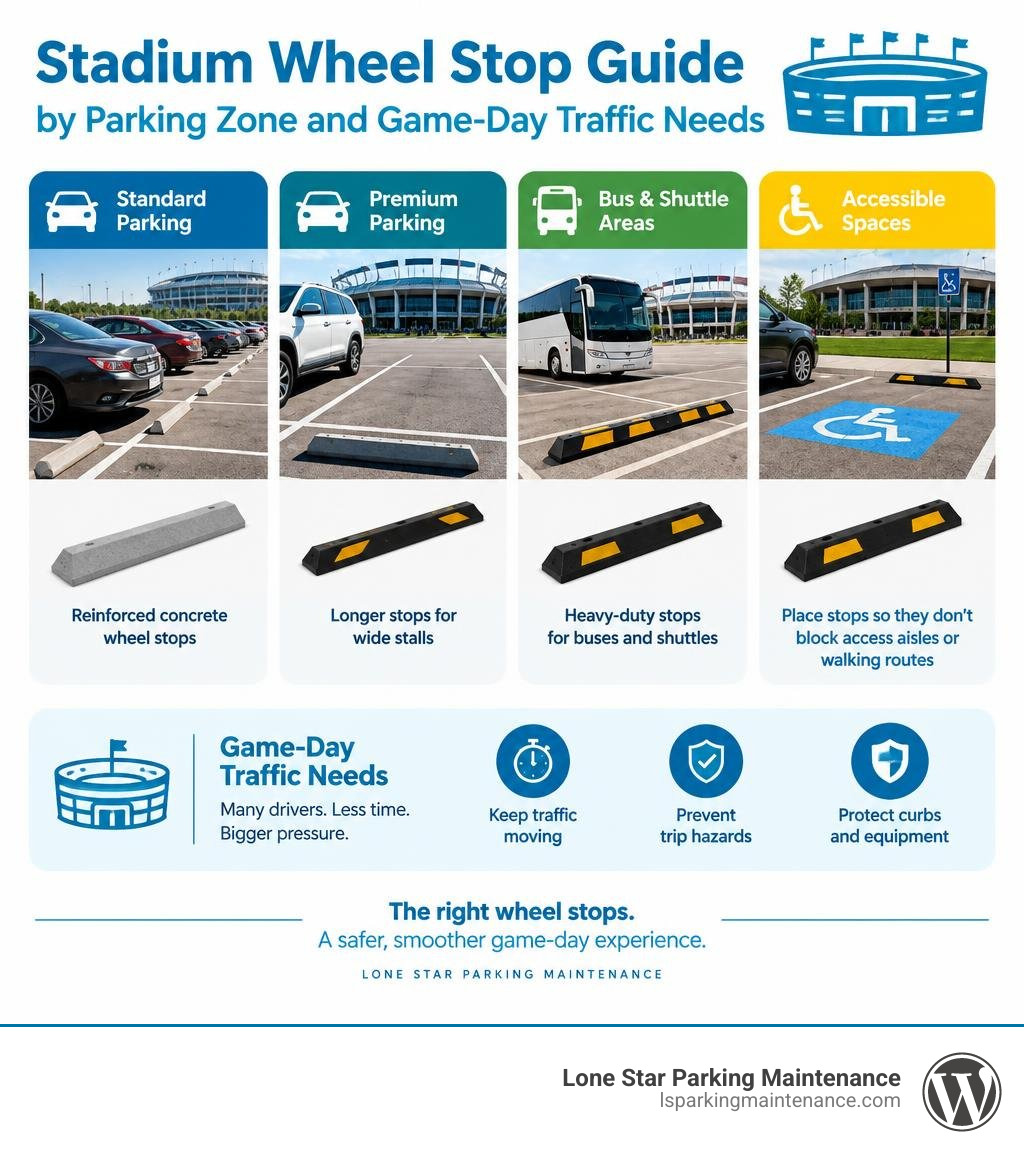
For DFW stadiums and arenas, choose wheel stops by parking zone: reinforced concrete for busy standard stalls, longer stops for wide premium stalls, and heavy-duty stops for bus and shuttle areas. In accessible spaces, place stops so they do not block access aisles or walking routes. Check the lot surface and anchoring plan before ordering.
Game-day traffic puts many drivers into the lot at once. Stops that crack or shift can slow parking, create trip hazards, and leave curbs or nearby equipment exposed. The right mix of size, placement, and visibility helps the lot work better when crowds arrive and leave.
I’m Cason, and I’ll walk through the practical criteria for selecting reliable wheel stops for stadiums in DFW to ensure your venue stands up to heavy event traffic.
Explore our practical guides on parking lot bumper stops, selecting commercial parking wheel stops, and executing safe parking wheel stops installation.
Why Commercial Parking Demands Heavy-Duty Wheel Stops for Stadiums DFW
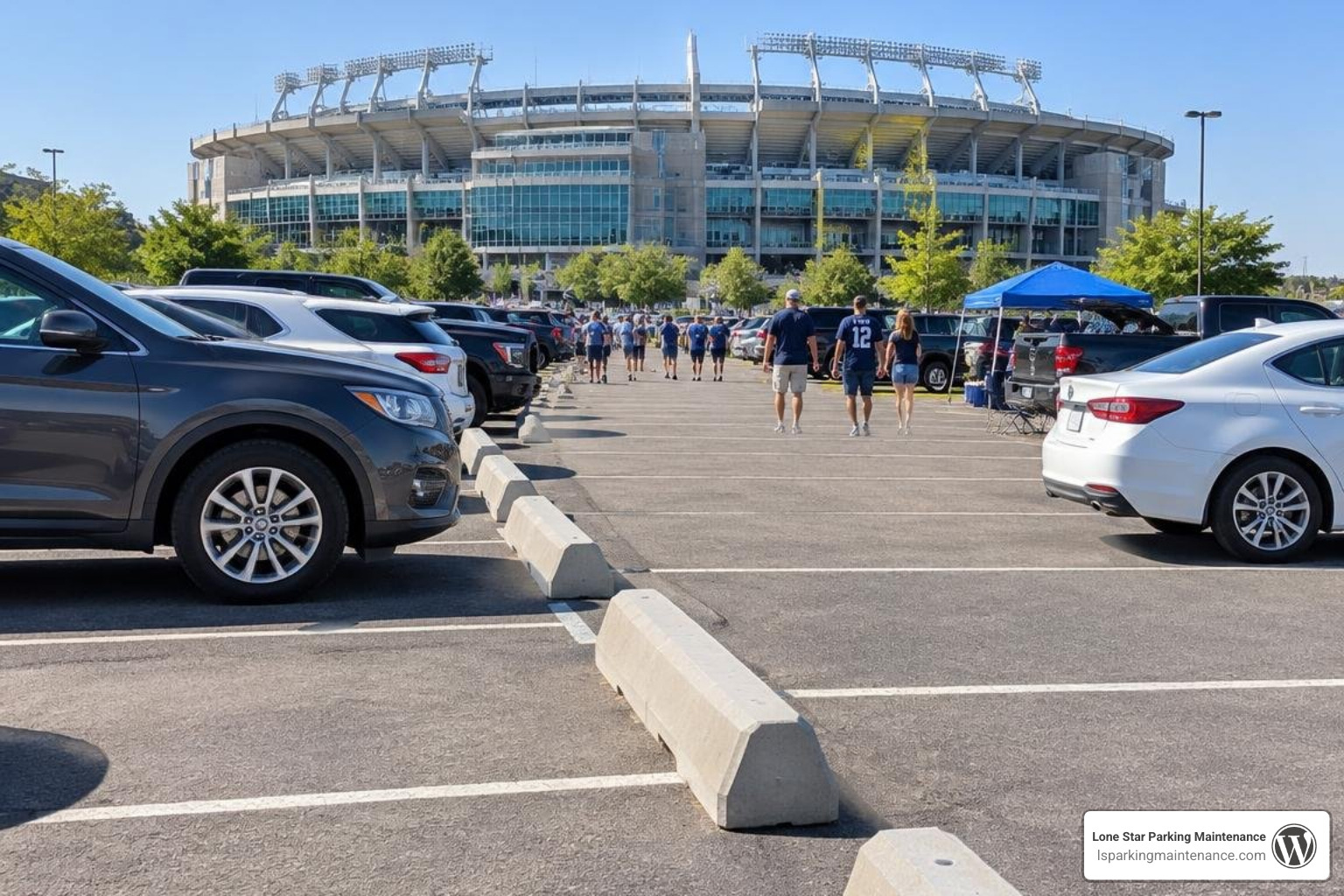
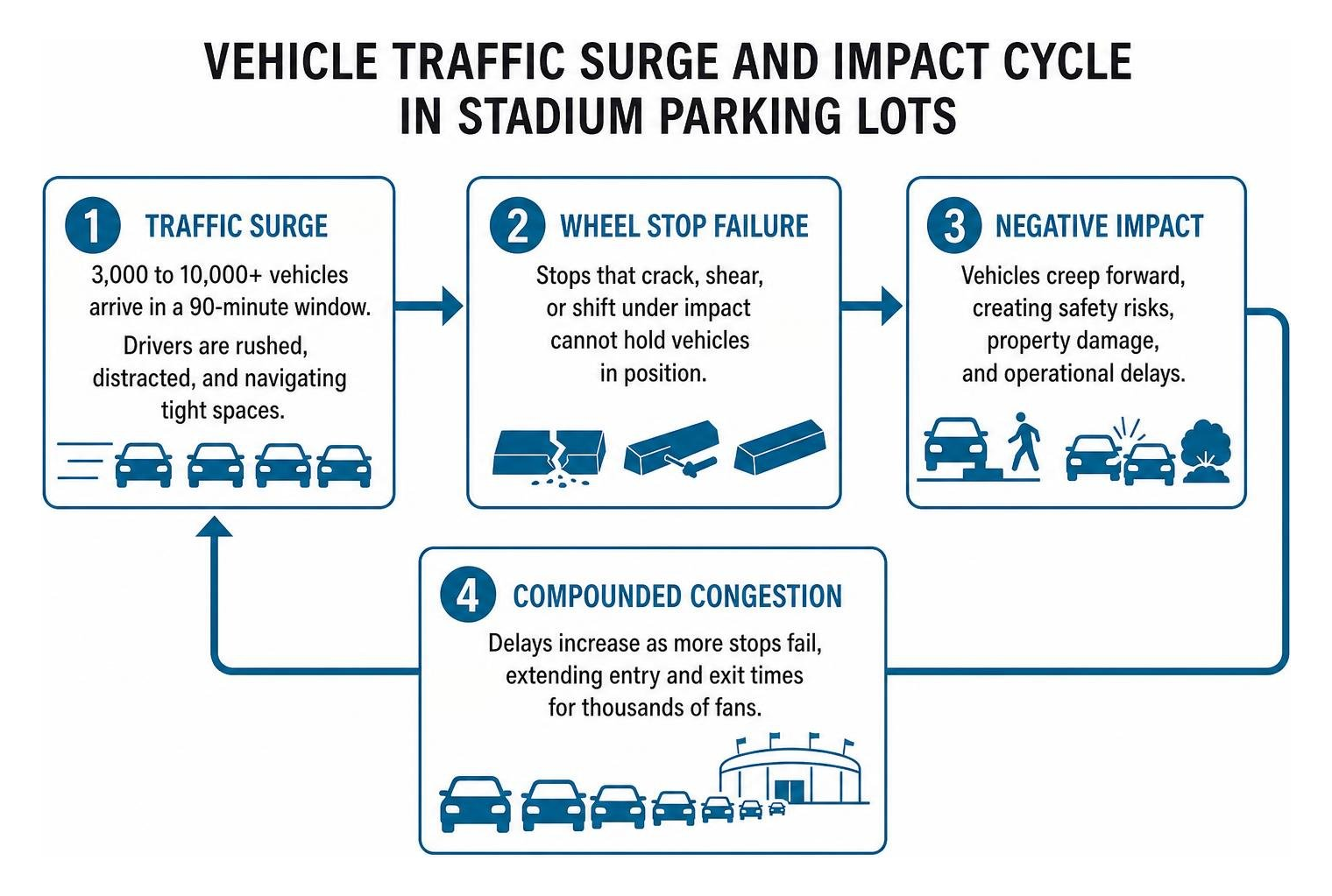
Managing an entertainment venue or sports arena in North Texas is unlike managing any standard retail plaza or office complex. When 80,000 fans descend on Arlington or Dallas for a rivalry matchup, the parking facility experiences what we call an acute traffic surge. Instead of steady, distributed arrivals across an eight-hour business day, stadium parking decks and surface lots must absorb 3,000 to 10,000+ vehicles within a tight 90-minute window.
During these high-pressure arrivals, drivers are often rushed, distracted, and navigating tight spaces. Standard commercial-grade wheel stops—typically lightweight unreinforced concrete or hollow plastic—quickly fail under this level of stress. When a driver overshoots a stall at speed, standard barriers can shear clean off their pins, fracture down the middle, or shift out of alignment.
Why did the wheel stop go to school? To become a “parking” pro! But jokes aside, failing barriers in a stadium lot are no laughing matter. When stops dislodge during a surge, vehicles creep forward into pedestrian walkways, damage delicate landscaping, or strike adjacent cars. In fact, facility data shows that deploying high-visibility, reinforced concrete wheel stops in combination with a proven guide to safe wheel stop placement can cut vehicle-to-vehicle collisions in high-traffic lots by up to 30%.
Furthermore, DFW weather adds its own severe demands. Our North Texas climate swings from blistering 105°F summer heat waves to sharp winter freeze-thaw cycles. Low-density concrete absorbs moisture, which expands during winter freezes, resulting in spalling and cracking. High-density, steel-reinforced units resist water penetration and withstand direct physical impacts, ensuring parking structures remain safe and functional across 150+ major events per year.
Top Wheel Stop Types and Configurations for Event Venues
Selecting the appropriate hardware for large-scale venues requires evaluating compressive strength, impact resistance, vehicle dimensions, and total lifecycle costs.
While standard commercial lots might cut upfront costs with lightweight alternatives, high-capacity venues require precast concrete wheel stoppers cast from high-strength mixes to prevent ongoing maintenance headaches.
| Feature / Metric | Standard Hollow Rubber / Plastic | Standard Commercial Concrete | 4,500 PSI Steel-Reinforced Concrete | Heavy-Duty Transit Concrete (Bus/Shuttle) |
|---|---|---|---|---|
| Compressive Strength | N/A (Flexible polymer) | 2,500 – 3,000 PSI | 4,500 PSI (Cylinder-Tested) | 4,500+ PSI (Dual Rebar Cage) |
| Internal Reinforcement | None | Fiber mesh or none | Continuous steel rebar | Heavy-gauge welded steel rebar |
| Standard Weight | 15 – 35 lbs | 100 – 120 lbs | 165 – 210 lbs | 250 – 350+ lbs |
| Typical Lifespan | 2 – 4 Years (Deforms/tears) | 3 – 5 Years (Cracks under surges) | 15 – 20 Years | 15 – 20 Years |
| Surge Suitability | Low (Shifts under impact) | Moderate (Prone to chipping) | Exceptional (Zero shift) | Maximum (Resists heavy axle loads) |
| Recommended Zone | Temporary / Overflow | Light commercial retail | Standard, VIP & ADA Stalls | Bus loops & Rideshare staging |
While rubber options offer flexibility in low-speed garages, heavy steel-reinforced concrete remains the gold standard for outdoor stadium fields and massive parking decks. A 4,500 PSI cylinder-tested concrete stop provides the physical mass (165+ lbs) and tensile strength needed to stop an SUV or truck without dislodging its anchor pins.
Over a 10-year facility maintenance cycle, investing in commercial-grade concrete stops eliminates recurring labor costs associated with re-anchoring dislodged rubber blocks or replacing fractured commercial units every three years.
Choosing the Right Wheel Stops for Stadiums DFW by Parking Zone
Large sports venues require zoned parking architectures to maximize density while accommodating diverse vehicle classes. Using our buying checklist for parking stops, venue managers can match specific stop profiles to distinct stall configurations:
Compact Vehicle Stalls (4-Foot Units / ~105 lbs):
Designed for designated compact zones near arena perimeter walls. A 48-inch length provides adequate wheel contact while leaving generous clearance on either side, preventing trip hazards for pedestrians slipping between closely parked cars.Standard Parking Bays (6-Foot Units / ~165 lbs):
The industry benchmark for general admission parking stalls. Measuring 72 inches long, 5.25 inches high, and 7.5 inches wide, these stops provide ample coverage for pickup trucks, sedans, and SUVs commonly driven across North Texas.VIP & Premium Suites Parking (8-Foot Units / ~210 lbs):
Wider VIP stalls accommodate high-end luxury vehicles, oversized pickups, and full-size SUVs. An 8-foot (96-inch) bumper provides an expansive contact surface, ensuring vehicles centered slightly off-axis still strike the stop evenly without bypassing the barrier.
Heavy-Duty Staging: Transit and Shuttle Zones
Managing game-day logistics goes beyond passenger cars. Shuttles, charter buses, and rideshare vehicles experience constant turnaround in dedicated staging lots. Standard passenger vehicle stops cannot withstand the axle weights or high bumper profiles of heavy transit equipment.
For high-volume shuttle drops and bus holding lanes, facilities require heavy-duty commercial blocks reinforced with heavy-gauge steel rebar. These units feature higher profiles (up to 7 or 8 inches) and reinforced pinning systems capable of resisting repeated dynamic impacts from multi-ton vehicles.
Using guidance from our parking lot bumper stops guide, installing heavy-duty units along transit corridors protects pedestrian boarding areas, prevents heavy buses from encroaching onto passenger waiting curbs, and safeguards perimeter infrastructure from accidental backing collisions.
Compliance, Safety, and Structural Integration for Arena Facilities
Installing parking hardware in an arena setting requires close attention to municipal safety codes, ADA compliance, and structural engineering integrity. When parking hardware is placed incorrectly, it quickly turns into an accessibility barrier or creates structural vulnerabilities on elevated parking decks.
In elevated parking structures, wheel stop installation must be coordinated with deck waterproofing. When surface water penetrates anchor holes, freeze-thaw expansion can compromise the concrete slab. Combining proper expansion anchors with advanced multi-layer deck coatings—utilizing primer, elastomeric intermediate coats, and durable topcoats—seals anchor penetrations against moisture intrusion and extends the operational life of the structure.
Integrating durable wheel stops with high-visibility pavement markings and proper parking spot signage ensures clear traffic flow, protects lighting bollards, and prevents costly structural repairs.
Installing ADA-Compliant Wheel Stops for Stadiums DFW
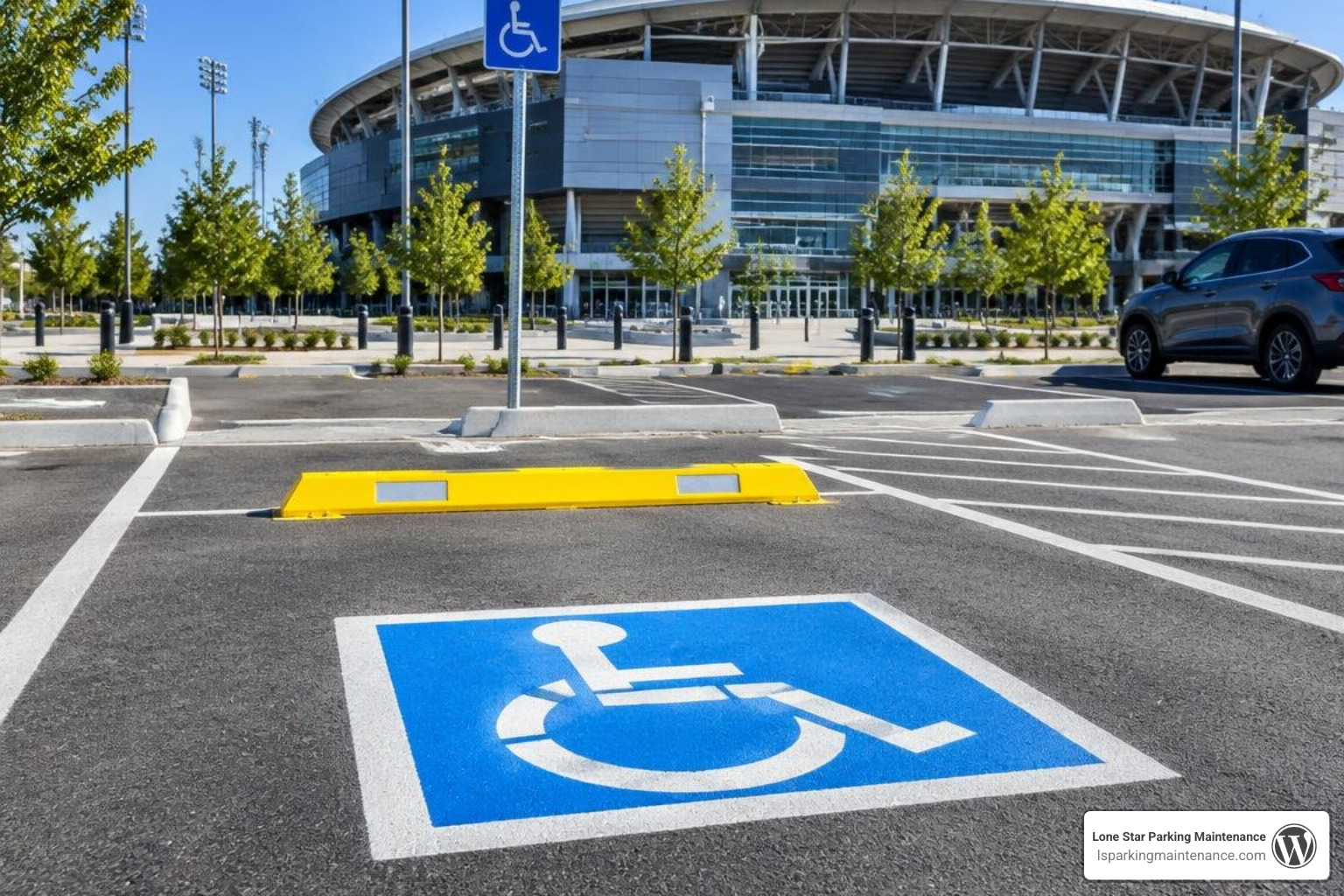
Accessibility is a major priority for sports and entertainment venues. Under the Americans with Disabilities Act (ADA) and local Texas accessibility standards, wheel stops in accessible parking spaces must never obstruct the continuous accessible route connecting vehicles to stadium entrance gates.
Key safety protocols for ADA stall wheel stops include:
- Pedestrian Clearance: Wheel stops must be positioned so vehicle overhang does not reduce the clear width of accessible walkways below 36 inches (or 48 inches along primary stadium entry concourses).
- Aisle Isolation: Wheel stops must never be installed within the painted access aisles adjacent to accessible stalls, where they would present a severe tripping hazard for individuals with mobility aids.
- Nighttime Visibility: For evening kickoffs and concerts, ADA wheel stops should feature high-visibility reflective striping or safety yellow coatings to ensure they are clearly seen in low-light conditions.
For a deeper look at proper layout measurements, see our wheel stop installation manual.
Anchoring and Parking Deck Preservation
Proper installation requires tailored anchoring methods based on the underlying surface:
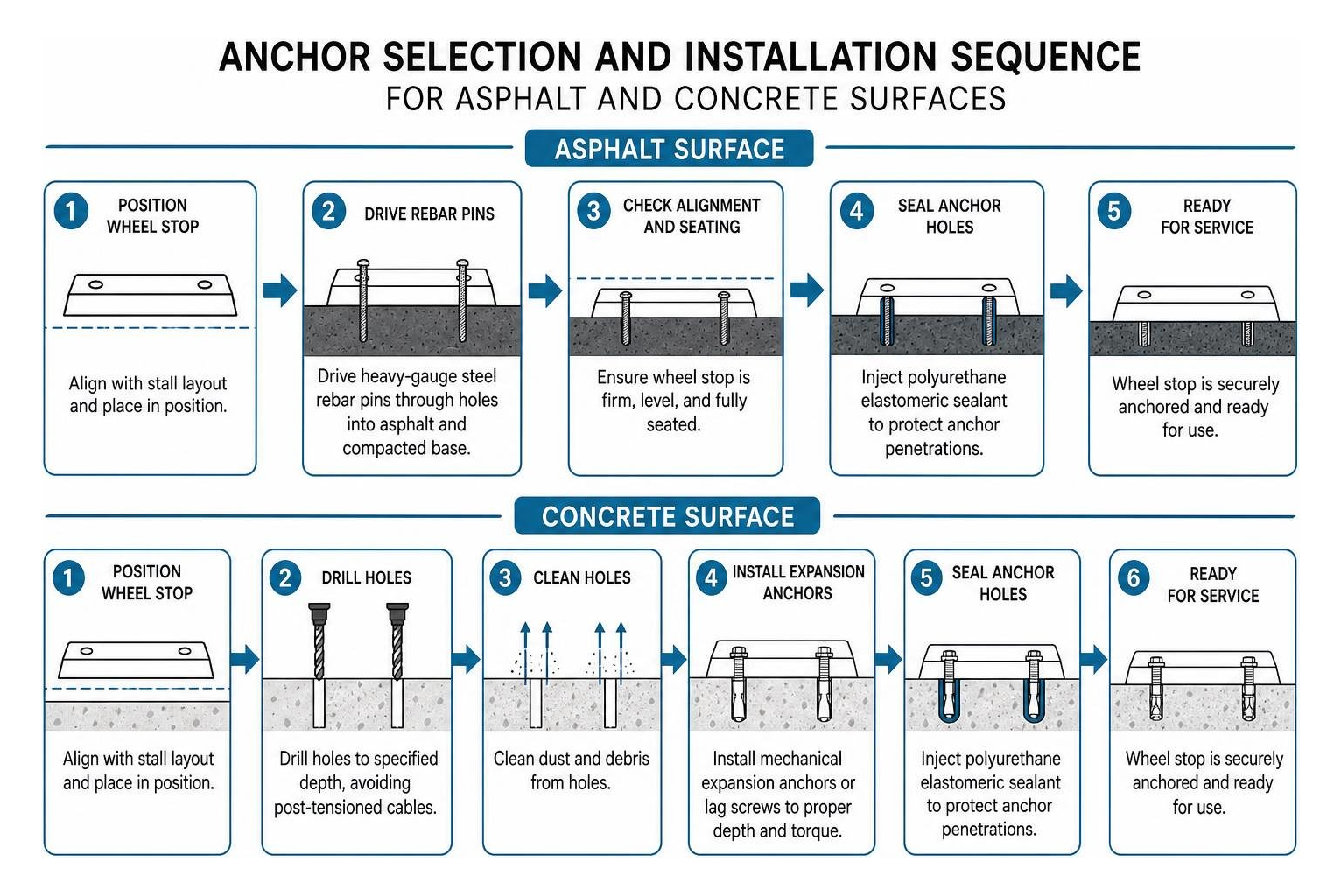
- Asphalt Surfaces: We drive heavy-gauge steel rebar pins (typically 1/2-inch to 5/8-inch diameter and 12 to 18 inches long) through the precast stop holes directly into the asphalt and compacted base subgrade. This provides lateral holding strength against heavy tire pushes.
- Concrete Decks and Post-Tensioned Slabs: Drilling into elevated parking garage slabs requires precision. Installers must use mechanical expansion anchors or heavy-duty concrete lag screws set to specific depths, carefully avoiding post-tensioned structural cables.
- Moisture Sealing: High-grade polyurethane elastomeric sealants should be injected into anchor holes prior to setting hardware, creating an impermeable barrier against rain and chemical runoff.
Following structured 5-step installation methods guarantees the hardware remains firmly anchored through years of heavy event operations.
Frequently Asked Questions About Stadium Wheel Stops in DFW
What concrete strength is recommended to handle stadium traffic surges?
Stadium environments require a minimum compressive strength of 4,500 PSI cylinder-tested precast concrete. Standard 2,500 or 3,000 PSI residential mixes quickly crack and crumble under repeated vehicle impact.
Internal reinforcement with continuous steel rebar cages gives the unit the necessary tensile strength to absorb repeated shock loads from heavy pickup trucks and SUVs without splitting. For complete material requirements, review our vehicle wheel stopper fundamentals.
How do heavy-duty wheel stops reduce long-term maintenance costs?
While cheap, unreinforced stops may carry a lower initial purchase price, they frequently fail within 24 to 36 months when subjected to the intense surge dynamics of major game days. Failed stops result in broken concrete debris, misaligned stalls, damaged curbs, and potential vehicle liability claims.
Investing in 4,500 PSI steel-reinforced units provides a 15- to 20-year operational lifespan, virtually eliminating recurring equipment replacement costs, reducing routine maintenance hours, and protecting expensive perimeter structures from vehicle impacts.
What is the typical lead time for large-scale stadium parking upgrades in North Texas?
For large-scale stadium upgrades involving several hundred to thousands of parking stalls, production and staged delivery typically range from 2 to 4 weeks depending on batch customization and reflective striping requirements.
Professional installation across a multi-thousand-vehicle facility is generally executed in phased off-season sections or low-traffic mid-week windows, allowing venues to maintain normal operations without disrupting scheduled events.
Conclusion
Game-day parking is the first and last impression fans have of your sports venue. When thousands of vehicles arrive and depart simultaneously, durable parking lot infrastructure keeps traffic moving smoothly, protects pedestrians, and safeguards stadium assets from expensive damage.
By investing in high-strength 4,500 PSI steel-reinforced concrete stops matched to your specific parking zones—from compact bays to heavy-duty shuttle loops—venue managers ensure their parking operations run seamlessly from opening kickoff to post-concert egress.
At Lone Star Parking Maintenance, we specialize in high-capacity parking solutions throughout the DFW Metroplex, delivering commercial striping, surface repairs, and professional protective curb stop and pole cover installation. Reach out to our team today to evaluate your venue’s parking infrastructure and prepare your lots for game-day crowds.