
Why Parking Structure Maintenance Protects Your Garage
Parking structure maintenance starts with keeping water, salt, and debris off the deck and out of joints. For a commercial garage, that means scheduling annual visual walk-throughs, clearing drains before wet or freezing weather, washing away deicing residue, and repairing cracked sealants, damaged coatings, and concrete defects quickly.
Open-air garages face constant traffic, weather, and moisture. When water carries chlorides through failed joints or worn deck protection, reinforcing steel can corrode. That corrosion can lead to cracks, delamination, and falling concrete. Small maintenance issues can become safety risks, costly repairs, and avoidable disruptions to parking operations.
A consistent plan also supports safer walking routes, clear striping, working lights, reliable drainage, and a better experience for tenants and visitors. The goal is simple: find water-entry points and early concrete damage before they threaten the structure.
I’m Cason, and this guide breaks down the practical steps property managers can use to protect a parking garage year-round.
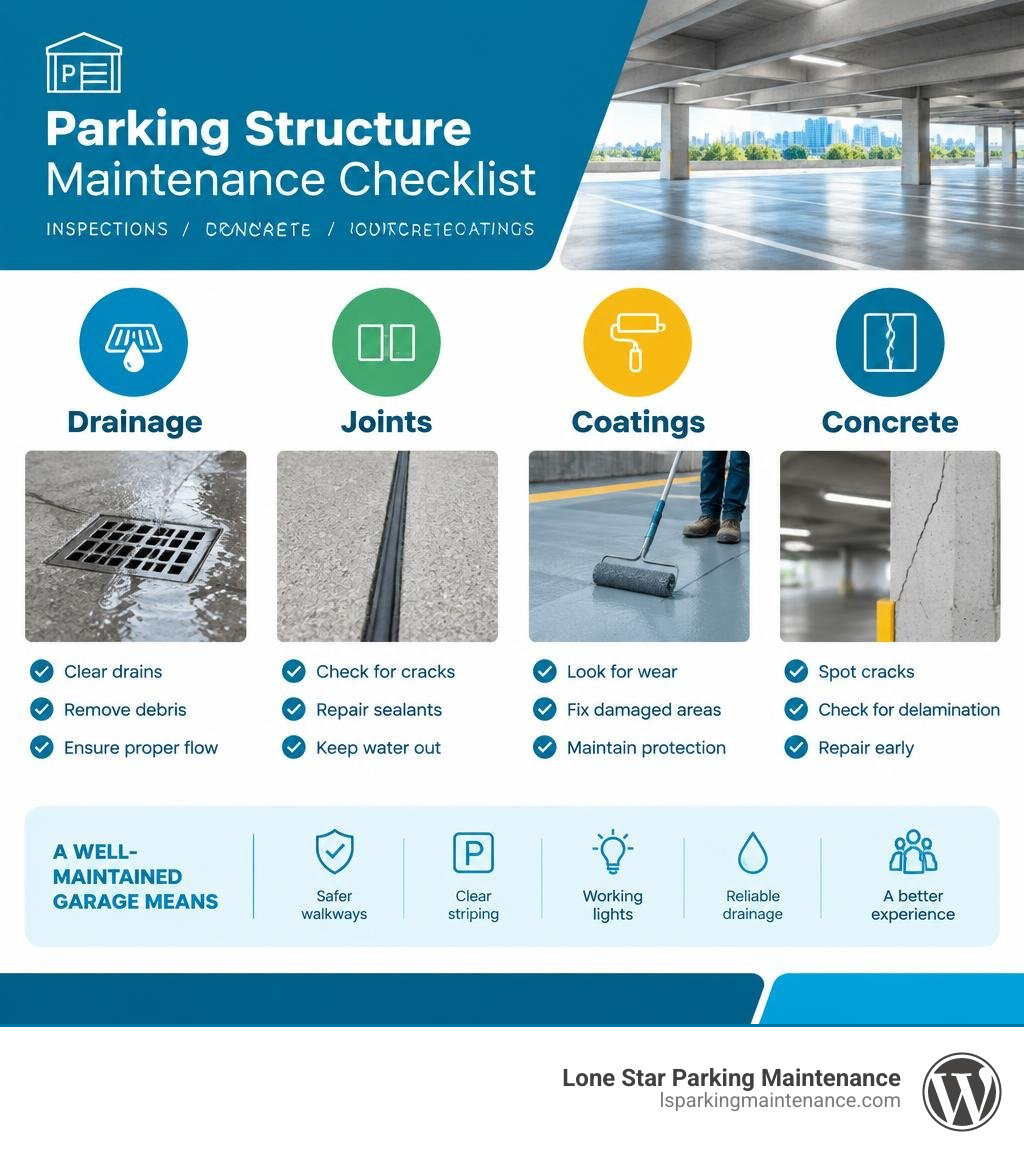
Quick look at parking structure maintenance:
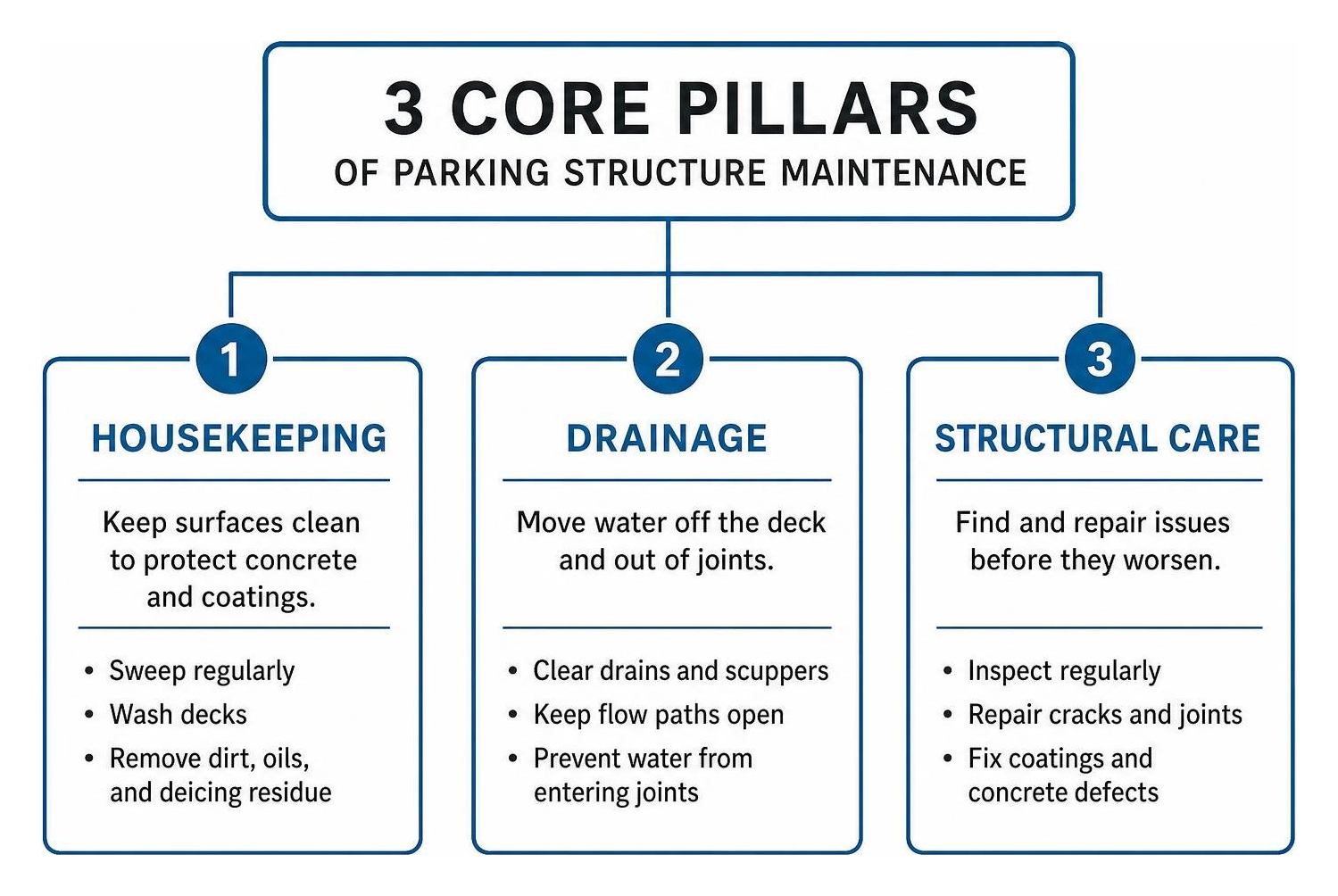
Core Pillars of Parking Structure Maintenance
Multi-level parking garages take a beating unlike almost any other commercial asset. Unlike enclosed office buildings, parking decks are open-air environments subjected to direct solar radiation, thermal cycling, dynamic vehicle loads, and automotive fluids. In fact, parking structures deteriorate two to three times faster than standard enclosed buildings.
A proactive approach to facility preservation drastically reduces overall life-cycle costs. Research demonstrates that establishing an intentional preventive maintenance program yields roughly a 545% return on investment compared to deferred, reactive repairs. Following recognized industry standards, such as the Maintenance Manual for Precast Concrete Parking Structures, allows property managers to safeguard physical assets while preventing sudden, budget-breaking structural interventions.
Housekeeping and Deck Washdowns
Routine housekeeping is the frontline defense against accelerated concrete degradation. Windborne dirt, automotive grease, grit, and abrasive sands accumulate continuously on driving surfaces. When trapped under turning tires, these loose particles act like liquid sandpaper, grinding down protective traffic coatings and unsealed concrete surfaces.
Conducting routine garage floor maintenance should include regular sweeping and scheduled washdowns. Removing chemical contaminants through commercial high pressure cleaning neutralizes embedded oils, vehicle grime, and deicing residues brought in by commuter traffic. Washing down decks at least once or twice a year clears micro-contaminants before they seep deeper into the concrete matrix.
Drainage Management and Snow Removal Protocols
Water is the primary catalyst behind nearly all structural concrete deterioration. Standing or ponding water creates localized chemical saturation points that break down top-layer finishes and accelerate chloride penetration. Regular maintenance requires inspecting deck drains, scuppers, and internal plumbing lines to eliminate blockages before rain events occur.
Addressing commercial parking structure drainage systems prevents pooling water from saturating floor slabs. During winter freeze events, property managers must implement strict snow removal protocols:
- Blade Selection: Always equip plows with polyurethane or rubber-tipped cutting edges. Steel blades can slice through traffic coatings and tear expansion joint glands.
- Weight Restrictions: Never exceed the live-load capacity of elevated decks with heavy skid-steers or oversized snow removal machinery.
- Chemical Deicers: Avoid corrosive rock salts (sodium chloride or calcium chloride). Instead, specify non-corrosive alternatives like calcium magnesium acetate (CMA) or potassium acetate to protect concrete integrity and embedded steel.
- Age Precautions: Never apply chemical deicers to concrete that has been in place for less than one year.
Identifying and Repairing Concrete Deterioration
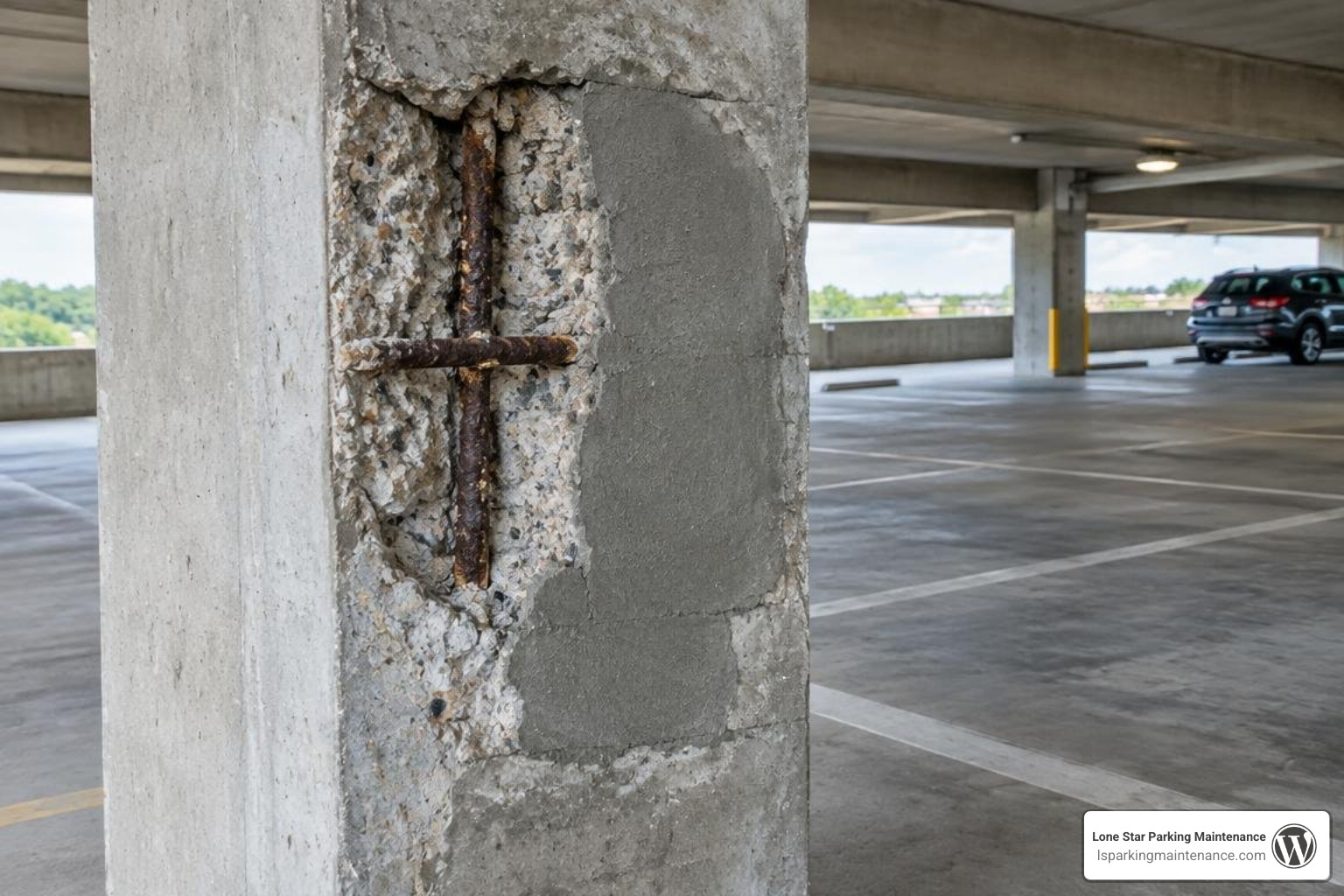
Reinforced concrete depends on the alkaline environment of cement paste to protect internal steel rebar from oxidation. However, when moisture and atmospheric carbonation penetrate the slab, or when chloride concentrations reach the critical corrosion threshold (approximately 0.2% chloride by weight of cement), that protective layer breaks down.
When internal steel bars corrode, the resulting iron oxide (rust) expands up to six times the volume of the original metal. This intense internal expansive force creates tensile stresses exceeding the concrete’s strength, leading to delamination and spalling. As detailed in the parking structure restoration field guide, arresting corrosion requires addressing the root chemical and structural mechanisms rather than applying surface-level cosmetic patches.
Diagnosing Delamination, Spalling, and Cracking
Identifying hidden defects before they manifest as falling debris is a vital part of facility safety. Maintenance teams and structural engineers use proven evaluation techniques:
- Acoustic Sounding (Chain Drag): Dragging steel chains across concrete decks reveals hidden subsurface delaminations. Intact concrete produces a clear, high-pitched ring, while delaminated concrete emits a distinctive, hollow thudding sound.
- Visual Crack Mapping: Tracking cracks helps determine whether fractures are dynamic (moving under traffic loads) or static.
- Rout-and-Seal Procedures: For non-structural, moving cracks, crews rout a clean groove along the crack line and pack it with flexible elastomeric sealants to stop water infiltration.
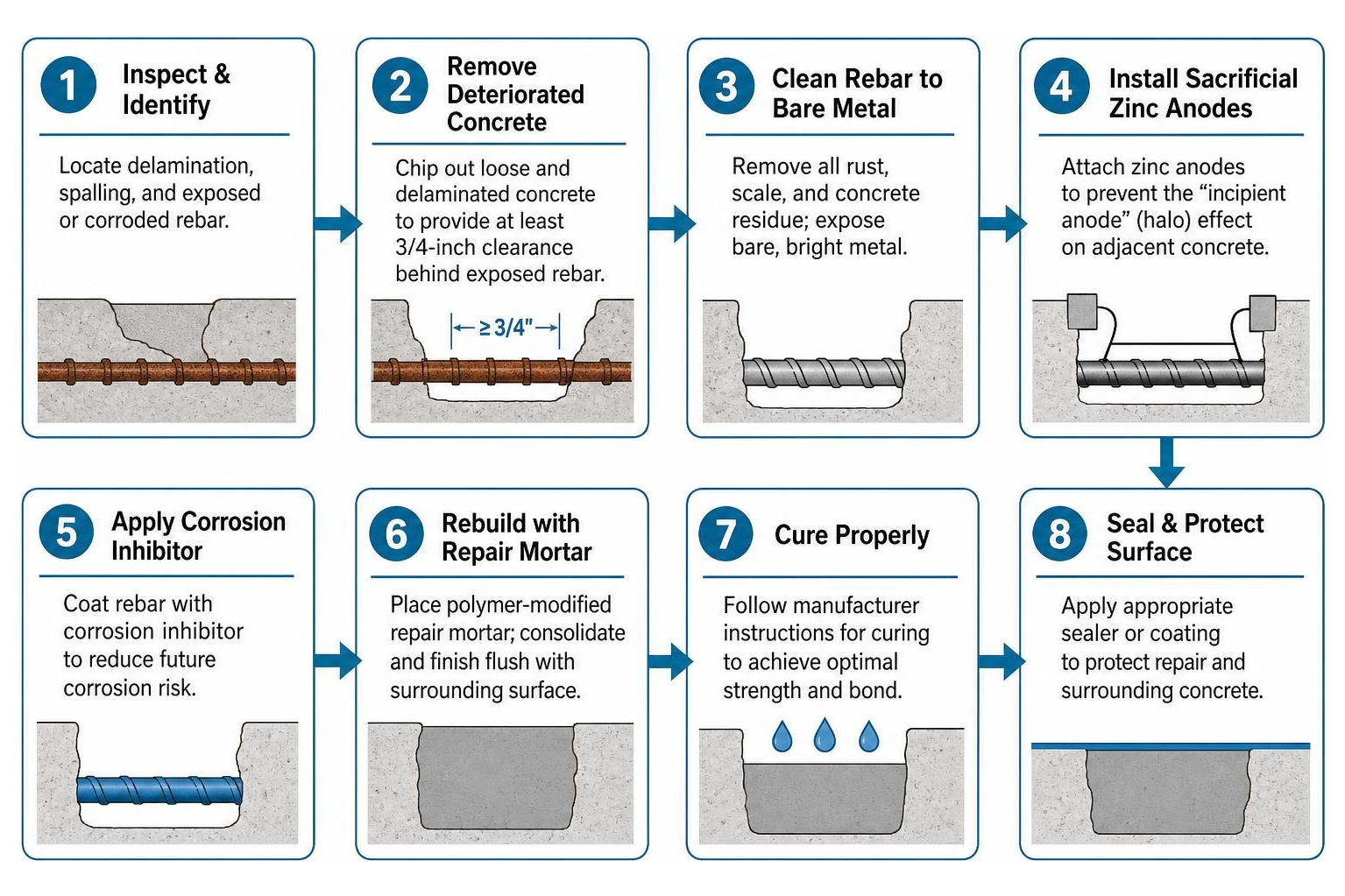
When deep delaminations compromise load capacity, proper concrete structural repair methods and floor crack repair strategies must be executed. Crews must chip out deteriorating concrete to provide at least a 3/4-inch clearance behind the exposed rebar, clean the steel to bare bright metal, and install sacrificial zinc anodes to prevent the “incipient anode” (halo) effect from damaging adjacent slab areas.
Post-Tensioned Cable and Reinforcement Protection
A significant percentage of modern multi-story garages utilize post-tensioned (PT) concrete systems, where high-strength steel tendons are tensioned within plastic or metal ducts. PT systems are exceptionally durable, but corrosion within anchorage zones or along unbonded tendons can compromise structural stability.
Property managers should watch for warning signs such as rust stains at exterior anchorage pockets, unexplained vertical deck cracks, or tendon blowouts. Advanced diagnostic tools like Ground-Penetrating Radar (GPR) and half-cell potential mapping (ASTM C876) allow engineers to assess tendon integrity without destructive probing. When repairs are necessary, hydrodemolition is often preferred over pneumatic jackhammers because it removes deteriorated concrete without vibrating or nicking critical PT tendons, reinforcing concrete structure safety.
Waterproofing Systems, Sealants, and Expansion Joints
Waterproofing systems are a garage’s primary armor against moisture ingress. Maintaining these protective barriers prevents aggressive chemicals from reaching the structural slab beneath.
| Feature | Traffic-Bearing Elastomeric Membranes | Penetrating Chemical Sealers (Silane/Siloxane) |
|---|---|---|
| Primary Mechanism | Continuous waterproof physical barrier membrane | Chemical barrier that penetrates pores and repels liquid |
| Best Application | Elevated decks over occupied space, ramps, turning zones | Ground-supported slabs, upper weather-exposed decks |
| Service Lifespan | 5–10 years (recoat wear course as needed) | 5–7 years |
| Crack Bridging | Excellent (dynamic crack-bridging capability) | None (does not bridge moving surface cracks) |
| Visual Appearance | Solid, opaque colored finish with slip-resistant grit | Natural, unpainted concrete appearance |
According to the ACI PRC-362.2-21 Guide for Structural Maintenance, waterproofing assemblies require proactive condition reviews to maintain their protective qualities throughout their design lifespan.
Joint Sealant Care and Expansion Joint Systems
Expansion joints are designed to accommodate the thermal expansion, contraction, and seismic movement of large precast or cast-in-place concrete panels. However, because they run through the entire slab thickness, they represent the single most common leak path in parking garages.
Standard polyurethane joint sealants possess a typical service lifespan of 7 to 10 years. Over time, UV exposure, chemical degradation, and joint cycling cause adhesive or cohesive failures. Facilities require regular inspections to catch torn gland seals, split elastomeric nosings, or failed backer rods. Addressing worn joints early through preventive parking structure sealcoating prevents water from cascading down onto lower structural beams, columns, and parked customer vehicles.
Traffic-Bearing Membranes and Penetrating Silane Sealers
For elevated decks, high-performance elastomeric polyurethane membranes form a seamless, watertight envelope. These multi-layer systems include a flexible primer/base coat that bridges fine hairline cracks, followed by textured wear courses infused with silica sand or aluminum oxide to provide pedestrian and vehicular slip resistance.
Penetrating sealers—typically 40% to 100% silane or siloxane formulations—penetrate the concrete’s capillary network to form a hydrophobic barrier. While invisible, these sealers reduce water absorption by over 85%. Silane treatments should be tested for water repellency every five years to identify when full reapplication is required.
Safety, Lighting, and Regulatory Compliance
A safe parking facility protects patrons from both physical hazards and security vulnerabilities. Maintaining clear driving lanes, accessible paths of travel, impact barriers, and compliant markings keeps your structure safe and legally compliant.
Essential Checklists for Parking Structure Maintenance
Routine audits ensure early detection of developing structural and operational concerns. Maintaining clear, visible layouts using durable high traffic line striping and running periodic structural condition auditing keeps facilities operating smoothly.
Illumination Standards and Safety Markings
Proper lighting is essential for garage safety, navigation, and crime prevention. Dim or flickering lighting increases liability exposure from vehicle collisions and trip-and-fall incidents. According to Illuminating Engineering Society (IES) standards, general parking bays should maintain a minimum of 1 to 2 foot-candles (10–20 lux), while ramps, entrances, and pedestrian paths require higher illumination levels.
Upgrading to modern energy-efficient LED lighting upgrades provides uniform visibility, minimizes dark shadows, and reduces utility costs. Establishing a routine schedule to clean dust off fixtures and replace declining lamps ensures light output remains at compliant levels year-round.
Planning Long-Term Facility Operations and Tracking
Managing a multi-level concrete garage successfully requires a structured, long-term operational strategy. Maintaining a dedicated Project Maintenance Manual—complete with original engineering drawings, waterproofing specifications, maintenance records, and repair warranties—helps managers track lifecycle performance and make data-driven capital expenditure decisions.
Establishing a Parking Structure Maintenance Budget and Log
Deferring garage upkeep is one of the costliest financial missteps a property manager can make. Emergency structural repairs often cost four to five times more than routine preventive care.
To maintain structural health, industry benchmarks recommend allocating approximately $400 to $600 per parking space annually for total facility maintenance. For structural upkeep alone, budgeting 2% to 3% of the structure’s original replacement cost each year ensures adequate capital for timely joint renewals, deck recoating, and localized concrete repairs. Maintaining detailed digital logs of every repair helps owners justify capital expenditures and demonstrate regulatory compliance.
Frequently Asked Questions About Parking Deck Upkeep
How often should structural inspections be performed on a parking garage?
A visual walk-through inspection should be performed by onsite facility staff at least once a year to catch surface cracks, drain clogs, and sealant failures. Additionally, a comprehensive structural condition appraisal—led by a licensed professional engineer using non-destructive testing (such as chain dragging and half-cell potential testing)—should be conducted every 3 to 5 years.
What is the most effective way to prevent concrete corrosion in parking garages?
The most reliable method is keeping water out by maintaining intact traffic-bearing membranes and flexible joint sealants. Combining these surface barriers with regular power-washing to clear away deicing chemicals, reapplying penetrating silane sealers, and installing sacrificial zinc anodes during spall repairs helps halt internal rebar oxidation.
Why are snow removal practices critical for parking structure preservation?
Improper snow removal can cause severe structural and surface damage. Steel plow blades can slice through waterproof deck coatings and tear expansion joints. Additionally, piling dense snow piles can easily exceed the live-load limits of upper decks. Always specify rubber-tipped plows and use non-corrosive deicers like calcium magnesium acetate.
Conclusion
A parking structure is a major capital asset that demands intentional, consistent care. Neglecting small leaks, hairline cracks, or worn joint seals can turn manageable upkeep into complex, expensive structural repairs. By implementing routine housekeeping, maintaining waterproofing systems, clearing drainage paths, and scheduling regular professional audits, you protect both the safety of your patrons and the long-term value of your property.
At Lone Star Parking Maintenance, we help commercial property owners across the DFW Metroplex protect their parking investments. From surface repairs and power washing to high-durability coatings and professional parking lot and garage striping services, our team delivers dependable maintenance solutions that keep your garage safe, compliant, and operating at its best. Contact us today to plan your facility’s maintenance program.