
Choose Parking Chocks and Wheel Stops for the Right Job
Choose a fixed wheel stop to show drivers where to park and help keep tires away from garage walls. Choose portable wheel chocks to help keep a parked vehicle or trailer from rolling during loading, service, or storage. If you need both vehicle positioning and rollaway protection, use both. A wheel stop is not a substitute for chocks or a parking brake.
For DFW property managers, the right choice starts with the vehicle, the parking surface, and the clearance between the tire and anything behind the stall. Selecting the correct combination of parking chocks and wheel stops is the first step toward preventing property damage and rollaway incidents.
I’m Cason, and I’ll walk you through how to choose and use each one safely.
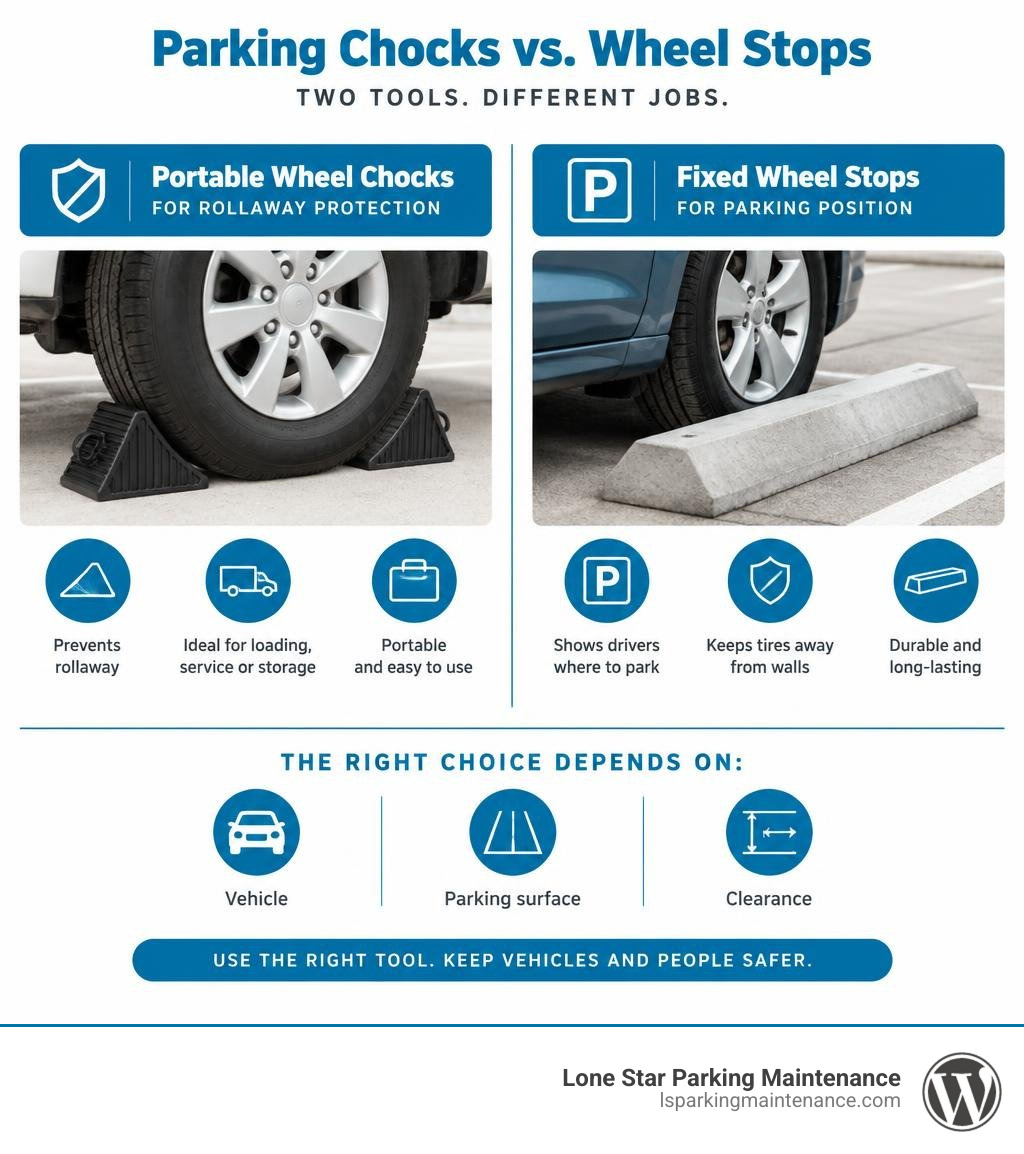
Basic parking chocks wheel stops terms:
Key Differences Between Parking Chocks, Wheel Stops, and Speed Bumps
To protect your facility, vehicles, and pedestrians, you must understand the mechanical boundaries of traffic control devices. While people often mix up these terms, portable chocks, permanent wheel stops, and speed bumps serve completely distinct functions.
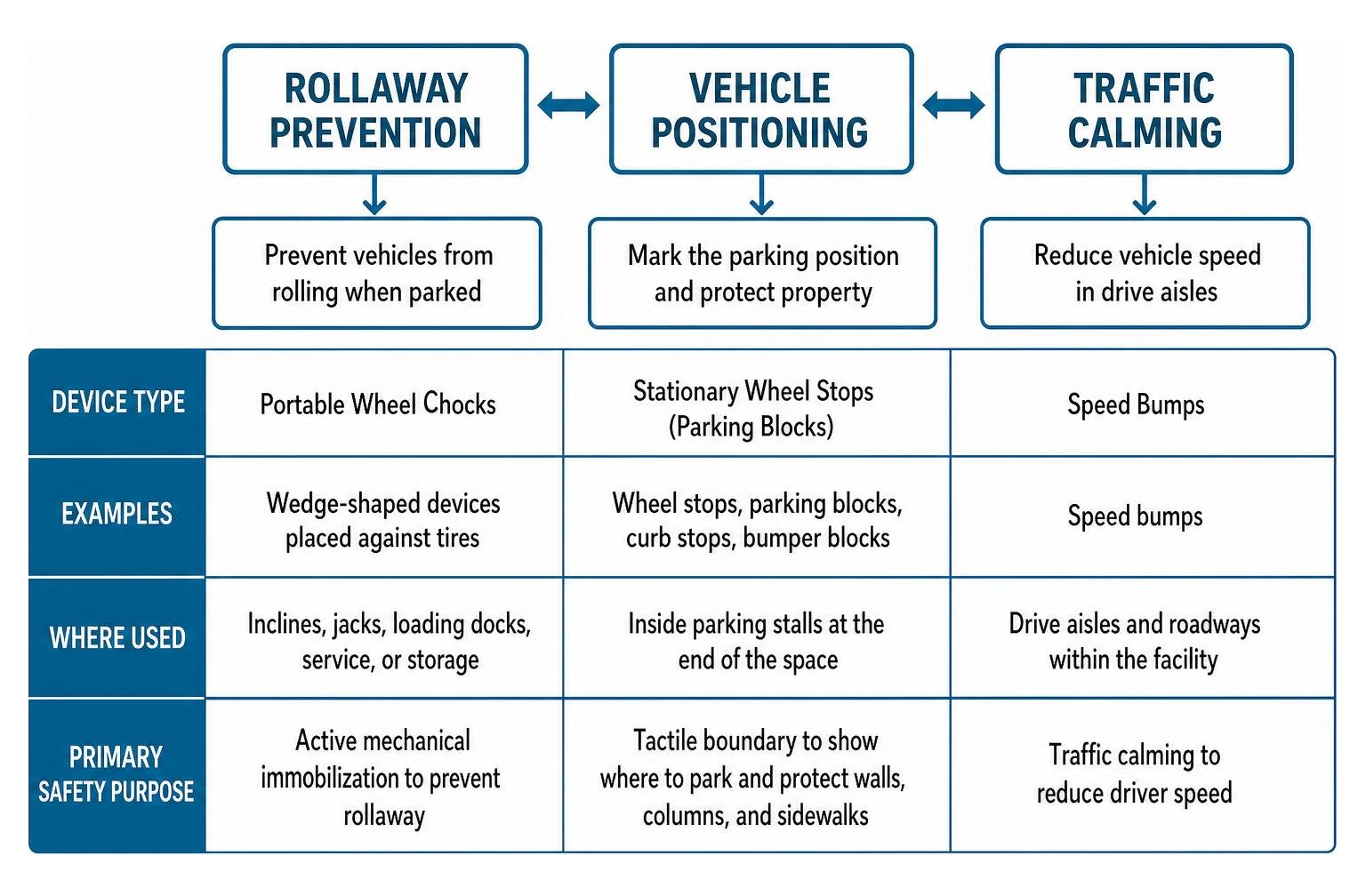
- Portable Wheel Chocks: These wedge-shaped devices provide active mechanical immobilization. You place them directly against the curvature of a tire to block rotational movement. They act as a critical mechanical failsafe when a vehicle is parked on an incline, raised on a jack, or backed into a freight loading dock.
- Stationary Wheel Stops: Also called parking blocks, curb stops, or bumper blocks, these stationary barriers mount directly to the pavement surface. They provide a tactile physical boundary for drivers, protecting end walls, structural columns, utility meters, and pedestrian sidewalks from front or rear bumper overhang. Gaining a fundamental understanding of wheel stoppers ensures you install barriers that protect both vehicle tires and adjacent structures.
- Speed Bumps: These roadway profiles provide traffic calming. Unlike wheel stops, which act as terminal stopping points within a parking bay, speed bumps encourage drivers to slow down along active drive aisles.
| Device Type | Mobility | Common Installation Method | Typical Load Capability | Primary Safety Purpose |
|---|---|---|---|---|
| Wheel Chock | Fully Portable / Bracket-Mounted | Placed manually against tire tread | Up to 285,000+ lbs (Aviation / Rail / Haulers) | Active rollaway prevention & loading bay securement |
| Wheel Stop | Stationary / Fixed Barrier | Concrete lag bolts, rebar spikes, or adhesive | 20,000 to 40,000 lbs (Impact resistance) | Vehicle stall positioning & perimeter wall protection |
| Speed Bump | Semi-Permanent / Fixed Profile | Anchoring pins or high-grade epoxy | High-frequency dynamic vehicular loads | Mid-aisle vehicle deceleration & traffic calming |
Stationary Wheel Stops: Garage and Parking Lot Applications
Stationary wheel stops bring order to high-density commercial garages and surface lots. When vehicles enter a parking stall too quickly, bumper overhang can damage drywall, electrical conduits, landscaping, or high-pressure storefront glass. Installing heavy-duty precast concrete wheel stoppers stops cars in their tracks before tires roll past safe parameters.
Beyond property protection, properly installed wheel stops keep pedestrian walkways open. Without them, truck grilles and SUV front ends can easily encroach across sidewalk pathways, violating accessibility clearances and creating trip hazards.
Portable Wheel Chocks: Active Immobilization and Loading Docks
A stationary parking bumper stops a creeping vehicle, but it cannot prevent a heavy commercial trailer from rolling away on an incline. That job requires portable wheel chocks. Industrial facilities, repair bays, and loading docks rely on chocks as a mandatory line of defense.
When heavy forklifts enter and exit the rear of a freight trailer, the repetitive momentum can nudge the trailer away from the dock plate—a dangerous hazard known as trailer creep. High-traction wheel chocks wedge under the tire radius, transferring the vehicle’s rolling energy downward into the ground.
Material Selection for Parking Chocks and Wheel Stops
Selecting the right safety barrier requires balancing tensile strength, chemical resilience, and environmental conditions. Reviewing a comprehensive checklist for buying parking wheel stops helps you match the right material to your specific facility requirements.
Rubber and Polyurethane: Versatility and Spark-Proof Safety
Recycled rubber and molded polyurethane offer exceptional all-weather performance. High-density rubber flexes slightly under pressure, absorbing vehicle kinetic energy without cracking. It also stands up well to motor oil, road salts, hydraulic fluids, and severe UV rays. Modern sustainable manufacturing turns post-consumer waste into durable infrastructure: every 12 lbs of recycled rubber product removes one commercial tire from landfills.
For heavy-duty applications, products like the MaxxHaul Solid Rubber Wheel Chock 2-Pack feature non-slip traction pads and integrated handles, with an impressive 4.8-star rating from over 18,740 reviews. For fleet and utility vehicle applications, the Buyers Products WC1467A Rubber Wheel Chock (rated 4.7 stars across 101 reviews) provides a compact, chemical-resistant wedge with an integrated chain-eye for tethering. For parking areas and garages requiring full vehicle length management, durable rubber speed bumps and parking blocks conform smoothly to uneven surfaces without chipping.
In volatile industrial environments—such as chemical loading docks, aircraft hangars, and petroleum transfer hubs—spark-proof urethane is the industry standard. High-grade urethane chocks can compress up to half their thickness under immense weight and immediately rebound. Most importantly, they will not generate a mechanical spark if dragged across steel-reinforced concrete or metal tracks.
Concrete, Steel, and Aluminum: Heavy-Duty Applications
For permanent installations subject to high-volume commercial traffic, nothing beats structural steel, extruded aluminum, and reinforced concrete.
When managing high-traffic commercial distribution yards and multi-level parking garages, sourcing heavy-duty concrete parking blocks ensures your facility can handle high-impact vehicular collisions. Solid concrete stops absorb vehicle bumper impacts day in and day out, maintaining stall boundaries across extensive parking lots.
In heavy rail operations, keeping massive rolling stock secure requires specialized steel equipment. A freight railcar weighing up to 285,000 lbs can begin rolling from a simple wind gust because its precision roller bearings have near-zero rolling resistance. Railroad operations use all-steel chocks fitted with hardened, replaceable rail-biting spurs that dig directly into the rail head under load, creating an unyielding mechanical lock.
For commercial service fleets, lightweight extruded aluminum wheel chocks provide industrial-strength hold with exceptional portability. Aluminum alloys resist corrosion naturally and can be cast with aggressive bottom cleats that grip asphalt surfaces during emergency roadside repairs.
Proper Deployment and Best Practices for Vehicle Stabilization
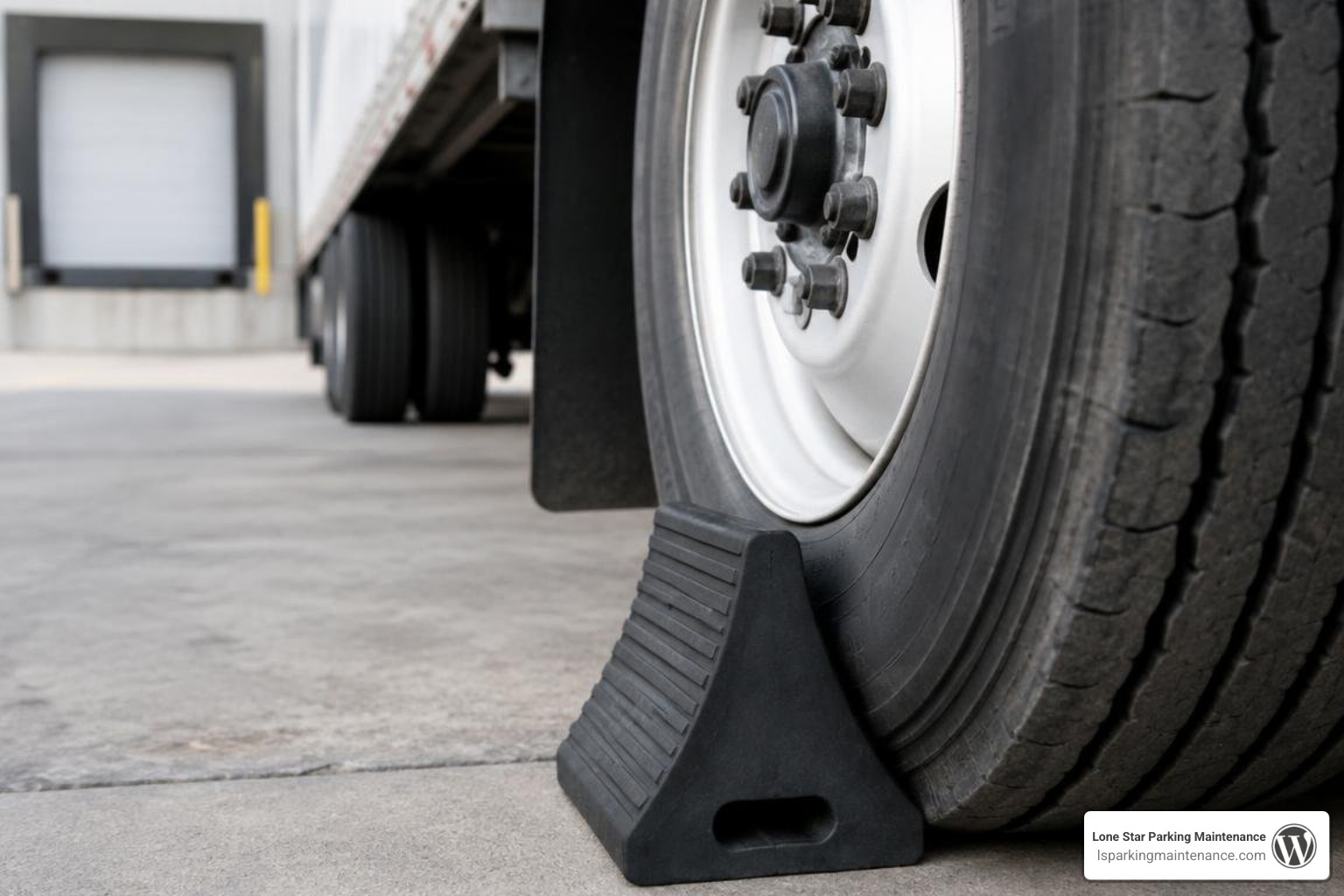
A wheel chock only works if you deploy it correctly. Placing a chock loosely near a tire won’t cut it. For maximum safety, tuck the curved face of the chock flush against the center tread of the tire. Always set the vehicle’s primary parking brake first, switch the transmission into park (or reverse for manual gearboxes), and then seat your chocks firmly.
When planning stall layouts, follow the rules of proper placement of wheel stops to ensure vehicles stop well before tires encounter structural columns, walls, or mechanical equipment.
Deploying Parking Chocks and Wheel Stops on Slopes and Icy Surfaces
Parking heavy vehicles on steep slopes, packed snow, or icy pavement requires careful chock placement:
- The Downhill Rolling Rule: When a vehicle is parked on an incline, always position your chocks on the downhill side of the tires. If the vehicle is pointed downhill, chock the front of the tires. If pointed uphill, chock the rear. On level ground, place chocks on both the front and rear of the tire.
- The Front-Wheel Rolling Principle: Rigorous field tests by propane delivery fleets—as detailed in scientific fleet testing on wheel chock policies—revealed unexpected hazards when parking on icy inclines. When drivers chocked the locked rear drive wheels, the weight of the truck occasionally caused those locked rear tires to act like sled runners, plowing a mound of snow ahead of them and sliding down the slope.
- The Unlocked Wheel Advantage: The fleet testing demonstrated that placing aggressive steel or aluminum cleated chocks on the downhill side of the unlocked front wheels allowed the tires to roll slightly forward onto the chock’s base. The downward weight of the vehicle pressed the chock’s aggressive teeth firmly into the ice, locking the vehicle securely in place.
- Tire Alignment: Always keep the front steering tires aligned straight ahead on icy grades. Angling the wheels reduces the contact area against the chock and makes the vehicle more likely to pivot and slide.
RVs, Trailers, and Specialized Vehicles: X-Chocks and Motorcycle Stands
Recreational vehicles, tandem-axle trailers, and motorcycles each require dedicated stabilization hardware:
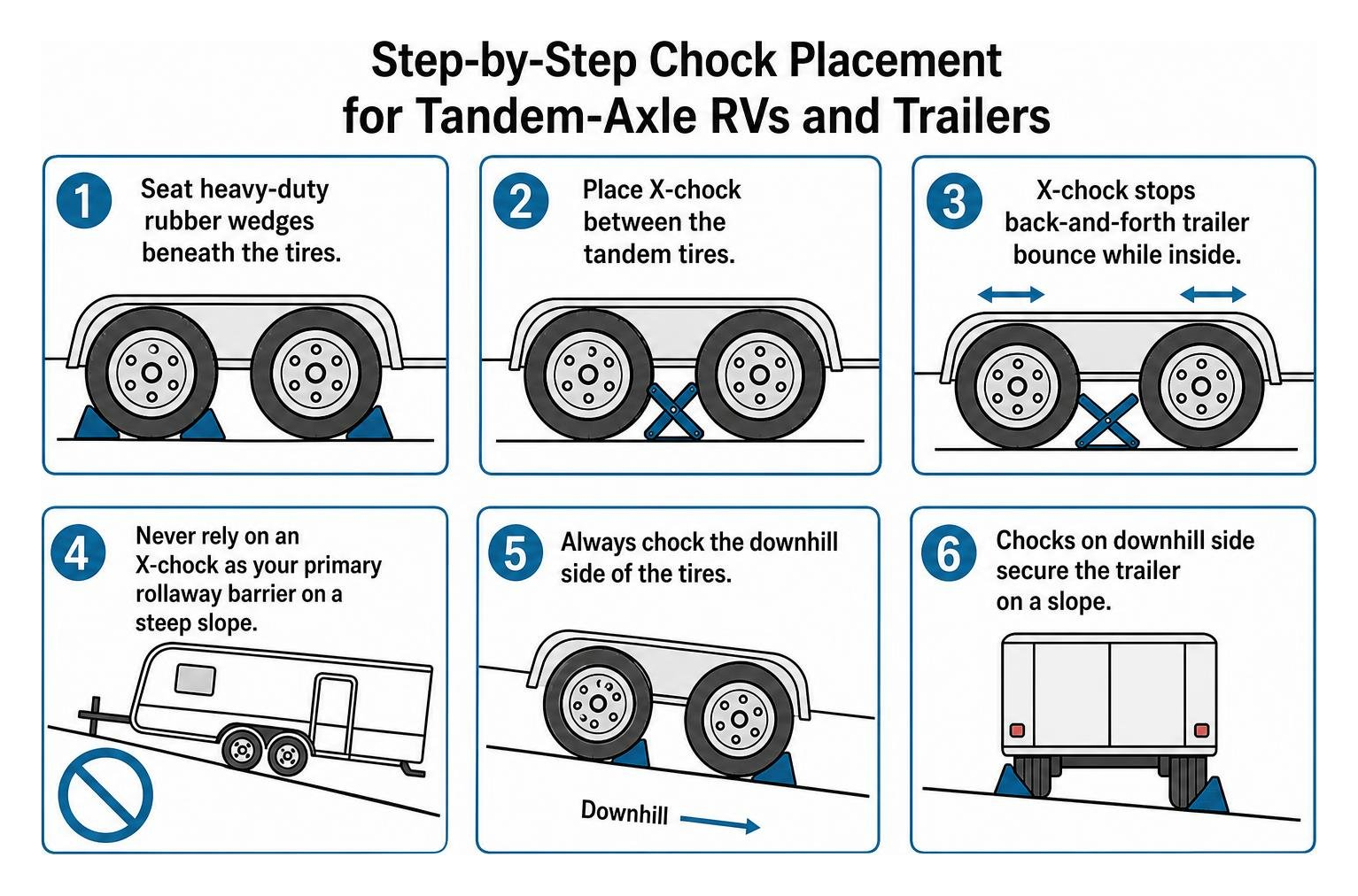
- X-Chocks for Tandem Axles: Expanding scissor-style chocks (X-chocks) fit between the tandem tires of travel trailers and fifth wheels. They work great at stopping back-and-forth trailer bounce while walking inside the camper. However, X-chocks are primarily stabilizers. Never rely on an X-chock as your primary rollaway barrier on a steep slope. Always seat heavy-duty rubber wedges beneath the tires before disconnecting your tow vehicle’s hitch.
- Motorcycle Transport and Storage: Securing a motorcycle in a garage or utility trailer requires an upright cradle. The Condor Pit Stop/Trailer Stop Motorcycle Wheel Chock uses an adjustable, pivoting drive-in cradle that locks front tires (from 14 to 22 inches) securely upright. Rated to hold bikes up to 3,000 lbs, it allows a single rider to roll their bike into place, step off, and attach tie-down straps without worrying about the bike falling over.
- Commercial Multi-Packs: Commercial maintenance fleets and warehouses often keep multi-packs on hand, such as the MaxxHaul 10″ x 8″ x 6″ Rubber Wheel Chock 5-Pack, which carries a 4.7-star rating across 9,202 reviews. These units feature integrated steel eyebolts for connecting safety tether chains across busy transport bays.
Garage Wheel Stop Installation and Long-Term Maintenance
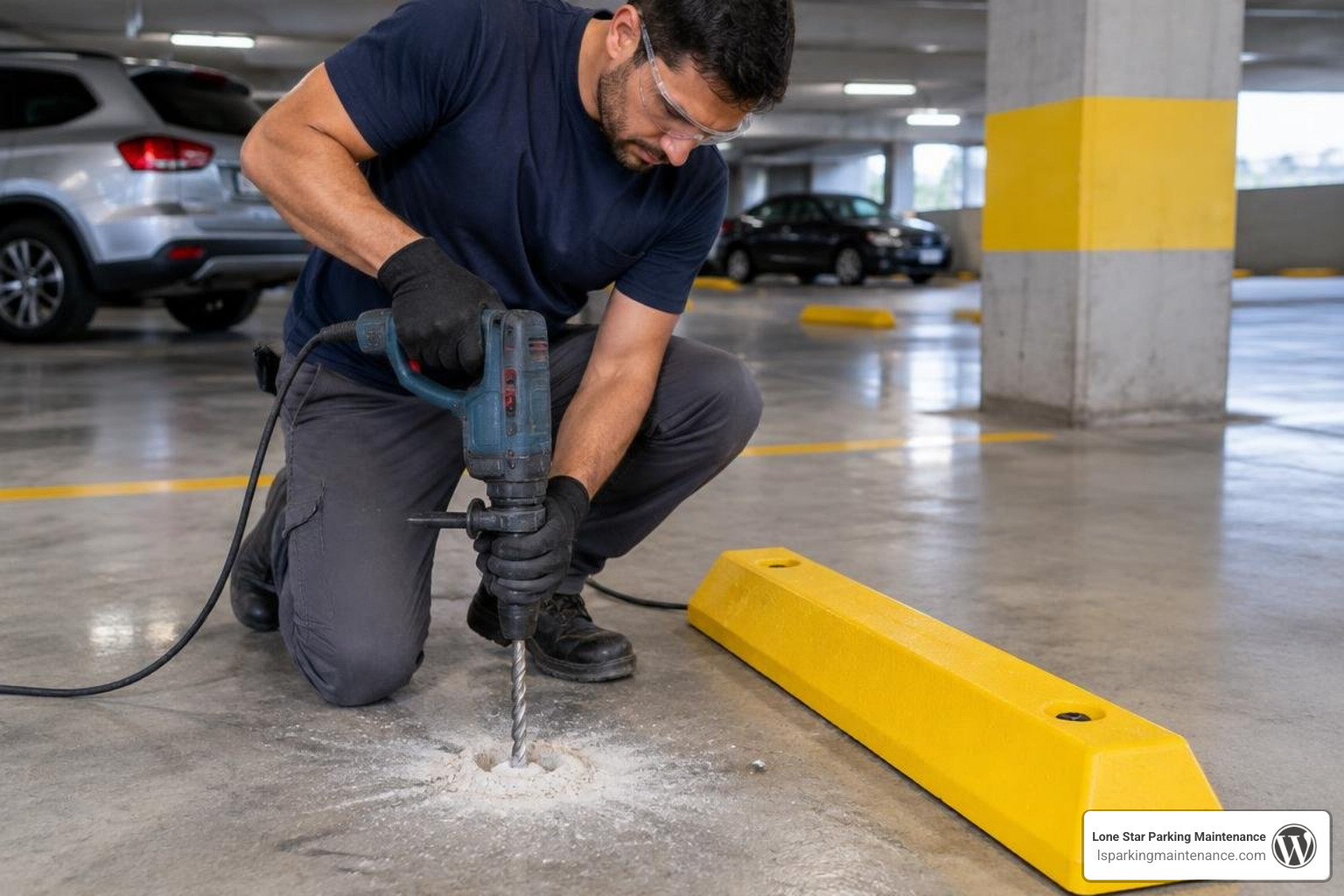
Installing parking stops in residential or commercial garages protects structural walls, mechanical closets, and storage racks from vehicle impacts. Following a clear guide on step-by-step garage wheel stop installation helps ensure your barriers are anchored safely and accurately.
Step-by-Step Anchoring for Concrete and Asphalt Surfaces
Different parking surfaces require specific installation methods:
- Stall Measurement and Alignment: Park your vehicle inside the stall with safe clearance between the front bumper and the wall (typically 24 to 36 inches from the wall to the front tire contact point). Mark your anchor hole locations onto the substrate.
- Concrete Drilling: For concrete garage floors, use an industrial rotary hammer drill equipped with a masonry bit to drill pilot holes for your anchors. Follow our five-step wheel stop installation guide to set your drill depth properly and vacuum out all concrete dust from the holes.
- Mechanical Fastener Installation: Drive commercial lag bolts through heavy-duty washers into expansion shields inside the concrete. Tighten down the bolts until the stop rests firmly against the slab.
- Adhesive Bonding Options: In multi-story parking structures with post-tensioned slabs (where drilling into the concrete could sever structural tension cables), secure your rubber wheel stops using industrial polyurethane construction adhesive.
- Asphalt Pinning: In outdoor asphalt lots, secure stops using rebar spikes driven directly through the asphalt into the sub-base, sealing the entry points to keep water from seeping in and causing freeze-thaw damage.
Maintaining Parking Chocks and Wheel Stops for Peak Reliability
Keep your parking barriers and chocks in top working condition with a simple maintenance routine:
- Inspect Hardware Every Quarter: Vehicle impacts and thermal expansion can loosen anchor bolts over time. Check your mounting hardware quarterly and re-torque loose fasteners to prevent wheel stops from shifting.
- Check for Material Fatigue: Inspect concrete stops for structural cracks or exposed rebar. For rubber and urethane units, check for UV dry-rot, deep cuts, or rounded tread edges that could reduce grip.
- Clean Away Oil and Grease: Motor oil, brake fluid, and coolant can create a slick film on chocks and stops. Pressure wash your barriers regularly to preserve their non-slip surface traction.
- Keep Portable Chocks Stored in Dedicated Brackets: Never leave loose wheel chocks lying around on the garage floor where vehicles can run them over. Mount dedicated storage brackets to garage walls or service vehicle beds so they are always clean, visible, and ready for work.
Frequently Asked Questions About Parking Chocks and Wheel Stops
Can X-chocks be used as primary wheel chocks on steep slopes?
No. X-chocks should never serve as your primary rollaway barrier on moderate to steep grades. Scissor-style chocks expand outward between tandem tires to minimize suspension wobble while people walk inside the trailer. However, they lack the ground-gripping base needed to resist dynamic downhill momentum. Always place heavy, wedge-style rubber or urethane chocks firmly against the downhill side of the tires before unhitching on an incline.
What OSHA standards regulate wheel chock usage during freight loading?
OSHA standard 29 CFR 1910.178(k)(1) requires that commercial freight truck brakes must be set and wheel chocks placed under the rear wheels to prevent trucks from rolling while they are boarded with powered industrial forklifts. OSHA 29 CFR 1910.178(m)(7) reiterates this mandate, requiring positive mechanical wheel blocking before loading or unloading uncoupled semi-trailers.
How do I prevent a vehicle from pushing or climbing over a wheel stop in a garage?
To prevent vehicles from overriding wheel stops, maintain a standard curb height between 4 and 6 inches, anchor the stops securely to the concrete using industrial lag bolts, and position the blocks so tires make contact before the vehicle gains upward momentum. Adding high-visibility reflective striping also gives drivers a clear visual reference as they pull into the bay.
Conclusion
Protecting your facility walls, equipment, and vehicles requires the right combination of stationary barriers and portable safety equipment. Stationary wheel stops keep vehicles positioned safely within their stalls, while portable, high-traction wheel chocks provide the mechanical grip needed to prevent dangerous vehicle rollaways during loading, maintenance, and storage.
Whether you manage a busy commercial fleet warehouse or oversee an extensive multi-level parking facility in the DFW Metroplex, our team at Lone Star Parking Maintenance delivers exceptional results. We provide comprehensive parking facility solutions—including precision stall striping, structural concrete repairs, high-durability power washing, and professional curb stop and protective installation—tailored specifically to your property’s safety needs. Reach out to our team today to keep your parking assets secure and fully protected.