
Where to Buy Concrete Parking Blocks for a High-Traffic Lot
For most car spaces, start with a 6-foot precast concrete wheel stop. Listings show prices around $49 to $127 per block, but delivery and installation can add to the total. For loading docks and truck parking, ask for a purpose-built truck stop instead. Compare each supplier’s dimensions, weight, concrete strength, and included anchor pins before you order.
Local precast yards and commercial parking suppliers may offer single blocks or bulk pricing. If you’re buying for a DFW facility, request a delivered quote and confirm who will unload the blocks; a large order may need a forklift on site.
I’m Cason, and I’ll help you sort through the options that matter most for your lot.
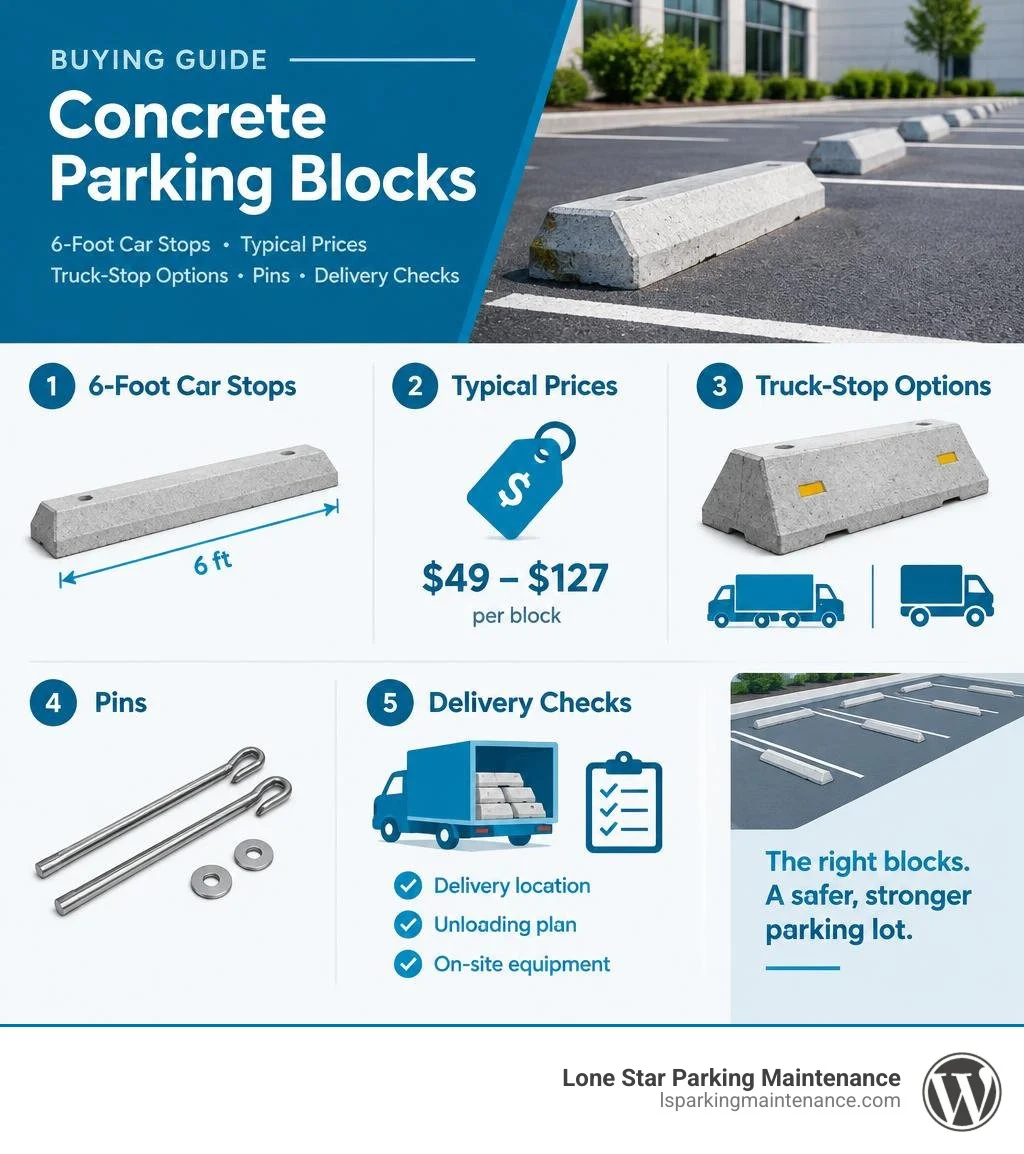
Quick concrete parking blocks for sale terms:
For broader industry guidance on precast concrete parking barriers, the Precast/Prestressed Concrete Institute offers technical resources on precast parking structures and related products.
Key Specifications for Commercial Concrete Parking Blocks for Sale
Selecting wheel stops for a busy commercial facility requires looking past the surface finish and evaluating the physical engineering of each unit. Standard commercial units are designed to withstand vehicle tire impact without sliding, chipping, or rolling over.
Standard dimensional baselines range from 4-7/8 inches to 5.5 inches in height and 7-5/8 inches to 8.25 inches in bottom width. These dimensions provide a stable base-to-height ratio that prevents tipping when struck by vehicle tires, while maintaining sufficient clearance for low-profile passenger cars. A block that is too tall risks tearing off plastic bumper covers and oil pans, whereas a curb that is too low can be overridden by light trucks and SUVs.
Relying on high-density precast concrete wheel stoppers ensures consistent dimensions, uniform aggregate consolidation, and predictable weight across hundreds of parking stalls.
Standard Car Stops vs. Heavy-Duty Industrial Truck Stops
Not every vehicle bay handles standard passenger sedans. Placing standard car curbs in front of semi-trailers or delivery flatbeds results in pulverized concrete within weeks.
- Standard Car Stops (6-Foot to 8-Foot): Weighing between 150 lbs and 275 lbs (with some 8-foot units reaching 325 lbs), these barriers control passenger sedans, pickup trucks, and minivans. Their mass provides substantial resting inertia, even before anchor pins are set.
- Industrial Truck Stops (8-Foot to 9-Foot): Engineered for freight terminals, logistics depots, and distribution centers handling 18-wheelers. A purpose-built 9-foot concrete truck stop measures approximately 108 inches long, 12 inches wide, and 7.5 to 12 inches high, weighing between 800 lbs and 1,185 lbs.
Installing designated heavy stops safeguards surrounding structures, light poles, and walkways. Learn more about how commercial lot parking protection preserves facility infrastructure.
Concrete Compressive Strength, Steel Rebar Reinforcement, and Water Absorption
A block’s internal formulation dictates its operational lifespan under heavy cycling and thermal swings:
- Compressive Strength (PSI): Quality precast car stops start at a minimum of 3,500 PSI, with premium commercial specifications delivering 5,500 PSI to over 8,000 PSI. Higher compressive strength directly correlates with impact resistance against vehicle tires.
- Internal Steel Reinforcement: High-tensile steel rebar prevents catastrophic fracturing. Standard curbs incorporate dual #3 or #5 rebar strands running their entire length, while 800-lb truck stops utilize four continuous sticks of #3 rebar combined with synthetic structural fibers.
- Low Moisture Absorption: High-grade mixes maintain a maximum absorption rate of 6.0%. Low permeability prevents moisture intrusion, protecting internal rebar from oxidation and preventing surface spalling during freezing temperatures.
Top Types of Commercial Concrete Wheel Stops
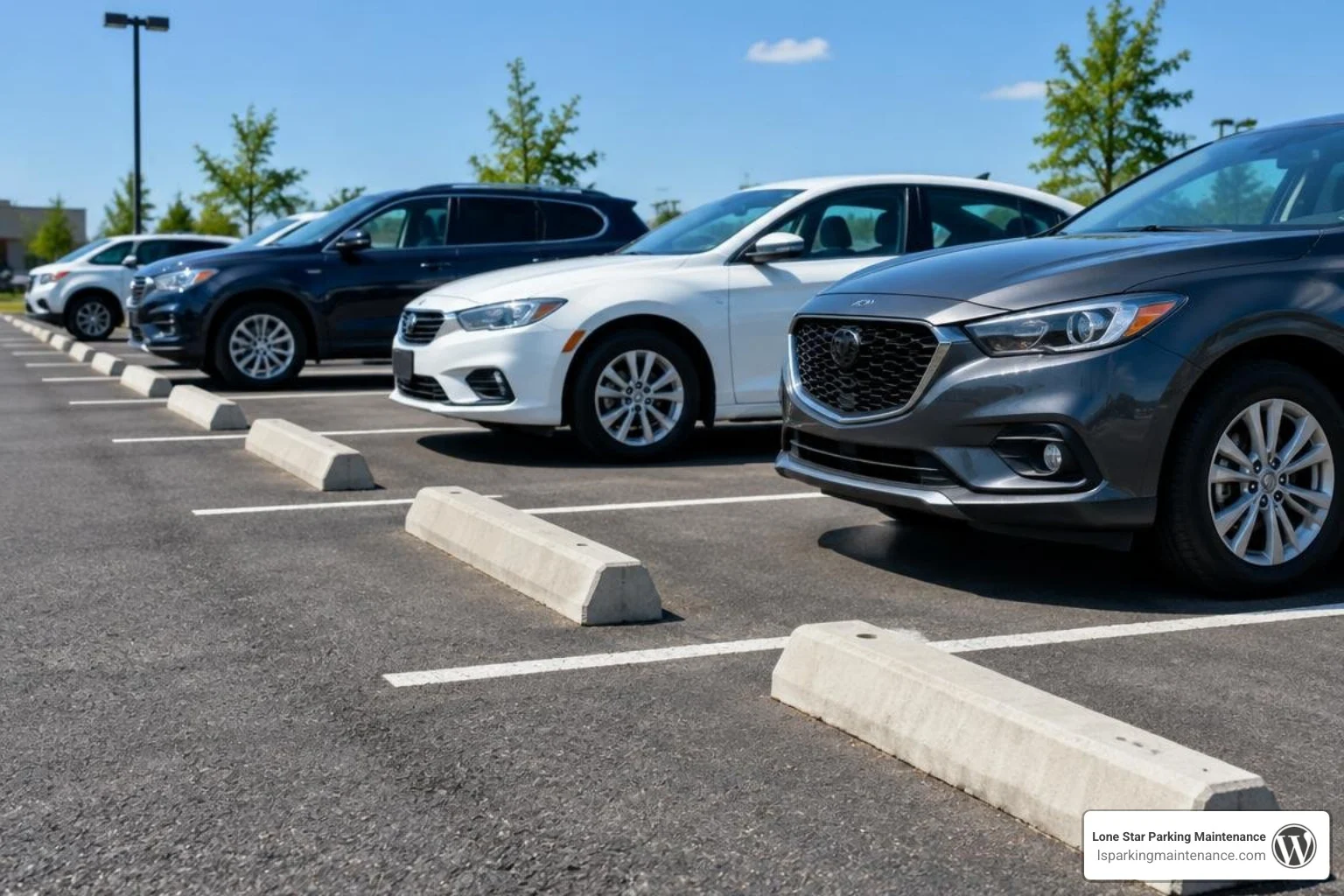
Commercial properties require tailored layouts. Selecting the appropriate block profile depends on lot slope, traffic volume, and drainage patterns. Before issuing a purchase order, review this buying checklist for parking wheel stops to match block types to your site plan.
Precast Concrete Parking Blocks for Sale in Bulk Bundles
For large lot developments or phased replacements, purchasing individual units at retail adds unnecessary cost. Commercial precast distributors provide contractor bundles, such as 180-pack full-truckload configurations. These bulk orders reduce individual unit prices from $49–$64 down to $30–$38.85 per unit—delivering roughly a 20% to 30% savings.
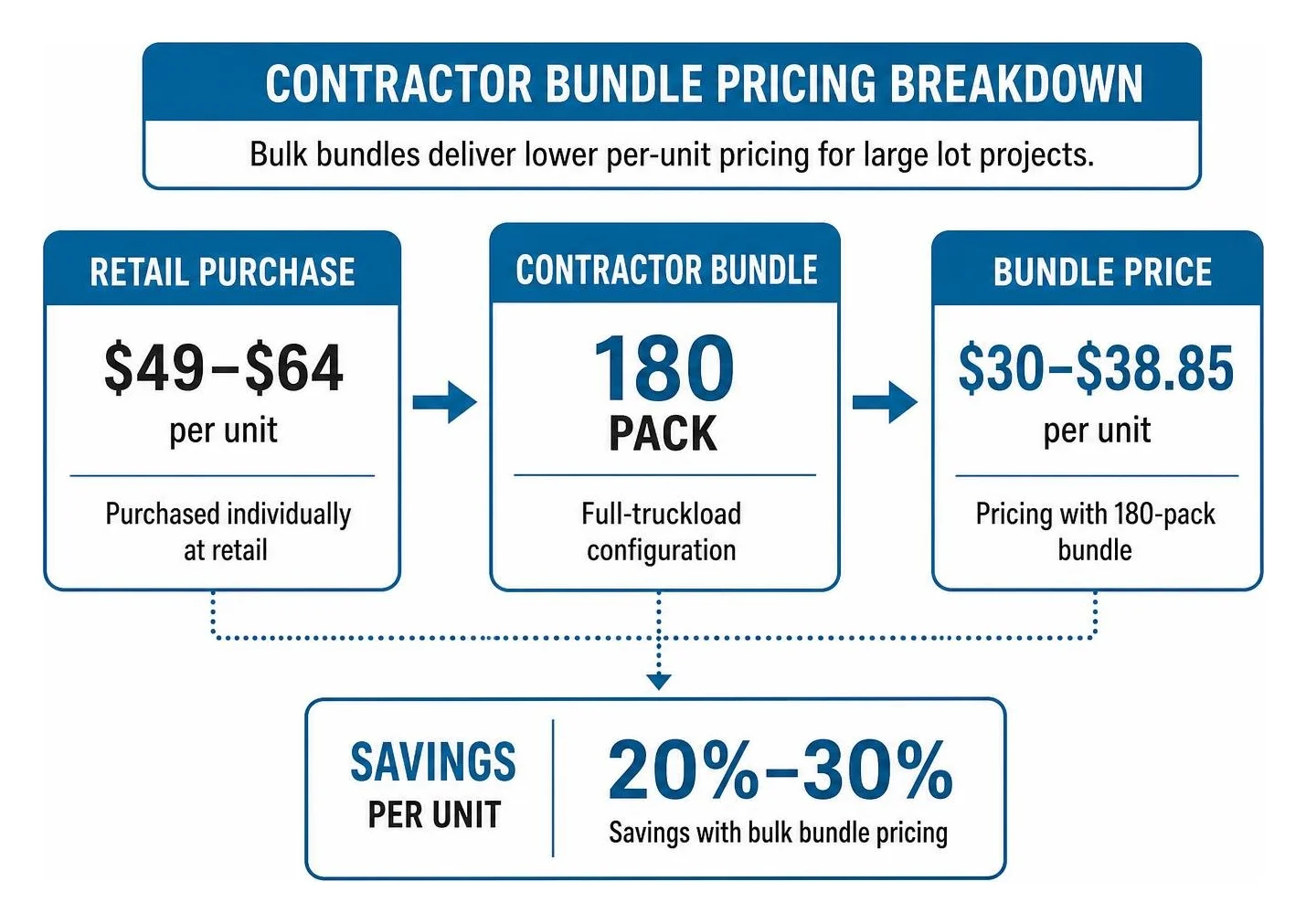
When ordering bulk lots, confirm that delivery includes palletized banding and factory-formed pin holes (typically 0.75-inch diameter) to ensure rapid installation upon arrival.
Specialty Drainage-Slot and Double-Sided Parking Curbs
Standard curbs can inadvertently act as small dams across sloped parking bays, trapping stormwater, motor oil, and trash against the pavement.
- Drainage-Slot Stops: These blocks feature factory-cast underside cutouts that allow water runoff to flow freely toward catch basins, preventing standing puddles and winter ice patches.
- Double-Sided (Shared) Curbs: Built with symmetrical sloped faces on both sides, double-sided blocks serve back-to-back parking stalls. They eliminate the need for two separate curbs between opposing stalls, reducing material costs across expansive surface decks.
Property owners balancing complex layout needs can consult our guide to parking lot bumper stops for detailed placement strategies.
High-Visibility Yellow and ADA-Compliant Colored Stops
Untreated grey concrete matches weathered asphalt, making curbs hard to see at dusk and creating tripping hazards for pedestrians.
- Safety Yellow Curbs: Coated with safety yellow traffic paint, these blocks alert drivers in tight garages and drive-through lanes.
- ADA Blue Curbs: Federal and local accessibility standards require dedicated accessible parking stalls to feature high-contrast blue demarcation.
Facilities managing diverse patron traffic can review our recommendations on medical center parking bumper choices to ensure compliant stall designation.
Concrete vs. Rubber and Recycled Plastic Wheel Stops
Property managers often compare precast concrete against lightweight synthetic substitutes like recycled rubber and high-density polyethylene (HDPE) plastic. While synthetic stops are lighter to ship, concrete remains the commercial standard for high-traffic environments.
| Performance Metric | Precast Concrete Stops | Recycled Rubber Stops | Recycled Plastic (HDPE) |
|---|---|---|---|
| Typical Lifespan | 20 to 30+ Years | 5 to 10 Years | 7 to 12 Years |
| Average Unit Weight (6′) | 150 to 275 lbs | 30 to 45 lbs | 15 to 30 lbs |
| Displacement Resistance | High (Mass + Anchor Pins) | Moderate (Anchors Only) | Low (Prone to tearing free) |
| UV & Sun Degradation | Immune (Zero degradation) | Minor surface chalking | Prone to warping over time |
| Chemical & Oil Resistance | High (6% max absorption) | High | High |
| Initial Purchase Cost | Low to Moderate ($49–$65) | Moderate ($45–$75) | Moderate to High ($50–$90) |
| Handling Requirements | 2-Man Lift / Machinery | 1-Man Carry | 1-Man Carry |
Because synthetic blocks weigh under 45 lbs, they rely entirely on their mounting bolts. When struck by heavy vehicles, these bolts can pull out of the asphalt. A 200-lb concrete barrier uses both mechanical pins and raw mass to stay firmly in place. Review our wheel stoppers vehicle retention guide for deeper insight into vehicle dynamics and barrier selection.
Anchoring Hardware, Placement, and Installation Guidelines
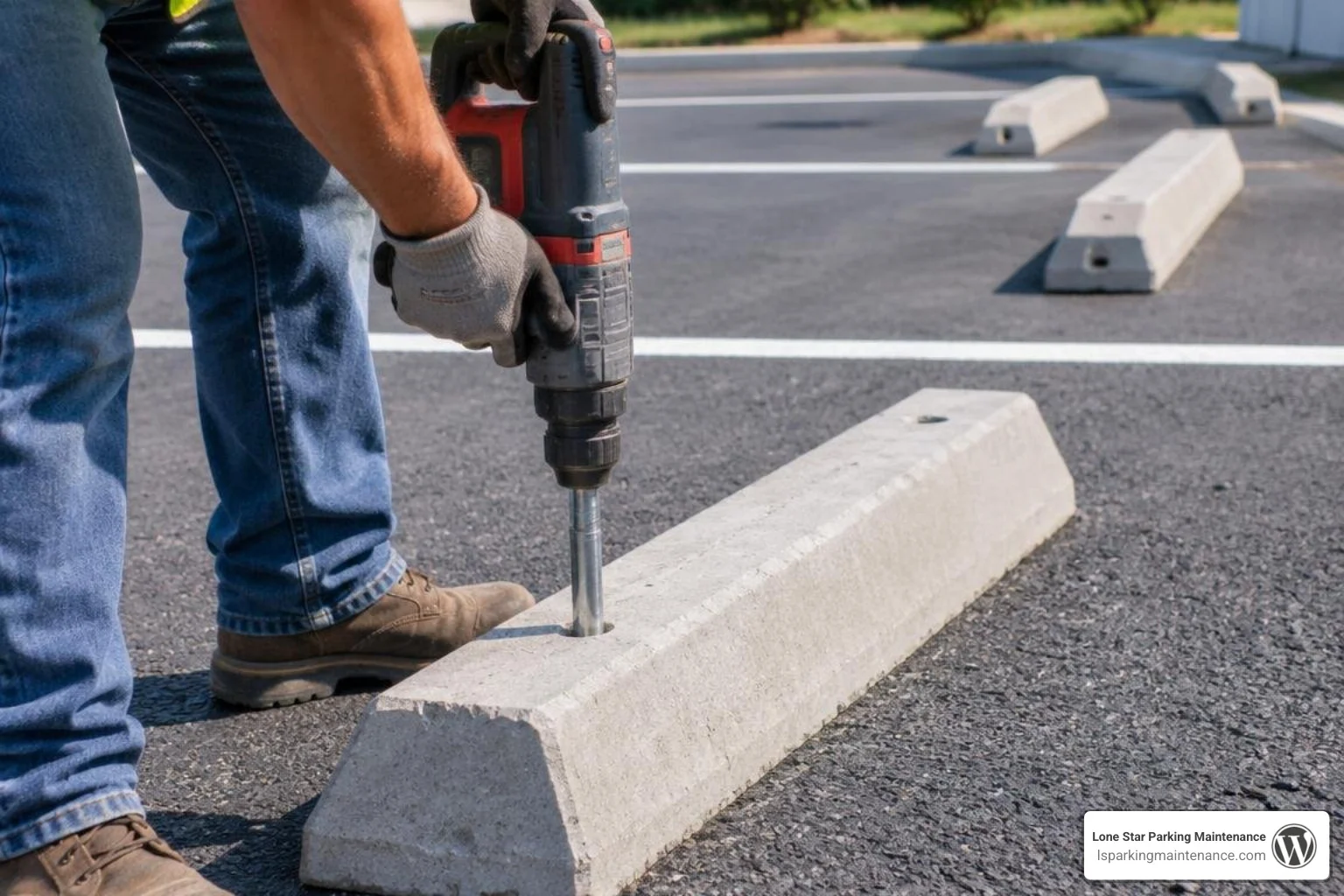
A parking stop must be positioned accurately to protect walkways and landscaping while allowing adequate vehicle overhang.
- Setback Distance: Align the center of the wheel stop 24 to 36 inches inward from the end of the stall or curb line. This allows standard vehicle front ends to clear sidewalks without reducing accessible pedestrian pathways.
- Stall Centering: Center the block horizontally within the stall striping lines, leaving adequate side clearance so pedestrians do not trip between parked cars.
For detailed positioning measurements and accessibility compliance, reference our safe wheel stop placement standards alongside our step-by-step wheel stop installation guide.
Evaluating Freight, Delivery Logistics, and Sourcing Concrete Parking Blocks for Sale
Transporting precast concrete requires careful logistics planning:
- Freight Capacity: A standard flatbed semi-trailer can transport roughly 45,000 to 48,000 lbs. That equates to approximately 200 to 240 standard 6-foot blocks (at 200 lbs each), or just 40 to 55 heavy-duty truck stops (at 800+ lbs each).
- Jobsite Offloading: Flatbed delivery drivers generally do not hand-unload palletized concrete. Your site crew must have an all-terrain forklift or skid steer with pallet forks ready when the transport arrives.
- Staging: Stage pallets evenly across the parking bays rather than stacking them in one location, preventing localized pavement stress and reducing manual carrying distances during pinning.
Fastening Methods for Asphalt vs. Concrete Pavements
- Asphalt Pavements: Drill pilot holes through the top block ports into the asphalt, then drive #5 (5/8-inch) or #6 (3/4-inch) steel rebar pins measuring 12 to 18 inches in length directly into the compacted base. The pin head should seat flush inside the factory counter-bore hole.
- Concrete Surfaces & Parking Garages: Never drive rebar spikes into elevated concrete parking decks, as this can fracture structural slabs or penetrate post-tension cables. Instead, drill precision holes and secure the block using expansion lag bolts or high-strength epoxy adhesives.
For comprehensive fastening techniques across different substrates, consult our wheel stop installation manual.
Frequently Asked Questions About Commercial Parking Blocks
How much do commercial concrete parking blocks cost?
Individual 6-foot commercial precast concrete parking blocks typically cost between $49.00 and $65.00 for standard grey finishes, with premium painted or specialty drain-slot blocks ranging up to $127.00. Large contractor orders (180+ units) can drop the unit price down to approximately $30.00 to $38.85. Heavy-duty 800-lb truck stops designed for distribution hubs generally run between $240.00 and $280.00 per unit.
How long do precast concrete wheel stops last under heavy traffic?
When cast at 3,500 to 5,500+ PSI with internal steel reinforcement, precast concrete parking blocks typically last 20 to 30 years. They resist UV radiation, engine oil spills, and temperature extremes, outlasting lightweight plastic and rubber alternatives.
What anchoring hardware is required to install concrete wheel stops?
Most installations use two anchor pins per block through pre-formed 0.75-inch receiver holes:
- Asphalt: Two #5 or #6 steel rebar pins (5/8-inch to 3/4-inch diameter), 12 to 18 inches long.
- Concrete: Heavy-duty lag bolts with expansion shields or two-part structural epoxy anchor studs.
Protect Your Parking Facility with Professional Installation
Equipping your parking facility with high-density precast concrete wheel stops protects exterior walls, protects pedestrian walkways, and prevents vehicle overhang damage. From assessing compressive strength ratings to coordinating flatbed delivery and anchoring on asphalt, proper installation ensures decades of reliable performance.
At Lone Star Parking Maintenance, we help property managers across the DFW Metroplex design, install, and maintain commercial parking facilities. Whether you need standard car stops, heavy-duty truck stops, or complete surface restoration, our team delivers high-quality workmanship backed by industry standards.
Contact our team today for a comprehensive quote on premium commercial wheel stops, site layout planning, and turnkey parking lot maintenance services.