
Is Your Parking Lot Worn Out But Not Done For?
Asphalt overlay services are one of the most cost-effective ways to restore a worn parking lot or driveway — without tearing everything out and starting over.
If your pavement is faded, cracked, or rough but still structurally sound underneath, you may not need a full replacement. Here’s the quick answer:
- Asphalt overlay = a new layer of asphalt (1.5–2.5 inches) applied directly over your existing pavement
- Best for surfaces with minor to moderate damage affecting less than 25–30% of the total area
- Extends pavement life by 8–12 years with proper maintenance
- Costs less and takes less time than full replacement (most jobs done in 1–2 days)
- Not suitable when the base layer has failed, there is widespread sinking, or major drainage problems exist
For DFW property managers dealing with faded striping, surface cracks, oil stains, and rough pavement, an overlay can restore safety and curb appeal at a fraction of the cost of full reconstruction.
I’m Cason, and in this guide I’ll walk you through everything you need to know to decide if an asphalt overlay is the right move for your property.
Asphalt overlay services vocabulary:
What is an Asphalt Overlay and How Does It Work?
At its core, an asphalt overlay is a pavement rehabilitation technique designed to give tired, worn-out surfaces a brand-new lease on life. Instead of spending tens of thousands of dollars to excavate your entire parking lot, we apply a fresh, hot-mix asphalt layer directly over the existing pavement.
The standard overlay thickness typically ranges from 1.5 to 2.5 inches (and up to 3 inches for heavy-duty commercial traffic). This new layer bonds with the old surface to act as a unified, structurally reinforced system.
When you hire professional asphalt overlay contractors, they don’t just dump hot asphalt over your old parking lot and call it a day. The process requires highly specialized machinery, careful temperature control, and rigorous surface preparation to ensure the new layer fuses perfectly with the old one. If you want to dive deeper into how this process compares to other resurfacing strategies, check out All About Parking Lot Resurfacing for a complete breakdown of your options.
Asphalt Overlay vs. Full Replacement vs. Mill and Pave
To make the best decision for your commercial property or residential community, it’s vital to understand how these three primary paving services differ.
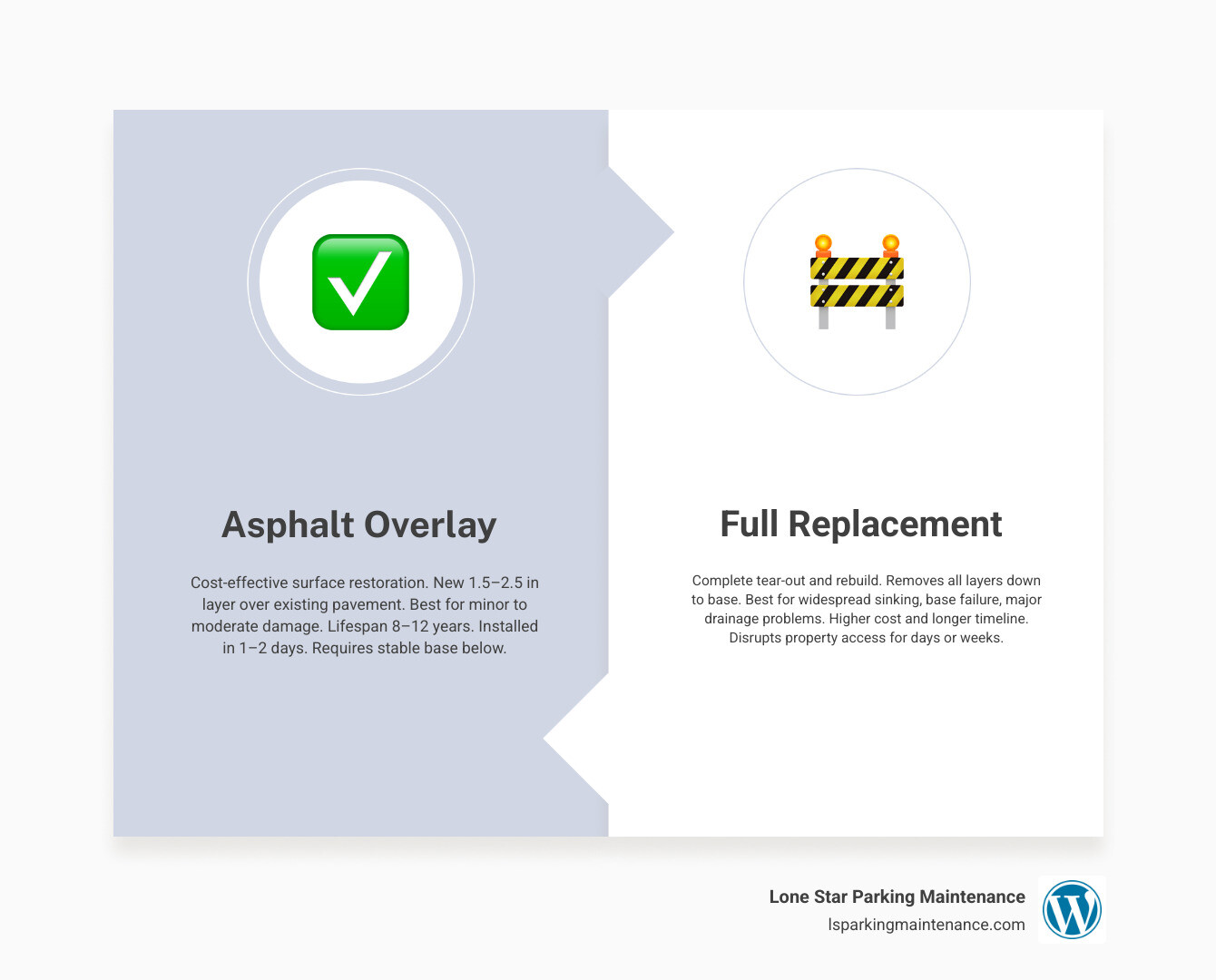
- Asphalt Overlay: We apply a new 1.5- to 2.5-inch layer of hot-mix asphalt directly on top of your existing pavement. This relies heavily on the structural integrity of your current aggregate base.
- Mill and Pave: We use a heavy milling machine to shave off the top 1.5 to 2 inches of damaged asphalt, clean the surface, and lay down a brand-new surface layer. This is perfect when the middle layer has surface distress but the underlying aggregate base remains rock-solid.
- Full Replacement: We excavate every single layer of asphalt, haul it away, repair or completely rebuild the aggregate stone base, and lay down multiple brand-new layers of asphalt.
Here is a quick reference table to help you compare your choices:
| Metric | Asphalt Overlay | Mill and Pave | Full Replacement |
|---|---|---|---|
| Average Cost | Low to Moderate | Moderate | High |
| Lifespan | 8 to 12 Years | 10 to 15 Years | 20 to 30 Years |
| Project Duration | 1 to 2 Days | 1 to 3 Days | 3 to 5+ Days |
| Disruption Level | Minimal | Moderate | High |
| Environmental Impact | Very Low | Low (Recycled Millings) | High |
For more details on choosing the right path, you can consult resources from the Asphalt Institute to see how industry standards govern these pavement rehabilitation decisions.
When to Choose Asphalt Overlay Services Over Full Replacement
Choosing between an overlay and a full replacement isn’t just about looking at your budget; it’s about evaluating the structural health of your pavement.
The absolute golden rule of asphalt overlay services is base stability. Think of your pavement like a house: if the foundation is cracked and sinking, putting a beautiful new roof on top won’t save it. If your aggregate base layer is failing, shifting, or turning into mud underneath, an overlay will fail almost immediately.
We look for a 25-30% surface distress threshold. If minor to moderate surface issues—like oxidation, raveling, and hairline cracks—affect less than 30% of your total parking lot area, you are a prime candidate for an overlay. However, if your parking lot looks like a war zone with deep alligator cracking, massive sinkholes, and shifting base soils across half the property, a full tear-out is inevitable.
To learn more about analyzing your pavement’s condition in the Dallas-Fort Worth area, check out Everything You Need to Know About DFW Asphalt Overlays.
The Cost-Effectiveness of Professional Asphalt Overlay Services
Let’s talk numbers. Budget savings are the number-one reason property managers choose an overlay. A full replacement requires heavy excavation equipment, fleet trucks to haul tons of old asphalt away, high dumping fees, and days of labor.
An overlay bypasses almost all of those costs. Because we use the existing pavement as our base, we drastically reduce material costs and labor hours.
Furthermore, the project duration is incredibly short. While a full replacement can shut down a commercial parking lot for a week or more—driving away customers and frustrating tenants—an overlay project is typically completed in just 1 to 2 days. For a comprehensive look at the financial and logistical benefits, read The Ultimate Guide to Resurfacing Asphalt Parking Lots.
Why Properties in Texas Benefit from Asphalt Overlay Services
Operating in the DFW Metroplex presents unique challenges for asphalt. The extreme Texas heat, combined with our infamous highly expansive clay soils, causes significant thermal movement. Pavement expands rapidly during July afternoons when surface temperatures exceed 140°F, and then contracts when things cool down.
This constant shifting creates stress cracks. If left untreated, water penetrates these cracks, softens the subgrade, and destroys the foundation. Because an overlay acts as a flexible, protective blanket, it reinforces the pavement and seals out water before major base damage can occur. To understand how to protect your DFW property from these intense climate cycles, refer to our Asphalt Parking Lot Repair Guide 2026.
The Step-by-Step Asphalt Overlay Installation Process
To get a high-performing, long-lasting surface, we follow professional paving standards to the letter. This is a highly coordinated, step-by-step sequence.
Here is how we execute a flawless overlay:
- Pavement Assessment: We inspect the site to check base stability, measure elevations, and identify drainage patterns.
- Cleaning & Surface Prep: We sweep away dirt, rocks, and vegetation. Oil spots are treated with specialized bonding agents.
- Milling (If Needed): We mill down edges, transitions, and areas around drainage inlets.
- Crack & Pothole Repair: We seal cracks wider than 1/4 inch and patch deep potholes to ensure a level sub-surface.
- Tack Coat Application: We spray a specialized asphalt oil mixture across the entire surface to act as an adhesive.
- Overlay Placement: We lay down hot-mix asphalt (typically 1.5 to 2.5 inches thick) using temperature-controlled paving machines.
- Compaction: Heavy steel-wheeled rollers compact the fresh asphalt to its target density.
- Curing & Reopening: The area is roped off to allow the surface to cool and cure before we repaint the stripes and reopen it to traffic.
The Critical Role of Surface Preparation and Milling
You cannot simply pave over transitions, curbs, and drainage inlets without creating dangerous trip hazards and water pooling issues. This is where asphalt milling comes into play.
Milling involves using a rotating drum with carbide teeth to grind down specific sections of the old asphalt. We perform edge milling along concrete gutters, sidewalks, and approach aprons. This creates a recessed channel so that when the new 2-inch overlay is applied, the finished surface sits perfectly flush with the concrete.
Milling also allows us to correct minor drainage issues, ensuring rainwater flows toward the storm drains instead of pooling in the middle of your driving lanes. To discover why this process is so vital in Texas, read Why Asphalt Milling Is the Secret to a Smooth Texas Road.
Preventing Reflective Cracking and Ensuring Proper Bonding
One of the biggest risks with any overlay is reflective cracking. If you have a deep crack in your old asphalt and you pave right over it without preparation, that crack will move under traffic loads and reflect up through your beautiful new surface within 1 to 3 years.
To prevent this, we perform intensive crack sealing and structural patching before paving.
Additionally, we apply a uniform tack coat. This special oil mixture is the “glue” that binds the old pavement to the new overlay. Without a high-quality tack coat, the two layers can delaminate, causing the top layer to slide, buckle, and peel away under the weight of turning vehicles. For a deeper dive into these prep methods, read The Complete Guide to Parking Lot Repairs.
Lifespan, Cost, and Maintenance of an Asphalt Overlay
When properly installed and maintained, an asphalt overlay can extend your pavement’s life by 8 to 12 years (and up to 15 years under ideal conditions). However, the key phrase here is properly maintained.
An overlay is still asphalt, meaning it is susceptible to UV oxidation, water penetration, and oil spills. To protect your investment, you must establish a proactive maintenance schedule immediately after installation.
Post-Installation Curing and Traffic Reopening
Once the final roller finishes compacting the hot mix, the curing clock starts. In most residential and commercial cases, you can drive on the new surface within 24 to 48 hours.
However, because Texas summers are incredibly hot, the asphalt can remain soft for several days. We highly recommend keeping heavy dumpsters, delivery trucks, and sharp turning vehicles off the new surface for the first week to prevent power-steering scuffs and tire ruts.
Essential Maintenance and Sealcoating Timelines
To lock in that rich, dark black color and protect your new overlay from the harsh DFW sun, you should plan to apply your first layer of sealcoat within 6 to 12 months after installation. This allows the fresh oils in the new asphalt to cure completely before we seal the surface.
To keep your asphalt looking pristine and protected:
- Apply a high-quality sealcoat every 3 to 5 years.
- Clean up oil, gasoline, and chemical spills immediately to prevent the asphalt from softening.
- Perform routine crack sealing as soon as minor cracks appear.
To learn more about protecting your new investment, read Everything You Need to Know About DFW Metro Asphalt Sealing. If you are looking for top-tier service providers, you can browse through our guide on Smooth Operators Your Guide to the Best Asphalt Sealcoating Companies. For cost estimates and protection strategies, check out How Much to Seal the Deal on Your Asphalt and learn about the ultimate defensive barrier in The Magic Shield for Your Asphalt.
Frequently Asked Questions About Asphalt Resurfacing
Will existing cracks show through the new overlay?
Yes, they can. This is called reflective cracking. If the underlying pavement has deep cracks, the thermal expansion and traffic loading will eventually cause those cracks to telegraph up to the surface within 1 to 3 years. However, we drastically reduce this risk by performing thorough crack sealing and structural repairs prior to laying down the new asphalt.
Can an asphalt overlay be installed during the winter?
No. Asphalt overlays require warm, dry conditions to bond and compact properly. If the ambient or ground temperature is too cold, the hot-mix asphalt will cool down too quickly, preventing the rollers from achieving the density required for a durable surface. In the DFW Metroplex, our prime paving season runs from late spring through mid-autumn.
Will an overlay raise my pavement surface too high?
It won’t if it’s done correctly! We use precision edge milling around sidewalks, curbs, transitions, and drainage inlets. By shaving down the perimeter of the existing lot before paving, we ensure that the new overlay transitions smoothly and remains perfectly flush with all concrete structures.
Conclusion
An asphalt overlay is an incredibly smart, cost-effective way to make your DFW parking lot look and perform like brand new without the massive price tag of a full replacement. By preserving your stable aggregate base and adding a fresh, durable 1.5- to 2.5-inch layer of hot-mix asphalt, you can easily add another decade of life to your pavement.
At Lone Star Parking Maintenance, we are committed to helping DFW property owners protect their investments. From precision asphalt overlays and repairs to professional parking lot striping, signage, and sealcoating, we deliver top-quality materials and unparalleled customer service across the entire Metroplex.
Ready to transform your worn-out parking lot? Visit our parking lot striping page to learn how we can handle your project from the first layer of asphalt to the final coat of paint!